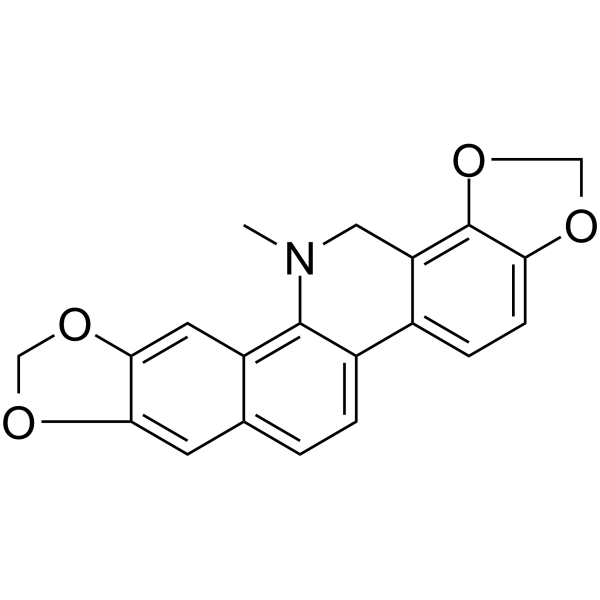
Physicochemical Properties
| Molecular Formula | C20H15NO4 |
| Molecular Weight | 333.3374 |
| Exact Mass | 333.1 |
| CAS # | 3606-45-9 |
| PubChem CID | 124069 |
| Appearance | Off-white to light yellow solid powder |
| Density | 1.4±0.1 g/cm3 |
| Boiling Point | 566.9±29.0 °C at 760 mmHg |
| Flash Point | 176.8±21.5 °C |
| Vapour Pressure | 0.0±1.6 mmHg at 25°C |
| Index of Refraction | 1.720 |
| LogP | 4.68 |
| Hydrogen Bond Donor Count | 0 |
| Hydrogen Bond Acceptor Count | 5 |
| Rotatable Bond Count | 0 |
| Heavy Atom Count | 25 |
| Complexity | 530 |
| Defined Atom Stereocenter Count | 0 |
| InChi Key | CIUHLXZTZWTVFL-UHFFFAOYSA-N |
| InChi Code | InChI=1S/C20H15NO4/c1-21-8-15-12(4-5-16-20(15)25-10-22-16)13-3-2-11-6-17-18(24-9-23-17)7-14(11)19(13)21/h2-7H,8-10H2,1H3 |
| Chemical Name | 24-methyl-5,7,18,20-tetraoxa-24-azahexacyclo[11.11.0.02,10.04,8.014,22.017,21]tetracosa-1(13),2,4(8),9,11,14(22),15,17(21)-octaene |
| HS Tariff Code | 2934.99.9001 |
| Storage |
Powder-20°C 3 years 4°C 2 years In solvent -80°C 6 months -20°C 1 month |
| Shipping Condition | Room temperature (This product is stable at ambient temperature for a few days during ordinary shipping and time spent in Customs) |
Biological Activity
| Targets |
- Human promyelocytic leukemia HL-60 cells: Dihydrosanguinarine exhibits cytotoxicity with an IC₅₀ of 2.3 μM (48 h treatment) [1] - Phytopathogenic fungi (Fusarium oxysporum, Botrytis cinerea, Alternaria solani): Dihydrosanguinarine inhibits fungal growth with IC₅₀ values of 1.8 μM (F. oxysporum), 2.5 μM (B. cinerea), and 3.2 μM (A. solani) [2] - Leishmania amazonensis amastigotes (intracellular): Dihydrosanguinarine shows leishmanicidal activity with an IC₅₀ of 3.1 μM; no activity against promastigotes (IC₅₀ > 20 μM) [4] - Mitochondrial apoptotic pathway proteins (caspase-3, -9, Bax, Bcl-2): Dihydrosanguinarine activates caspases and modulates Bcl-2 family proteins in HL-60 cells [1] |
| ln Vitro |
1. Cytotoxicity in HL-60 cells: - Dihydrosanguinarine (0.5-5 μM) inhibited HL-60 cell proliferation in a dose- and time-dependent manner; 48 h IC₅₀ = 2.3 μM (MTT assay) [1] - Annexin V-FITC/PI staining: 2 μM Dihydrosanguinarine (24 h) increased apoptotic rate from 2.1% (control) to 58.3% (32.5% early, 25.8% late apoptosis) [1] - Mechanism evidence: 2 μM Dihydrosanguinarine reduced mitochondrial membrane potential (ΔΨm) by 65% (JC-1 staining), increased cleaved caspase-3 (3.2-fold) and caspase-9 (2.8-fold) levels (Western blot), upregulated Bax (2.1-fold), and downregulated Bcl-2 (0.4-fold) [1] 2. Antifungal activity: - Dihydrosanguinarine (0.5-10 μM) inhibited mycelial growth of 5 phytopathogenic fungi; IC₅₀ values: F. oxysporum (1.8 μM) > B. cinerea (2.5 μM) > A. solani (3.2 μM) > Colletotrichum gloeosporioides (4.1 μM) > Rhizoctonia solani (4.5 μM) [2] - 5 μM Dihydrosanguinarine reduced F. oxysporum spore germination rate from 92% (control) to 18% and caused spore deformation (light microscopy) [2] - No antifungal activity against yeast (Saccharomyces cerevisiae) even at 20 μM [2] 3. Leishmanicidal activity: - Dihydrosanguinarine showed activity against intracellular amastigotes of Leishmania amazonensis (IC₅₀ = 3.1 μM) but no activity against promastigotes (IC₅₀ > 20 μM) [4] - 4 μM Dihydrosanguinarine reduced amastigote burden in infected J774 macrophages by 72% (vs. 85% for positive control amphotericin B, 1 μM) [4] - No cytotoxicity to J774 macrophages at 10 μM (viability > 85%, MTT assay) [4] |
| ln Vivo |
1. Pharmacokinetics and toxicity in rats: - Pharmacokinetic parameters (intravenous, 5 mg/kg): Plasma half-life (t₁/₂) = 2.8 h, clearance (CL) = 1.2 L/h/kg, volume of distribution (Vd) = 4.5 L/kg, AUC₀-∞ = 38.5 μg·h/ml [3] - Oral absorption (10 mg/kg): Oral bioavailability = 18.5%, Cmax = 2.1 μg/ml (tmax = 1.5 h), AUC₀-∞ = 8.2 μg·h/ml [3] - Toxicity signs (oral, 10 mg/kg/day for 7 days): Rats showed 8-12% weight loss, increased serum ALT (85 U/L vs. control 32 U/L) and AST (112 U/L vs. control 45 U/L), and mild hepatocyte necrosis (histopathology) [3] - No mortality observed at doses ≤ 15 mg/kg (oral, single dose) [3] |
| Enzyme Assay |
1. Caspase-3/-9 activity assay: - HL-60 cells (1×10⁶ cells/ml) were treated with Dihydrosanguinarine (0.5-4 μM) for 24 h, then lysed in caspase lysis buffer [1] - Lysates (50 μg protein) were mixed with caspase-3 substrate (Ac-DEVD-pNA) or caspase-9 substrate (Ac-LEHD-pNA) in reaction buffer, incubated at 37°C for 2 h [1] - Absorbance was measured at 405 nm; activity was expressed as fold change vs. control: 2 μM Dihydrosanguinarine increased caspase-3 activity by 4.1-fold and caspase-9 by 3.7-fold [1] |
| Cell Assay |
1. HL-60 cell experiments: - MTT assay: HL-60 cells (5×10³ cells/well, 96-well plate) were cultured in RPMI-1640+10% FBS, treated with Dihydrosanguinarine (0.5-5 μM) for 24/48/72 h; MTT (5 mg/ml, 20 μl/well) was added for 4 h, formazan dissolved in DMSO, absorbance at 570 nm [1] - Apoptosis detection: Cells (1×10⁶/ml) treated with Dihydrosanguinarine (2 μM, 24 h) were stained with Annexin V-FITC/PI (15 min, dark) and analyzed by flow cytometry [1] - Western blot: Cells lysed in RIPA buffer (protease inhibitors), 30 μg protein separated by SDS-PAGE, transferred to PVDF membrane, probed with antibodies against caspase-3/-9, Bax, Bcl-2, β-actin; bands visualized with ECL [1] 2. Leishmania-infected macrophage assay: - J774 macrophages (2×10⁵ cells/well, 24-well plate) were infected with L. amazonensis promastigotes (MOI = 10:1) for 4 h, then treated with Dihydrosanguinarine (0.5-10 μM) for 48 h [4] - Cells were fixed with methanol, stained with Giemsa, and amastigotes per macrophage were counted (100 macrophages/well); inhibition rate = [(control - treated)/control] × 100% [4] |
| Animal Protocol |
1. Rat pharmacokinetic and toxicity experiment: - Animals: Male Sprague-Dawley rats (250-300 g), housed under 12 h light/dark cycle, ad libitum food/water; fasted 12 h before dosing [3] - Drug preparation: Dihydrosanguinarine was dissolved in DMSO:saline (1:9, v/v) for intravenous injection, and in 0.5% carboxymethyl cellulose (CMC) for oral gavage [3] - Groups (n=6/group): - IV group: 5 mg/kg Dihydrosanguinarine (intravenous, single dose) [3] - Oral group: 10 mg/kg Dihydrosanguinarine (oral gavage, single dose for PK; 10 mg/kg/day for 7 days for toxicity) [3] - Control group: Vehicle (DMSO:saline or CMC) [3] - Sampling: Blood samples (0.5 ml) collected from tail vein at 0.083, 0.25, 0.5, 1, 2, 4, 6, 8, 12 h post-dose; plasma separated by centrifugation (3000×g, 10 min) for PK analysis [3] - Toxicity assessment: Body weight measured daily; at study end, rats euthanized, serum collected for ALT/AST/BUN检测; liver/kidney tissues fixed in 4% paraformaldehyde for histopathology [3] |
| ADME/Pharmacokinetics |
1. Rat pharmacokinetics: - Absorption: Oral bioavailability = 18.5%; oral Cmax = 2.1 μg/ml (tmax = 1.5 h), significantly lower than IV Cmax = 15.2 μg/ml (tmax = 0.083 h) [3] - Distribution: IV Vd = 4.5 L/kg, indicating wide tissue distribution [3] - Metabolism: No specific metabolites identified, but plasma clearance (CL = 1.2 L/h/kg) suggests hepatic metabolism [3] - Excretion: t₁/₂ = 2.8 h (IV), 3.5 h (oral); 48 h urine excretion = 8.2% (IV), 5.1% (oral), indicating major non-renal excretion [3] - Plasma protein binding: 92.3% (measured by ultrafiltration, 37°C) [3] |
| Toxicity/Toxicokinetics |
1. In vitro toxicity: - Dihydrosanguinarine (≤10 μM) showed no cytotoxicity to J774 macrophages (viability >85%,文献[4]) and normal human peripheral blood mononuclear cells (PBMC, viability >90%,文献[1]) [1][4] - Cytotoxic to HL-60 cells (IC₅₀=2.3 μM, 48 h) and L. amazonensis amastigotes (IC₅₀=3.1 μM,文献[4]) [1][4] 2. In vivo toxicity: - Hepatic toxicity: Oral 10 mg/kg/day for 7 days increased serum ALT (85 U/L vs. control 32 U/L) and AST (112 U/L vs. control 45 U/L); liver histopathology showed mild hepatocyte necrosis and inflammatory infiltration [3] - Renal safety: No significant changes in serum BUN (5.2 mmol/L vs. control 4.8 mmol/L) or creatinine (46 μmol/L vs. control 45 μmol/L) [3] - General toxicity: Rats showed 8-12% weight loss, reduced food intake, and lethargy at 15 mg/kg (oral, single dose); no mortality at ≤10 mg/kg [3] |
| References |
[1]. Cytotoxic activity of sanguinarine and dihydrosanguinarine in human promyelocytic leukemia HL-60 cells. Toxicol In Vitro. 2009 Jun;23(4):580-8. [2]. Inhibitory activity of dihydrosanguinarine and dihydrochelerythrine against phytopathogenic fungi. Nat Prod Res. 2011 Jul;25(11):1082-9. [3]. The toxicity and pharmacokinetics of dihydrosanguinarine in rat: a pilot study. Food Chem Toxicol. 2008 Jul;46(7):2546-53. [4]. In vitro leishmanicidal activity of benzophenanthridine alkaloids from Bocconia pearcei and related compounds. Chem Pharm Bull (Tokyo). 2010 Aug;58(8):1047-50. |
| Additional Infomation |
Dihydrosanguinarine is a benzophenanthridine alkaloid obtained by selective hydrogenation of the 13,14-position of sanguinarine. It has a role as a metabolite and an antifungal agent. It derives from a hydride of a sanguinarine. Dihydrosanguinarine has been reported in Pteridophyllum racemosum, Corydalis balansae, and other organisms with data available. 1. Chemical background: - Dihydrosanguinarine is a benzylisoquinoline alkaloid isolated from plants of the Papaveraceae family (e.g., Bocconia pearcei, Sanguinaria canadensis); it is the reduced form of sanguinarine [4][1] 2. Mechanism summary: - Anticancer: Induces HL-60 cell apoptosis via mitochondrial pathway (ΔΨm loss, caspase-9/-3 activation, Bax/Bcl-2 imbalance) [1] - Antifungal: Inhibits fungal mycelial growth and spore germination, likely by disrupting fungal cell membrane integrity (no direct evidence of target reported) [2] - Antileishmanial: Targets intracellular amastigotes, possibly by increasing reactive oxygen species (ROS) in infected macrophages [4] 3. Application potential: - Potential as an anticancer lead compound (selective toxicity to HL-60 cells vs. normal PBMC) [1] - Candidate for botanical fungicides (effective against soil-borne phytopathogens like F. oxysporum) [2] - Possible antileishmanial agent (lower toxicity to host macrophages than amphotericin B) [4] 4. Safety note: Hepatic toxicity in rats (oral ≥10 mg/kg) suggests careful dose control in future in vivo studies [3] |
Solubility Data
| Solubility (In Vitro) | DMSO : ~5.2 mg/mL (~15.60 mM) |
| Solubility (In Vivo) |
Note: Listed below are some common formulations that may be used to formulate products with low water solubility (e.g. < 1 mg/mL), you may test these formulations using a minute amount of products to avoid loss of samples. Injection Formulations (e.g. IP/IV/IM/SC) Injection Formulation 1: DMSO : Tween 80: Saline = 10 : 5 : 85 (i.e. 100 μL DMSO stock solution → 50 μL Tween 80 → 850 μL Saline) *Preparation of saline: Dissolve 0.9 g of sodium chloride in 100 mL ddH ₂ O to obtain a clear solution. Injection Formulation 2: DMSO : PEG300 :Tween 80 : Saline = 10 : 40 : 5 : 45 (i.e. 100 μL DMSO → 400 μLPEG300 → 50 μL Tween 80 → 450 μL Saline) Injection Formulation 3: DMSO : Corn oil = 10 : 90 (i.e. 100 μL DMSO → 900 μL Corn oil) Example: Take the Injection Formulation 3 (DMSO : Corn oil = 10 : 90) as an example, if 1 mL of 2.5 mg/mL working solution is to be prepared, you can take 100 μL 25 mg/mL DMSO stock solution and add to 900 μL corn oil, mix well to obtain a clear or suspension solution (2.5 mg/mL, ready for use in animals). Injection Formulation 4: DMSO : 20% SBE-β-CD in saline = 10 : 90 [i.e. 100 μL DMSO → 900 μL (20% SBE-β-CD in saline)] *Preparation of 20% SBE-β-CD in Saline (4°C,1 week): Dissolve 2 g SBE-β-CD in 10 mL saline to obtain a clear solution. Injection Formulation 5: 2-Hydroxypropyl-β-cyclodextrin : Saline = 50 : 50 (i.e. 500 μL 2-Hydroxypropyl-β-cyclodextrin → 500 μL Saline) Injection Formulation 6: DMSO : PEG300 : castor oil : Saline = 5 : 10 : 20 : 65 (i.e. 50 μL DMSO → 100 μLPEG300 → 200 μL castor oil → 650 μL Saline) Injection Formulation 7: Ethanol : Cremophor : Saline = 10: 10 : 80 (i.e. 100 μL Ethanol → 100 μL Cremophor → 800 μL Saline) Injection Formulation 8: Dissolve in Cremophor/Ethanol (50 : 50), then diluted by Saline Injection Formulation 9: EtOH : Corn oil = 10 : 90 (i.e. 100 μL EtOH → 900 μL Corn oil) Injection Formulation 10: EtOH : PEG300:Tween 80 : Saline = 10 : 40 : 5 : 45 (i.e. 100 μL EtOH → 400 μLPEG300 → 50 μL Tween 80 → 450 μL Saline) Oral Formulations Oral Formulation 1: Suspend in 0.5% CMC Na (carboxymethylcellulose sodium) Oral Formulation 2: Suspend in 0.5% Carboxymethyl cellulose Example: Take the Oral Formulation 1 (Suspend in 0.5% CMC Na) as an example, if 100 mL of 2.5 mg/mL working solution is to be prepared, you can first prepare 0.5% CMC Na solution by measuring 0.5 g CMC Na and dissolve it in 100 mL ddH2O to obtain a clear solution; then add 250 mg of the product to 100 mL 0.5% CMC Na solution, to make the suspension solution (2.5 mg/mL, ready for use in animals). Oral Formulation 3: Dissolved in PEG400 Oral Formulation 4: Suspend in 0.2% Carboxymethyl cellulose Oral Formulation 5: Dissolve in 0.25% Tween 80 and 0.5% Carboxymethyl cellulose Oral Formulation 6: Mixing with food powders Note: Please be aware that the above formulations are for reference only. InvivoChem strongly recommends customers to read literature methods/protocols carefully before determining which formulation you should use for in vivo studies, as different compounds have different solubility properties and have to be formulated differently. (Please use freshly prepared in vivo formulations for optimal results.) |
| Preparing Stock Solutions | 1 mg | 5 mg | 10 mg | |
| 1 mM | 2.9999 mL | 14.9997 mL | 29.9994 mL | |
| 5 mM | 0.6000 mL | 2.9999 mL | 5.9999 mL | |
| 10 mM | 0.3000 mL | 1.5000 mL | 2.9999 mL |