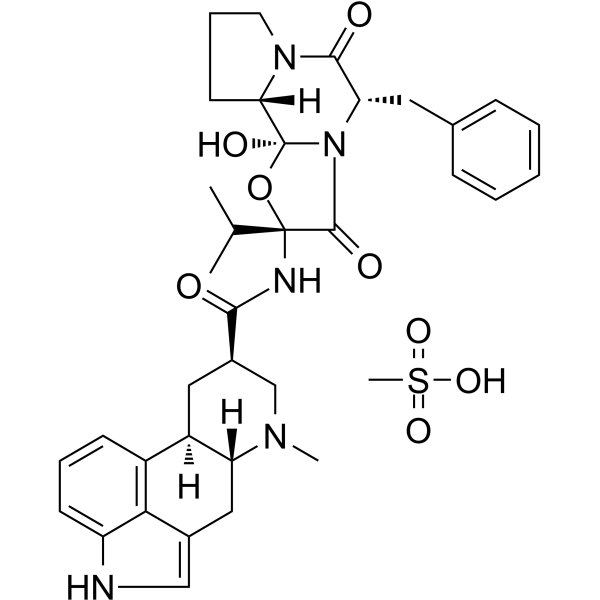
Physicochemical Properties
| Molecular Formula | C35H41N5O5.CH4O3S |
| Molecular Weight | 707.8362 |
| Exact Mass | 707.299 |
| CAS # | 24730-10-7 |
| PubChem CID | 444034 |
| Appearance | White to off-white solid powder |
| Boiling Point | 899.3ºC at 760 mmHg |
| Flash Point | 497.7ºC |
| Vapour Pressure | 8.49E-35mmHg at 25°C |
| LogP | 3.506 |
| Hydrogen Bond Donor Count | 4 |
| Hydrogen Bond Acceptor Count | 9 |
| Rotatable Bond Count | 5 |
| Heavy Atom Count | 50 |
| Complexity | 1300 |
| Defined Atom Stereocenter Count | 7 |
| SMILES | CC(C)[C@@]1(C(=O)N2[C@H](C(=O)N3CCC[C@H]3[C@@]2(O1)O)CC4=CC=CC=C4)NC(=O)[C@@H]5C[C@H]6[C@@H](CC7=CNC8=CC=CC6=C78)N(C5)C.CS(=O)(=O)O |
| InChi Key | SPXACGZWWVIDGR-SPZWACKZSA-N |
| InChi Code | InChI=1S/C35H41N5O5.CH4O3S/c1-20(2)34(37-31(41)23-16-25-24-11-7-12-26-30(24)22(18-36-26)17-27(25)38(3)19-23)33(43)40-28(15-21-9-5-4-6-10-21)32(42)39-14-8-13-29(39)35(40,44)45-34;1-5(2,3)4/h4-7,9-12,18,20,23,25,27-29,36,44H,8,13-17,19H2,1-3H3,(H,37,41);1H3,(H,2,3,4)/t23-,25-,27-,28+,29+,34-,35+;/m1./s1 |
| Chemical Name | (6aR,9R,10aR)-N-[(1S,2S,4R,7S)-7-benzyl-2-hydroxy-5,8-dioxo-4-propan-2-yl-3-oxa-6,9-diazatricyclo[7.3.0.02,6]dodecan-4-yl]-7-methyl-6,6a,8,9,10,10a-hexahydro-4H-indolo[4,3-fg]quinoline-9-carboxamide;methanesulfonic acid |
| HS Tariff Code | 2934.99.9001 |
| Storage |
Powder-20°C 3 years 4°C 2 years In solvent -80°C 6 months -20°C 1 month Note: Please store this product in a sealed and protected environment, avoid exposure to moisture. |
| Shipping Condition | Room temperature (This product is stable at ambient temperature for a few days during ordinary shipping and time spent in Customs) |
Biological Activity
| Targets | γ-Secretase (regulates amyloid-β (Aβ) peptide production from amyloid precursor protein (APP)) [1] |
| ln Vitro |
Dihydroergonovine (DHEC) (2–20 μM; 24 hours) has an IC50 value of 25 μM and inhibits γ-secretase activity in T100 cells without compromising cell viability [1]. Dihydroergocristine (2–20 μM; 24 hours) decreases γ-secretase activity in fibroblasts, promotes dose-dependent accumulation of APP carboxyl-terminal fragment (APP-CTF) in HEK293 and suppresses the synthesis of Aβ by cells [1]. In HEK293 cells stably expressing human APP695 (Swedish mutation), Dihydroergocristine mesylate (0.1-10 μM) dose-dependently reduced the secretion of Aβ40 and Aβ42 peptides. At 1 μM, Aβ40 was reduced by 32% and Aβ42 by 38%; at 10 μM, Aβ40 was reduced by 58% and Aβ42 by 65%, as detected by sandwich ELISA [1] The compound did not affect the expression level of APP or the cleavage of APP by β-secretase (measured by Western blot for APP C-terminal fragment β, C99), indicating specific inhibition of γ-secretase-mediated Aβ generation [1] In primary cortical neurons isolated from APP/PS1 transgenic mouse embryos, Dihydroergocristine mesylate (1-5 μM) similarly reduced Aβ42 secretion by 42% (5 μM) without affecting neuronal viability (MTT assay: >90% viability vs. control) [1] |
| ln Vivo |
In 6-month-old APP/PS1 transgenic mice (n=8 per group), oral administration of Dihydroergocristine mesylate (1 mg/kg/day or 3 mg/kg/day) for 3 months dose-dependently reduced cerebral Aβ levels. The 3 mg/kg dose decreased soluble Aβ40 by 45% and Aβ42 by 52% in the hippocampus, and reduced insoluble Aβ plaque burden by 48% (immunohistochemical staining with anti-Aβ antibody) [1] Behavioral tests showed that the 3 mg/kg dose improved spatial learning and memory in the Morris water maze: escape latency was reduced from 58 seconds (vehicle control) to 32 seconds, and time spent in the target quadrant increased by 63% [1] No significant changes in brain APP expression or β-secretase activity were observed, confirming the compound’s specific effect on γ-secretase [1] |
| Enzyme Assay | Purified recombinant human γ-secretase complex was incubated with a fluorogenic APP-derived peptide substrate and Dihydroergocristine mesylate (0.01-20 μM) in reaction buffer at 37°C for 2 hours. The cleavage product was detected by measuring fluorescence intensity at excitation/emission wavelengths of 355 nm/460 nm. Relative γ-secretase activity was calculated by comparing fluorescence signals to the vehicle control. At 10 μM, the compound inhibited γ-secretase activity by 57% [1] |
| Cell Assay |
Western Blot Analysis[1] Cell Types: WT HEK293 cells; Fibroblast Tested Concentrations: 2 μM, 5 μM, 10 μM, 20 μM Incubation Duration: 24 hrs (hours) Experimental Results: APP-CTF accumulation increased in a dose-dependent manner. Purified recombinant human γ-secretase complex was incubated with a fluorogenic APP-derived peptide substrate and Dihydroergocristine mesylate (0.01-20 μM) in reaction buffer at 37°C for 2 hours. The cleavage product was detected by measuring fluorescence intensity at excitation/emission wavelengths of 355 nm/460 nm. Relative γ-secretase activity was calculated by comparing fluorescence signals to the vehicle control. At 10 μM, the compound inhibited γ-secretase activity by 57% [1] |
| Animal Protocol | 6-month-old male APP/PS1 transgenic mice were randomly divided into vehicle control, 1 mg/kg, and 3 mg/kg treatment groups (n=8 per group). Dihydroergocristine mesylate was dissolved in 0.5% methylcellulose and administered via oral gavage once daily for 3 months. Control mice received 0.5% methylcellulose. After treatment, mice were subjected to the Morris water maze test for behavioral assessment. Mice were then euthanized, and hippocampal tissues were collected to measure soluble/insoluble Aβ levels (ELISA) and plaque burden (immunohistochemistry) [1] |
| Toxicity/Toxicokinetics |
In vitro toxicity: Dihydroergocristine mesylate (up to 10 μM) had no significant cytotoxicity on HEK293 cells or primary cortical neurons (MTT assay: >90% viability vs. control) [1] In APP/PS1 transgenic mice, 3-month oral administration (up to 3 mg/kg/day) caused no significant changes in body weight, food intake, or liver/kidney function (serum ALT, AST, creatinine, BUN unchanged). No histopathological abnormalities were observed in the liver, kidney, heart, or brain [1] |
| References |
[1]. The FDA-approved natural product dihydroergocristine reduces the production of the Alzheimer's disease amyloid-β peptides. Sci Rep. 2015 Nov 16;5:16541. |
| Additional Infomation |
Dihydroergocristine mesylate is the methanesulfonic acid salt of dihydroergocristine. It has been used as the for the symptomatic treatment of mental deterioration associated with cerebrovascular insufficiency and in peripheral vascular disease. It is also a component of ergoloid mesylate (codergocrine mesilate), a mixture of ergot alkaloid derivatives that is used as a vasodilator and has shown mild benefits in the treatment of vascular dementia. It has a role as a vasodilator agent, an alpha-adrenergic antagonist and a geroprotector. It contains a dihydroergocristine. A 9,10alpha-dihydro derivative of ERGOTAMINE that contains an isopropyl sidechain at the 2' position of the molecule. See also: Dihydroergocristine (annotation moved to). Dihydroergocristine mesylate is a semisynthetic derivative of ergot alkaloids, derived from natural ergot fungi metabolites, and is FDA-approved for the treatment of age-related cognitive decline and peripheral vascular disorders [1] Its anti-Alzheimer’s disease mechanism is mediated by specific inhibition of γ-secretase activity, reducing the production of neurotoxic Aβ40 and Aβ42 peptides without affecting β-secretase or APP expression [1] The compound crosses the blood-brain barrier, as evidenced by reduced cerebral Aβ levels and improved memory function in APP/PS1 transgenic mice, supporting its potential for treating Alzheimer’s disease [1] |
Solubility Data
| Solubility (In Vitro) |
DMSO : ~50 mg/mL (~70.64 mM) H2O : ~1 mg/mL (~1.41 mM) |
| Solubility (In Vivo) |
Solubility in Formulation 1: ≥ 2.5 mg/mL (3.53 mM) (saturation unknown) in 10% DMSO + 40% PEG300 + 5% Tween80 + 45% Saline (add these co-solvents sequentially from left to right, and one by one), clear solution. For example, if 1 mL of working solution is to be prepared, you can add 100 μL of 25.0 mg/mL clear DMSO stock solution to 400 μL PEG300 and mix evenly; then add 50 μL Tween-80 to the above solution and mix evenly; then add 450 μL normal saline to adjust the volume to 1 mL. Preparation of saline: Dissolve 0.9 g of sodium chloride in 100 mL ddH₂ O to obtain a clear solution. Solubility in Formulation 2: ≥ 2.5 mg/mL (3.53 mM) (saturation unknown) in 10% DMSO + 90% (20% SBE-β-CD in Saline) (add these co-solvents sequentially from left to right, and one by one), clear solution. For example, if 1 mL of working solution is to be prepared, you can add 100 μL of 25.0 mg/mL clear DMSO stock solution to 900 μL of 20% SBE-β-CD physiological saline solution and mix evenly. Preparation of 20% SBE-β-CD in Saline (4°C,1 week): Dissolve 2 g SBE-β-CD in 10 mL saline to obtain a clear solution. Solubility in Formulation 3: ≥ 2.5 mg/mL (3.53 mM) (saturation unknown) in 10% DMSO + 90% Corn Oil (add these co-solvents sequentially from left to right, and one by one), clear solution. For example, if 1 mL of working solution is to be prepared, you can add 100 μL of 25.0 mg/mL clear DMSO stock solution to 900 μL of corn oil and mix evenly. (Please use freshly prepared in vivo formulations for optimal results.) |
| Preparing Stock Solutions | 1 mg | 5 mg | 10 mg | |
| 1 mM | 1.4127 mL | 7.0637 mL | 14.1275 mL | |
| 5 mM | 0.2825 mL | 1.4127 mL | 2.8255 mL | |
| 10 mM | 0.1413 mL | 0.7064 mL | 1.4127 mL |