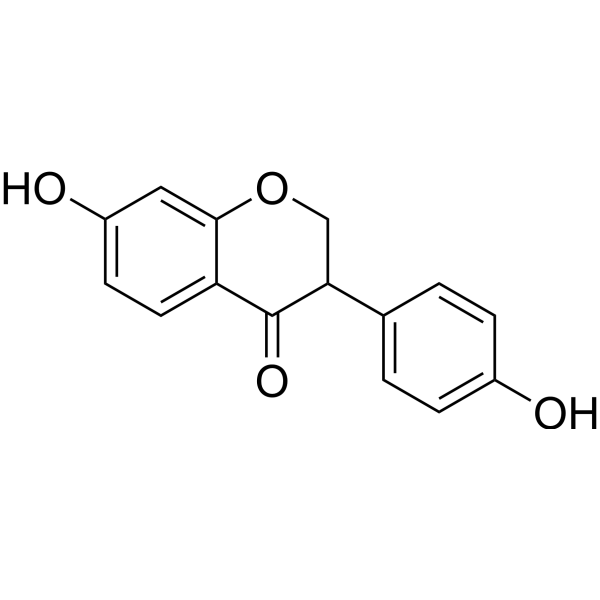
Physicochemical Properties
| Molecular Formula | C15H12O4 |
| Molecular Weight | 256.25338 |
| Exact Mass | 256.073 |
| CAS # | 17238-05-0 |
| PubChem CID | 176907 |
| Appearance | Off-white to gray solid powder |
| Density | 1.4±0.1 g/cm3 |
| Boiling Point | 529.5±50.0 °C at 760 mmHg |
| Melting Point | 250-251ºC |
| Flash Point | 206.9±23.6 °C |
| Vapour Pressure | 0.0±1.4 mmHg at 25°C |
| Index of Refraction | 1.662 |
| LogP | 2.79 |
| Hydrogen Bond Donor Count | 2 |
| Hydrogen Bond Acceptor Count | 4 |
| Rotatable Bond Count | 1 |
| Heavy Atom Count | 19 |
| Complexity | 335 |
| Defined Atom Stereocenter Count | 0 |
| InChi Key | JHYXBPPMXZIHKG-UHFFFAOYSA-N |
| InChi Code | InChI=1S/C15H12O4/c16-10-3-1-9(2-4-10)13-8-19-14-7-11(17)5-6-12(14)15(13)18/h1-7,13,16-17H,8H2 |
| Chemical Name | 7-hydroxy-3-(4-hydroxyphenyl)-2,3-dihydrochromen-4-one |
| Synonyms | dihydrodaidzein; 17238-05-0; 7-hydroxy-3-(4-hydroxyphenyl)chroman-4-one; Dihydro Daidzein; (+/-)-Dihydrodaidzein; Dihydrodaidzein (keto); 7,4'-Dihydroxyisoflavanone; 7-hydroxy-3-(4-hydroxyphenyl)-2,3-dihydrochromen-4-one; |
| HS Tariff Code | 2934.99.9001 |
| Storage |
Powder-20°C 3 years 4°C 2 years In solvent -80°C 6 months -20°C 1 month |
| Shipping Condition | Room temperature (This product is stable at ambient temperature for a few days during ordinary shipping and time spent in Customs) |
Biological Activity
| Targets | Dietary phytoestrogen |
| ln Vitro | Dihydrodaidzein is a hydroxyisoflavanone that is isoflavanone carrying two hydroxy substituents located at positions 4' and 7. It has a role as a metabolite. |
| ln Vivo | Dietary phytoestrogens have been implicated in the prevention of chronic diseases. However, it is uncertain whether the phytoestrogens or the foods associated with phytoestrogens account for the observed effects. We report here a new liquid chromatography photodiode array mass spectrometry (LC-PDA-MS) assay for the determination of nanomolar amounts of the most prominent dietary phytoestrogens (genistein, dihydrogenistein, daidzein, dihydrodaidzein, glycitein, O-desmethylangolensin, hesperetin, naringenin, quercetin, enterodiol, enterolactone) in human plasma or serum and urine. This assay was found to be suitable for the assessment of quercetin exposure in an onion intervention study by measuring urinary quercetin levels. Other successful applications of this assay in clinical and epidemiologic studies validated the developed method and confirmed previous results on the negative association between urinary isoflavone excretion and breast cancer risk.[1] |
| Cell Assay |
The detection and quantitation of Dihydrodaidzein in human biological matrices were performed using a liquid chromatography-photodiode array-electrospray ionization-mass spectrometry (LC-PDA-ESI-MS) method. The cell-based assays for pharmacological activity are not described. For analytical purposes, urine samples were thawed, centrifuged, and the clear supernatant was incubated with β-glucuronidase and arylsulfatase to hydrolyze conjugated analytes. After adding an internal standard, the mixture was extracted with ethyl ether. The combined organic phases were dried, reconstituted, and analyzed by LC-PDA-ESI-MS. Similarly, for plasma/serum analysis, samples were incubated with β-glucuronidase and arylsulfatase, followed by protein precipitation with acetonitrile. The hydrolyzed analytes were then extracted into diethyl ether, dried, reconstituted, and analyzed. [1] |
| ADME/Pharmacokinetics |
Metabolism / Metabolites Dihydrodazein has known human metabolites that include Tetrahydrodaidzein and (2S,3S,4S,5R)-3,4,5-Trihydroxy-6-[[3-(4-hydroxyphenyl)-4-oxo-2,3-dihydrochromen-7-yl]oxy]oxane-2-carboxylic acid. Dihydrodazein is a known human metabolite of Daidzein. The provided literature does not detail comprehensive ADME/PK parameters (e.g., absorption, distribution, metabolism, excretion, half-life, oral bioavailability) for Dihydrodaidzein. The method was used to measure total (conjugated + unconjugated) and unconjugated levels of Dihydrodaidzein in human plasma/serum. Unconjugated levels were reported to be only 1–3% of the total concentrations, which aligns with earlier reports. [1] In a pilot study with 20 healthy volunteers, the mean urinary concentration of Dihydrodaidzein was 2394 nM. [1] |
| References |
[1]. Liquid chromatographic-photodiode array mass spectrometric analysis of dietary phytoestrogens from human urine and blood. J Chromatogr B Analyt Technol Biomed Life Sci. 2002 Sep 25;777(1-2):45-59. |
| Additional Infomation |
Dihydrodaidzein is a hydroxyisoflavanone that is isoflavanone carrying two hydroxy substituents located at positions 4' and 7. It has a role as a metabolite. Dihydrodaidzein is a metabolite of the dietary isoflavone daidzein and is classified as a phytoestrogen. [1] The developed LC-PDA-ESI-MS assay was validated for the simultaneous determination of nanomolar amounts of Dihydrodaidzein and other prominent dietary phytoestrogens in human plasma/serum and urine. [1] For urine analysis, the intra-assay coefficient of variation (CV) for Dihydrodaidzein was 1%, and the inter-assay CV was 1%. Spiking recovery rates for Dihydrodaidzein in urine ranged from 96% to 107%. The limit of quantitation (LOQ) for Dihydrodaidzein in urine was 39 nM (786 fmol, 201 pg per 20 μL injection). [1] |
Solubility Data
| Solubility (In Vitro) | DMSO : ~100 mg/mL (~390.24 mM) |
| Solubility (In Vivo) |
Solubility in Formulation 1: ≥ 2.5 mg/mL (9.76 mM) (saturation unknown) in 10% DMSO + 40% PEG300 + 5% Tween80 + 45% Saline (add these co-solvents sequentially from left to right, and one by one), clear solution. For example, if 1 mL of working solution is to be prepared, you can add 100 μL of 25.0 mg/mL clear DMSO stock solution to 400 μL PEG300 and mix evenly; then add 50 μL Tween-80 to the above solution and mix evenly; then add 450 μL normal saline to adjust the volume to 1 mL. Preparation of saline: Dissolve 0.9 g of sodium chloride in 100 mL ddH₂ O to obtain a clear solution. Solubility in Formulation 2: ≥ 2.5 mg/mL (9.76 mM) (saturation unknown) in 10% DMSO + 90% (20% SBE-β-CD in Saline) (add these co-solvents sequentially from left to right, and one by one), clear solution. For example, if 1 mL of working solution is to be prepared, you can add 100 μL of 25.0 mg/mL clear DMSO stock solution to 900 μL of 20% SBE-β-CD physiological saline solution and mix evenly. Preparation of 20% SBE-β-CD in Saline (4°C,1 week): Dissolve 2 g SBE-β-CD in 10 mL saline to obtain a clear solution. Solubility in Formulation 3: ≥ 2.5 mg/mL (9.76 mM) (saturation unknown) in 10% DMSO + 90% Corn Oil (add these co-solvents sequentially from left to right, and one by one), clear solution. For example, if 1 mL of working solution is to be prepared, you can add 100 μL of 25.0 mg/mL clear DMSO stock solution to 900 μL of corn oil and mix evenly. (Please use freshly prepared in vivo formulations for optimal results.) |
| Preparing Stock Solutions | 1 mg | 5 mg | 10 mg | |
| 1 mM | 3.9024 mL | 19.5122 mL | 39.0244 mL | |
| 5 mM | 0.7805 mL | 3.9024 mL | 7.8049 mL | |
| 10 mM | 0.3902 mL | 1.9512 mL | 3.9024 mL |