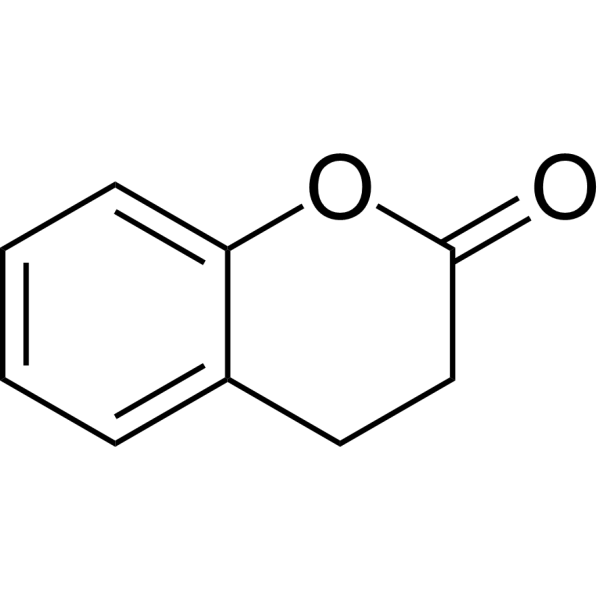
Physicochemical Properties
| Molecular Formula | C9H8O2 |
| Molecular Weight | 148.1586 |
| Exact Mass | 148.052 |
| CAS # | 119-84-6 |
| PubChem CID | 660 |
| Appearance | Colorless to light yellow <24°C powder,>25°C liquid |
| Density | 1.2±0.1 g/cm3 |
| Boiling Point | 272.0±15.0 °C at 760 mmHg |
| Melting Point | 24-25 °C(lit.) |
| Flash Point | 108.4±17.8 °C |
| Vapour Pressure | 0.0±0.6 mmHg at 25°C |
| Index of Refraction | 1.562 |
| LogP | 1.8 |
| Hydrogen Bond Donor Count | 0 |
| Hydrogen Bond Acceptor Count | 2 |
| Rotatable Bond Count | 0 |
| Heavy Atom Count | 11 |
| Complexity | 165 |
| Defined Atom Stereocenter Count | 0 |
| SMILES | O1C(C([H])([H])C([H])([H])C2=C([H])C([H])=C([H])C([H])=C12)=O |
| InChi Key | VMUXSMXIQBNMGZ-UHFFFAOYSA-N |
| InChi Code | InChI=1S/C9H8O2/c10-9-6-5-7-3-1-2-4-8(7)11-9/h1-4H,5-6H2 |
| Chemical Name | 3,4-dihydrochromen-2-one |
| HS Tariff Code | 2934.99.9001 |
| Storage |
Powder-20°C 3 years 4°C 2 years In solvent -80°C 6 months -20°C 1 month |
| Shipping Condition | Room temperature (This product is stable at ambient temperature for a few days during ordinary shipping and time spent in Customs) |
Biological Activity
| Targets |
Dihydrocoumarin (DHC) inhibits yeast Sir2p and human SIRT1 and SIRT2 deacetylases. SIRT1 inhibition IC₅₀ = 208 µM in an in vitro enzymatic assay [2]. SIRT2 inhibition shows similar dose dependency [2]. SIRT3 deacetylase activity was not affected by DHC [2]. |
| ln Vitro |
Dihydrocoumarin inhibits SIRT1 in an in vitro enzymatic assay in a concentration-dependent manner (IC50 of 208 μM). Even at micromolar concentrations, there was a reduction in SIRT1 deacetylase activity (85±5.8% and 73±13.7% activities at 1.6 μM and 8 μM, respectively). Similar dose-dependent inhibition of microtubule SIRT2 deacetylase was observed (IC50 of 295 μM) [1]. After 24 hours of treatment, dihydrocoumarin (1–5 mM) boosted the TK6 cell line's cytotoxicity in a dose-dependent way. At the 6-hour mark, dihydrocoumarin (1–5 mM) enhanced apoptosis in the TK6 cell line in a dose-dependent way. In the TK6 cell line, dihydrocoumarin at a dosage of 5 mM promotes apoptosis at the 6-hour time point [1]. After a 24-hour exposure period, dihydrocoumarin (1–5 mM) enhances p53 lysine 373 and 382 acetylation in a dose-dependent manner in the TK6 cell line [1]. Dihydrocoumarin (DHC) disrupts heterochromatic silencing in S. cerevisiae in a dose-dependent manner, similar to the established Sir2p inhibitor splitomicin [2]. DHC increases p53 acetylation at lysine 373 and 382 in a dose-dependent manner in TK6 lymphoblastoid cells following 24-hour exposure [2]. DHC increases cytotoxicity and apoptosis in TK6 cells in a dose-dependent manner, with apoptosis levels increasing more than 3-fold compared to controls [2]. DHC enhances cell killing by etoposide in TK6 and HEK293 cell lines [2]. DHC is not mutagenic, clastogenic, or aneugenic in previous in vivo and in vitro studies [2]. |
| Enzyme Assay |
The histone deacetylation assay with recombinant SIRT1 and SIRT2 was performed using a ³H-acetylated histone H4 peptide to measure deacetylase activity. DHC was tested for its ability to inhibit these enzymes in a concentration-dependent manner [2]. A separate assay measured the inhibition of yeast Sir2p using a galactose-inducible SIR2 overexpression system in yeast. Growth on galactose medium containing DHC was compared to controls to assess reversal of Sir2p-induced lethality [2]. |
| Cell Assay |
For immunoblot analysis, TK6 lymphoblastoid cells were exposed to various concentrations of DHC (1-5 mM) for 24 hours. Cell lysates were collected, and protein concentrations were determined. Equal amounts of protein were resolved by PAGE, transferred to nitrocellulose membranes, and probed with antibodies against acetylated p53 (lysine 373 and 382) [2]. Cellular cytotoxicity was assessed using the Trypan blue exclusion assay. TK6 cells exposed to DHC for 24 hours were counted, and the percentage of non-viable cells was calculated [2]. Apoptosis was measured by flow cytometry using annexin V-FITC and propidium iodide staining. TK6 cells were treated with DHC for 6 hours, stained, and analyzed to distinguish apoptotic from necrotic cells [2]. |
| Toxicity/Toxicokinetics |
Interactions The following drugs ... may increase ... response to coumarin or indandione derivatives: alcohol (acute intoxication), allopurinol, aminosalicylic acid, amiodarone, anabolic steroids, chloral hydrate, chloramphenicol, cimetidine, clofibrate, co-trimoxazole, danazol, dextrothyroxine sodium, diazoxide, diflunisal, disulfiram, erythromycin, ethacrynic acid, fenoprofen calcium, glucagon, ibuprofen, indomethacin, influenza virus vaccine, isoniazid, meclofenamate, mefenamic acid, methylthiouracil, metronidazole, miconazole, nalidixic acid, neomycin (oral), pentoxifylline, phenylbutazone, propoxyphene, propylthiouracil, quinidine, quinine, salicylates, streptokinase, sulfinpyrazone, sulfonamides, sulindac, tetracyclines, thiazides, thyroid drugs, tricyclic antidepressants, urokinase, vitamin E. /Coumarin & indandione derivatives/ The following drugs ... may ... decrease ... response to coumarin or indandione derivatives: alcohol (chronic alcoholism), barbiturates, carbamazepine, corticosteroids, corticotropin, ethchlorvynol, glutethimide, griseofulvin, mercaptopurine, methaqualone, oral contraceptives containing estrogen, rifampin, spironolactone, vitamin K. /Coumarin & indandione derivatives/ Non-Human Toxicity Values LD50 Rat oral 1460 mg/kg LD50 Mouse ip 200 mg/kg LD50 Guinea pig oral 1760 mg/kg Previous studies cited in the literature indicate that Dihydrocoumarin (DHC) is not a mutagen, clastogen, or aneuogen [2]. In the present study, DHC exposure in TK6 cells caused concentration-dependent increases in cytotoxicity and apoptosis [2]. |
| References |
[1]. The flavoring agent Dihydrocoumarin reverses epigenetic silencing and inhibits sirtuindeacetylases. PLoS Genet. 2005 Dec;1(6):e77. |
| Additional Infomation |
3,4-dihydrocoumarin is a white to pale yellow clear oily liquid with a sweet odor. Solidifies around room temperature. (NTP, 1992) 3,4-dihydrocoumarin is a chromanone that is the 3,4-dihydro derivative of coumarin. It has a role as a plant metabolite. It is functionally related to a coumarin. 3,4-Dihydrocoumarin has been reported in Lasiolaena morii, Daphnia pulex, and other organisms with data available. See also: 4-Chromanone (annotation moved to). Mechanism of Action Both 4-hydroxycoumarin derivatives and indandiones (also known as oral anticoagulants) are antagonists of vitamin K. Their use as rodenticides is based on the inhibition of the vitamin K-dependent step in the synthesis of a number of blood coagulation factors. The vitamin K-dependent proteins ...in the coagulation cascade... are the procoagulant factors II (prothrombin), VII (proconvertin), IX (Christmas factor) and X (Stuart-Prower factor), and the coagulation-inhibiting proteins C and S. All these proteins are synthesized in the liver. Before they are released into the circulation the various precursor proteins undergo substantial (intracellular) post-translational modification. Vitamin K functions as a co-enzyme in one of these modifications, namely the carboxylation at well-defined positions of 10-12 glutamate residues into gamma-carboxyglutamate (Gla). The presence of these Gla residues is essential for the procoagulant activity of the various coagulations factors. Vitamin K hydroquinone (KH2) is the active co-enzyme, and its oxidation to vitamin K 2,3-epoxide (KO) provides the energy required for the carboxylation reaction. The epoxide is than recycled in two reduction steps mediated by the enzyme KO reductase... . The latter enzyme is the target enzyme for coumarin anticoagulants. Their blocking of the KO reductase leads to a rapid exhaustion of the supply of KH2, and thus to an effective prevention of the formation of Gla residues. This leads to an accumulation of non-carboxylated coagulation factor precursors in the liver. In some cases these precursors are processed further without being carboxylated, and (depending on the species) may appear in the circulation. At that stage the under-carboxylated proteins are designated as descarboxy coagulation factors. Normal coagulation factors circulate in the form of zymogens, which can only participate in the coagulation cascade after being activated by limited proteolytic degradation. Descarboxy coagulation factors have no procoagulant activity (i.e. they cannot be activated) and neither they can be converted into the active zymogens by vitamin K action. Whereas in anticoagulated humans high levels of circulating descarboxy coagulation factors are detectable, these levels are negligible in warfarin-treated rats and mice. /Anticoagulant rodenticides/ Dihydrocoumarin (DHC) is a natural compound found in Melilotus officinalis (sweet clover) and is synthetically manufactured for use as a flavoring agent in beverages, chewing gum, gelatins, puddings, soft candy, frozen dairy products, and baked goods, as well as a fragrance in perfumes, cosmetics, lotions, and soaps [2]. Concentrations above 100 ppm (approximately 670 µM) are present in some food products [2]. The study suggests that DHC is an epigenetic toxicant that inhibits sirtuin deacetylases, which are linked to aging, and may promote p53-mediated apoptosis and potential tissue senescence [2]. |
Solubility Data
| Solubility (In Vitro) | DMSO : ~100 mg/mL (~674.95 mM) |
| Solubility (In Vivo) |
Solubility in Formulation 1: ≥ 2.5 mg/mL (16.87 mM) (saturation unknown) in 10% DMSO + 40% PEG300 + 5% Tween80 + 45% Saline (add these co-solvents sequentially from left to right, and one by one), clear solution. For example, if 1 mL of working solution is to be prepared, you can add 100 μL of 25.0 mg/mL clear DMSO stock solution to 400 μL PEG300 and mix evenly; then add 50 μL Tween-80 to the above solution and mix evenly; then add 450 μL normal saline to adjust the volume to 1 mL. Preparation of saline: Dissolve 0.9 g of sodium chloride in 100 mL ddH₂ O to obtain a clear solution. Solubility in Formulation 2: ≥ 2.5 mg/mL (16.87 mM) (saturation unknown) in 10% DMSO + 90% (20% SBE-β-CD in Saline) (add these co-solvents sequentially from left to right, and one by one), clear solution. For example, if 1 mL of working solution is to be prepared, you can add 100 μL of 25.0 mg/mL clear DMSO stock solution to 900 μL of 20% SBE-β-CD physiological saline solution and mix evenly. Preparation of 20% SBE-β-CD in Saline (4°C,1 week): Dissolve 2 g SBE-β-CD in 10 mL saline to obtain a clear solution. Solubility in Formulation 3: ≥ 2.5 mg/mL (16.87 mM) (saturation unknown) in 10% DMSO + 90% Corn Oil (add these co-solvents sequentially from left to right, and one by one), clear solution. For example, if 1 mL of working solution is to be prepared, you can add 100 μL of 25.0 mg/mL clear DMSO stock solution to 900 μL of corn oil and mix evenly. (Please use freshly prepared in vivo formulations for optimal results.) |
| Preparing Stock Solutions | 1 mg | 5 mg | 10 mg | |
| 1 mM | 6.7495 mL | 33.7473 mL | 67.4946 mL | |
| 5 mM | 1.3499 mL | 6.7495 mL | 13.4989 mL | |
| 10 mM | 0.6749 mL | 3.3747 mL | 6.7495 mL |