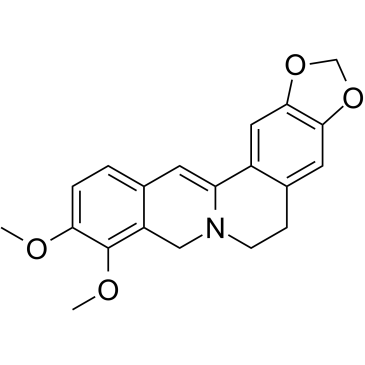
Dihydroberberine is a novel and potent inhibitor of pancreatic lipase with anti-inflammatory, anti-atherosclerotic, hypolipidemic and antitumor activities. It inhibits human ether-a-go-go-related gene (hERG) channels and remarkably reduces heat shock protein 90 (Hsp90) expression and its interaction with hERG.
Physicochemical Properties
| Molecular Formula | C20H19NO4 |
| Molecular Weight | 337.3692 |
| Exact Mass | 337.131 |
| CAS # | 483-15-8 |
| PubChem CID | 10217 |
| Appearance | Light yellow to yellow solid powder |
| Density | 1.4±0.1 g/cm3 |
| Boiling Point | 557.8±50.0 °C at 760 mmHg |
| Melting Point | 223-224ºC (dec.) |
| Flash Point | 170.7±27.3 °C |
| Vapour Pressure | 0.0±1.5 mmHg at 25°C |
| Index of Refraction | 1.679 |
| LogP | 5.09 |
| Hydrogen Bond Donor Count | 0 |
| Hydrogen Bond Acceptor Count | 5 |
| Rotatable Bond Count | 2 |
| Heavy Atom Count | 25 |
| Complexity | 538 |
| Defined Atom Stereocenter Count | 0 |
| InChi Key | FZAGOOYMTPGPGF-UHFFFAOYSA-N |
| InChi Code | InChI=1S/C20H19NO4/c1-22-17-4-3-12-7-16-14-9-19-18(24-11-25-19)8-13(14)5-6-21(16)10-15(12)20(17)23-2/h3-4,7-9H,5-6,10-11H2,1-2H3 |
| Chemical Name | 16,17-dimethoxy-5,7-dioxa-13-azapentacyclo[11.8.0.02,10.04,8.015,20]henicosa-1(21),2,4(8),9,15(20),16,18-heptaene |
| HS Tariff Code | 2934.99.9001 |
| Storage |
Powder-20°C 3 years 4°C 2 years In solvent -80°C 6 months -20°C 1 month Note: (1). Please store this product in a sealed and protected environment (e.g. under nitrogen), avoid exposure to moisture and light.(2). This product is not stable in solution, please use freshly prepared working solution for optimal results. |
| Shipping Condition | Room temperature (This product is stable at ambient temperature for a few days during ordinary shipping and time spent in Customs) |
Biological Activity
| Targets |
- Dihydroberberine targets human Ether-a-go-go Related Gene (hERG) potassium channels (inhibits hERG channel current), with an IC50 value of ~34.5 μM. [1] - Dihydroberberine targets inflammatory signaling pathways (e.g., NF-κB, TLR4/MyD88) and intestinal epithelial barrier-related proteins (e.g., ZO-1, occludin) to alleviate ulcerative colitis. [2] |
| ln Vitro |
When combined, dihydroberberine and sunitinib have a synergistic impact and show anti-cancer benefits on human NSCLC cell lines, including A549, NCI-H460, and NCI-H1299 cells. Dihydroberberine (25 μM; 48 hours) suppresses colony formation and cell proliferation in NCI-H460 [2]. To stop the cell cycle in the G1 phase, NCI-H460 cells were given a combination (DCS) of sunitinib (2 μM) and dihydroberberine (25 μM). DCS contributes to the induction of apoptosis and controls JNK/p38 MAPK signaling [2]. - Inhibition of hERG Channels in HEK293 Cells: 1. Current suppression: HEK293 cells stably expressing hERG channels were treated with Dihydroberberine (1–100 μM). The drug dose-dependently inhibited hERG peak tail currents: 10 μM inhibited by ~25%, 30 μM by ~50%, 100 μM by ~85% (whole-cell patch-clamp technique). The IC50 for hERG current inhibition was ~34.5 μM. [1] 2. Cell viability: Dihydroberberine (1–100 μM) treatment for 24 hours had no significant cytotoxicity on HEK293 cells (MTT assay), with cell viability >90% at all concentrations. [1] - Anti-Inflammatory and Intestinal Barrier-Protective Effects: 1. In RAW264.7 macrophages: Dihydroberberine (10, 20, 40 μM) inhibited LPS-induced production of TNF-α, IL-6, and IL-1β by ~30%–70% (ELISA) and downregulated TLR4/MyD88/NF-κB pathway proteins (TLR4, MyD88, p-NF-κB p65) by ~25%–60% (western blot) vs. LPS-only group. [2] 2. In Caco-2 intestinal epithelial cells: Dihydroberberine (20, 40 μM) reversed LPS-induced decrease in transepithelial electrical resistance (TEER) by ~45%–65% and increased expression of tight junction proteins (ZO-1, occludin) by ~35%–55% (immunofluorescence and western blot) vs. LPS-only group. [2] |
| ln Vivo |
In the mouse NCI-H460 xenograft model, dihydroberberine (250 mg/kg; gavaged once every other day for 14 days) efficiently suppresses tumor growth and proliferation and works in concert with sunitini [2]. - Protection Against DSS-Induced Ulcerative Colitis in Mice: 1. Animal model: C57BL/6 mice (6–8 weeks old) were given 3% dextran sulfate sodium (DSS) in drinking water for 7 days to induce ulcerative colitis. [2] 2. Drug treatment: Dihydroberberine was administered by gavage at doses of 50 mg/kg and 100 mg/kg once daily for 7 days; control group received equal volume of saline. [2] 3. Efficacy results: - Reduced body weight loss: From ~20% (DSS control) to ~12% (50 mg/kg) and ~8% (100 mg/kg); [2] - Increased colon length: From ~4.0 cm (DSS control) to ~5.2 cm (50 mg/kg) and ~5.8 cm (100 mg/kg); [2] - Decreased histological damage: Scores (epithelial erosion, inflammatory infiltration) dropped from ~7 (DSS control) to ~4 (50 mg/kg) and ~2 (100 mg/kg); [2] - Inhibited inflammation: Colonic TNF-α, IL-6 levels decreased by ~40%–70%, and ZO-1/occludin expression increased by ~35%–60% (ELISA and western blot). [2] |
| Enzyme Assay |
- hERG Channel Current Recording Assay: 1. HEK293 cells stably transfected with hERG cDNA were cultured in DMEM medium (10% FBS) at 37°C (5% CO₂) until 80% confluence. [1] 2. Whole-cell patch-clamp recordings were performed at room temperature (22–25°C). The pipette solution contained KCl (140 mM), MgCl₂ (1 mM), EGTA (5 mM), and HEPES (10 mM, pH 7.2). The bath solution contained NaCl (140 mM), KCl (5 mM), CaCl₂ (2 mM), MgCl₂ (1 mM), and HEPES (10 mM, pH 7.4). [1] 3. Dihydroberberine (1–100 μM) was added to the bath solution, and hERG currents were elicited by a voltage protocol (from -80 mV to +40 mV for 200 ms, then repolarized to -50 mV for 500 ms). Current amplitudes were analyzed to calculate inhibition rates and IC50. [1] - NF-κB Luciferase Reporter Assay: 1. RAW264.7 cells were co-transfected with NF-κB-luciferase reporter plasmid and Renilla luciferase plasmid (internal control). [2] 2. After 24 hours of transfection, cells were pretreated with Dihydroberberine (10, 20, 40 μM) for 1 hour, then stimulated with LPS (1 μg/mL) for 6 hours. [2] 3. Luciferase activity was measured using a dual-luciferase reporter assay system. Dihydroberberine dose-dependently reduced LPS-induced NF-κB luciferase activity by ~30%–65% vs. LPS-only group. [2] |
| Cell Assay |
- hERG-HEK293 Cell Viability Assay: 1. hERG-HEK293 cells were seeded in 96-well plates (5×10³ cells/well) and cultured for 24 hours. [1] 2. Cells were treated with Dihydroberberine (1–100 μM) for 24 hours (vehicle: DMSO). [1] 3. MTT reagent (5 mg/mL) was added, incubated for 4 hours, then DMSO was added to dissolve formazan crystals. Absorbance at 570 nm was measured to calculate cell viability. [1] - RAW264.7 Cell Inflammatory Assay: 1. RAW264.7 cells were seeded in 6-well plates (2×10⁶ cells/well) and cultured for 24 hours. [2] 2. Cells were pretreated with Dihydroberberine (10, 20, 40 μM) for 1 hour, then stimulated with LPS (1 μg/mL) for 24 hours. [2] 3. Supernatants were collected to detect TNF-α, IL-6, IL-1β via ELISA; cells were lysed to extract total protein for western blot (anti-TLR4, anti-MyD88, anti-p-NF-κB p65 antibodies). [2] |
| Animal Protocol |
- DSS-Induced Colitis Mouse Model Protocol: 1. Animal preparation: 6–8 weeks old male C57BL/6 mice (20–22 g) were acclimated for 1 week (free access to food/water, 25°C, 12h light/dark cycle). [2] 2. Colitis induction: Mice were given 3% DSS (molecular weight 36,000–50,000) in drinking water ad libitum for 7 consecutive days. [2] 3. Drug preparation: Dihydroberberine was dissolved in sterile saline to prepare solutions of 50 mg/kg and 100 mg/kg (based on mouse weight). [2] 4. Administration: Dihydroberberine was administered by oral gavage once daily for 7 days (starting on the first day of DSS treatment); control group received saline gavage. [2] 5. Sample collection: On day 8, mice were euthanized. Colons were harvested to measure length; colonic tissues were fixed in 4% paraformaldehyde (for histological analysis) or stored at -80°C (for ELISA and western blot). [2] |
| Toxicity/Toxicokinetics |
- In Vitro Cytotoxicity: Dihydroberberine (1–100 μM) had no significant cytotoxicity on hERG-HEK293, RAW264.7, or Caco-2 cells (MTT assay), with cell viability >90% after 24 hours of treatment. [1][2] - In Vivo Safety: In DSS-induced colitis mice, Dihydroberberine (50, 100 mg/kg) treatment for 7 days did not affect serum levels of alanine transaminase (ALT), aspartate transaminase (AST), blood urea nitrogen (BUN), or creatinine (Cr), indicating no obvious (hepatic/renal) toxicity. [2] |
| References |
[1]. Inhibitory effects and mechanism of dihydroberberine on hERG channels expressed in HEK293 cells. PLoS One. 2017 Aug 1;12(8):e0181823. [2]. Dihydroberberine, an isoquinoline alkaloid, exhibits protective effect against dextran sulfate sodium-induced ulcerative colitis in mice. Phytomedicine. 2021 Sep;90:153631. |
| Additional Infomation |
Lambertine is an alkaloid. Dihydroberberine has been reported in Thalictrum foliolosum, Chelidonium majus, and other organisms with data available. - Natural Source: Dihydroberberine is a hydrogenated derivative of berberine, an isoquinoline alkaloid naturally present in plants of the Berberidaceae family (e.g., Berberis vulgaris, Coptis chinensis). [1][2] - Mechanisms of Action: 1. hERG Channel Inhibition: Dihydroberberine binds to the pore region of hERG channels, prolonging the channel’s inactivation phase and reducing peak tail currents (relevant to cardiac repolarization). [1] 2. Anti-Colitis Effect: Dihydroberberine alleviates ulcerative colitis by two pathways: inhibiting TLR4/MyD88/NF-κB-mediated inflammation and upregulating tight junction proteins to protect the intestinal epithelial barrier. [2] |
Solubility Data
| Solubility (In Vitro) | DMSO : ~20 mg/mL (~59.28 mM () |
| Solubility (In Vivo) |
Solubility in Formulation 1: ≥ 2 mg/mL (5.93 mM) (saturation unknown) in 10% DMSO + 40% PEG300 +5% Tween-80 + 45% Saline (add these co-solvents sequentially from left to right, and one by one), clear solution. For example, if 1 mL of working solution is to be prepared, you can add 100 μL of 20.0 mg/mL clear DMSO stock solution to 400 μL PEG300 and mix evenly; then add 50 μL Tween-80 + to the above solution and mix evenly; then add 450 μL normal saline to adjust the volume to 1 mL. Preparation of saline: Dissolve 0.9 g of sodium chloride in 100 mL ddH₂ O to obtain a clear solution. (Please use freshly prepared in vivo formulations for optimal results.) |
| Preparing Stock Solutions | 1 mg | 5 mg | 10 mg | |
| 1 mM | 2.9641 mL | 14.8205 mL | 29.6410 mL | |
| 5 mM | 0.5928 mL | 2.9641 mL | 5.9282 mL | |
| 10 mM | 0.2964 mL | 1.4821 mL | 2.9641 mL |