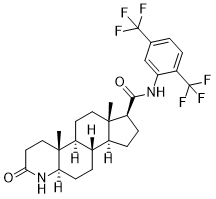
Dihydro Dutasteride is an impurity generated during the production of Dutasteride (GI198745, GG745; GI-198745, GG-745; Avodart, Avidart), which is an approved anticancer medication and a 5-α reductase inhibitor.
Physicochemical Properties
| Molecular Formula | C27H32F6N2O2 |
| Molecular Weight | 530.54600 |
| Exact Mass | 530.237 |
| Elemental Analysis | C, 61.12; H, 6.08; F, 21.49; N, 5.28; O, 6.03 |
| CAS # | 164656-22-8 |
| PubChem CID | 15871205 |
| Appearance | Typically exists as solid at room temperature |
| LogP | 7.201 |
| Hydrogen Bond Donor Count | 2 |
| Hydrogen Bond Acceptor Count | 8 |
| Rotatable Bond Count | 2 |
| Heavy Atom Count | 37 |
| Complexity | 922 |
| Defined Atom Stereocenter Count | 7 |
| SMILES | C[C@]12CC[C@H]3[C@H]([C@@H]1CC[C@@H]2C(=O)Nc4cc(ccc4C(F)(F)F)C(F)(F)F)CC[C@@H]5[C@@]3(CCC(=O)N5)C |
| InChi Key | AIUHDIPAGREENV-QWBYCMEYSA-N |
| InChi Code | InChI=1S/C27H32F6N2O2/c1-24-11-9-17-15(4-8-21-25(17,2)12-10-22(36)35-21)16(24)6-7-19(24)23(37)34-20-13-14(26(28,29)30)3-5-18(20)27(31,32)33/h3,5,13,15-17,19,21H,4,6-12H2,1-2H3,(H,34,37)(H,35,36)/t15-,16-,17-,19+,21+,24-,25+/m0/s1 |
| Chemical Name | (1S,3aS,3bS,5aR,9aR,9bS,11aS)-N-[2,5-bis(trifluoromethyl)phenyl]-9a,11a-dimethyl-7-oxo-1,2,3,3a,3b,4,5,5a,6,8,9,9b,10,11-tetradecahydroindeno[5,4-f]quinoline-1-carboxamide |
| Synonyms | Dihydro Dutasteride; 164656-22-8; Dihydrodutasteride; 1,2-Dihydrodutasteride; Y7B42KG7F8; GI201448X; (1S,3aS,3bS,5aR,9aR,9bS,11aS)-N-[2,5-bis(trifluoromethyl)phenyl]-9a,11a-dimethyl-7-oxo-1,2,3,3a,3b,4,5,5a,6,8,9,9b,10,11-tetradecahydroindeno[5,4-f]quinoline-1-carboxamide; 1H-Indeno(5,4-F)quinoline-7-carboxamide, N-(2,5-bis(trifluoromethyl)phenyl)hexadecahydro-4a,6a-dimethyl-2-oxo-, (4aR,4bS,6aS,7S,9aS,9bS,11aR)-; |
| HS Tariff Code | 2934.99.9001 |
| Storage |
Powder-20°C 3 years 4°C 2 years In solvent -80°C 6 months -20°C 1 month |
| Shipping Condition | Room temperature (This product is stable at ambient temperature for a few days during ordinary shipping and time spent in Customs) |
Biological Activity
| Targets | 5 alpha-reductase |
| ln Vitro | Dutasteride inhibited (3)H-T conversion to (3)H-DHT and, as anticipated, inhibited T-induced secretion of PSA and proliferation. However the drug also inhibited DHT-induced PSA secretion and cell proliferation (IC(50) approximately 1 microM). Finasteride also inhibited DHT action but was less potent than dutasteride. Dutasteride competed for binding the LNCaP cell AR with an IC(50) approximately 1.5 microM. High concentrations of dutasteride (10-50 microM), but not finasteride, in steroid-free medium, resulted in enhanced cell death, possibly by apoptosis. This was accompanied by loss of AR protein and decreased AR ligand-binding activity. Occupation of AR by R1881 partly protected against cell death and loss of AR protein. PC-3 prostate cancer cells, which do not contain AR, also were killed by high concentrations of dutasteride, as well as by 50 microM finasteride. Conclusions: Dutasteride exhibited some inhibitory actions in LNCaP cells possibly related to 5alphaR inhibition but also had antiandrogenic effects at relatively low concentrations and cell death-promoting effects at higher concentrations. Finasteride also was antiandrogenic, but less than dutasteride. The antiandrogenic effects may be mediated by the mutant LNCaP cell AR. Promotion of cell death by dutasteride can be blocked, but only in part, by androgens[1]. |
| ln Vivo | Short-term Dutasteride treatments with concentrations of 1 and 10 mg/kg significantly increase the total PSMA protein expression in a mouse LNCaP xenograft model. PSMA fluorescence intensity increases significantly even using lower daily concentrations of 0.1 mg/kg Dutasteride. Further investigations are needed to elucidate the impact of Dutasteride treatment on PSMA expression in patients. Cancer Rep (Hoboken). 2021 Dec;4(6):e1418. |
| Cell Assay | Reduction of T to DHT by 5alphaR in the prostate enhances androgenic activity for most targets. Inhibition of 5alphaR activity with finasteride attenuates androgen action in men and animal models. The objective of this study was to compare and contrast the effects of a potent new 5alphaR inhibitor, dutasteride, with finasteride in the LNCaP prostate cancer cell line. Methods: LNCaP cells were incubated for varying times with T or DHT in steroid-free medium in the absence or presence of increasing doses of dutasteride or finasteride and the effects on 5alphaR activity, PSA accumulation in the medium, and on cell proliferation were determined. Drug effects on apoptosis were investigated using Annexin V staining and a cell death ELISA assay. Effects of the drugs on AR ligand-binding activity and on AR protein levels were determined[1]. |
| Animal Protocol | Four groups of mice bearing LNCaP xenografts were treated for 14 days with daily intraperitoneal injections of either vehicle control or different concentrations of Dutasteride (0.1, 1, 10 mg/kg). Total expression of PSMA, androgen receptor (AR), and caspase-3 protein was analyzed using immunoblotting (WES). In addition, PSMA, cleaved caspase-3 and Ki-67 expression was assessed and quantified by immunohistochemistry. Tumor size was measured by caliper on day 7 and 14, tumor weight was assessed following tissue harvesting. The mean PSMA protein expression in mice increased significantly after treatment with 1 mg/kg (10-fold) or 10 mg/kg (sixfold) of Dutasteride compared to vehicle control. The mean fluorescence intensity significantly increased by daily injections of 0.1 mg/kg Dutasteride (1.6-fold) as well as 1 and 10 mg/kg Dutasteride (twofold). While the reduction in tumor volume following treatment with high concentrations of 10 mg/kg Dutasteride was nonsignificant, no changes in AR, caspase-3, cleaved caspase-3, and Ki-67 expression were observed.Cancer Rep (Hoboken) . 2021 Dec;4(6):e1418. |
| References | [1]. Dutasteride, the dual 5alpha-reductase inhibitor, inhibits androgen action and promotes cell death in the LNCaP prostate cancer cell line. Prostate. 2004 Feb 1;58(2):130-44. |
| Additional Infomation | Dutasteride has been shown to increase expression of the prostate-specific membrane antigen (PSMA) in prostate cancer cells in previous in vitro studies. This 5-alpha-reductase inhibitor is commonly used for the treatment of symptomatic benign prostatic enlargement. The modulation of PSMA expression might affect PSMA-based prostate cancer imaging and therapy. Aim: The purpose of this work was to further analyze concentration-dependent effects of Dutasteride on PSMA expression in a mouse xenograft model.Cancer Rep (Hoboken). 2021 Dec;4(6):e1418. |
Solubility Data
| Solubility (In Vitro) | May dissolve in DMSO (in most cases), if not, try other solvents such as H2O, Ethanol, or DMF with a minute amount of products to avoid loss of samples |
| Solubility (In Vivo) |
Note: Listed below are some common formulations that may be used to formulate products with low water solubility (e.g. < 1 mg/mL), you may test these formulations using a minute amount of products to avoid loss of samples. Injection Formulations (e.g. IP/IV/IM/SC) Injection Formulation 1: DMSO : Tween 80: Saline = 10 : 5 : 85 (i.e. 100 μL DMSO stock solution → 50 μL Tween 80 → 850 μL Saline) *Preparation of saline: Dissolve 0.9 g of sodium chloride in 100 mL ddH ₂ O to obtain a clear solution. Injection Formulation 2: DMSO : PEG300 :Tween 80 : Saline = 10 : 40 : 5 : 45 (i.e. 100 μL DMSO → 400 μLPEG300 → 50 μL Tween 80 → 450 μL Saline) Injection Formulation 3: DMSO : Corn oil = 10 : 90 (i.e. 100 μL DMSO → 900 μL Corn oil) Example: Take the Injection Formulation 3 (DMSO : Corn oil = 10 : 90) as an example, if 1 mL of 2.5 mg/mL working solution is to be prepared, you can take 100 μL 25 mg/mL DMSO stock solution and add to 900 μL corn oil, mix well to obtain a clear or suspension solution (2.5 mg/mL, ready for use in animals). Injection Formulation 4: DMSO : 20% SBE-β-CD in saline = 10 : 90 [i.e. 100 μL DMSO → 900 μL (20% SBE-β-CD in saline)] *Preparation of 20% SBE-β-CD in Saline (4°C,1 week): Dissolve 2 g SBE-β-CD in 10 mL saline to obtain a clear solution. Injection Formulation 5: 2-Hydroxypropyl-β-cyclodextrin : Saline = 50 : 50 (i.e. 500 μL 2-Hydroxypropyl-β-cyclodextrin → 500 μL Saline) Injection Formulation 6: DMSO : PEG300 : castor oil : Saline = 5 : 10 : 20 : 65 (i.e. 50 μL DMSO → 100 μLPEG300 → 200 μL castor oil → 650 μL Saline) Injection Formulation 7: Ethanol : Cremophor : Saline = 10: 10 : 80 (i.e. 100 μL Ethanol → 100 μL Cremophor → 800 μL Saline) Injection Formulation 8: Dissolve in Cremophor/Ethanol (50 : 50), then diluted by Saline Injection Formulation 9: EtOH : Corn oil = 10 : 90 (i.e. 100 μL EtOH → 900 μL Corn oil) Injection Formulation 10: EtOH : PEG300:Tween 80 : Saline = 10 : 40 : 5 : 45 (i.e. 100 μL EtOH → 400 μLPEG300 → 50 μL Tween 80 → 450 μL Saline) Oral Formulations Oral Formulation 1: Suspend in 0.5% CMC Na (carboxymethylcellulose sodium) Oral Formulation 2: Suspend in 0.5% Carboxymethyl cellulose Example: Take the Oral Formulation 1 (Suspend in 0.5% CMC Na) as an example, if 100 mL of 2.5 mg/mL working solution is to be prepared, you can first prepare 0.5% CMC Na solution by measuring 0.5 g CMC Na and dissolve it in 100 mL ddH2O to obtain a clear solution; then add 250 mg of the product to 100 mL 0.5% CMC Na solution, to make the suspension solution (2.5 mg/mL, ready for use in animals). Oral Formulation 3: Dissolved in PEG400 Oral Formulation 4: Suspend in 0.2% Carboxymethyl cellulose Oral Formulation 5: Dissolve in 0.25% Tween 80 and 0.5% Carboxymethyl cellulose Oral Formulation 6: Mixing with food powders Note: Please be aware that the above formulations are for reference only. InvivoChem strongly recommends customers to read literature methods/protocols carefully before determining which formulation you should use for in vivo studies, as different compounds have different solubility properties and have to be formulated differently. (Please use freshly prepared in vivo formulations for optimal results.) |
| Preparing Stock Solutions | 1 mg | 5 mg | 10 mg | |
| 1 mM | 1.8848 mL | 9.4242 mL | 18.8484 mL | |
| 5 mM | 0.3770 mL | 1.8848 mL | 3.7697 mL | |
| 10 mM | 0.1885 mL | 0.9424 mL | 1.8848 mL |