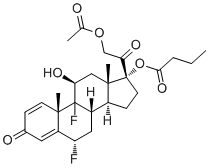
Physicochemical Properties
| Molecular Formula | C27H34F2O7 |
| Molecular Weight | 508.5515 |
| Exact Mass | 508.227 |
| CAS # | 23674-86-4 |
| PubChem CID | 443936 |
| Appearance | White to off-white solid powder |
| Density | 1.3±0.1 g/cm3 |
| Boiling Point | 600.3±55.0 °C at 760 mmHg |
| Melting Point | 192 - 194ºC |
| Flash Point | 316.9±31.5 °C |
| Vapour Pressure | 0.0±3.9 mmHg at 25°C |
| Index of Refraction | 1.545 |
| LogP | 3.67 |
| Hydrogen Bond Donor Count | 1 |
| Hydrogen Bond Acceptor Count | 9 |
| Rotatable Bond Count | 8 |
| Heavy Atom Count | 36 |
| Complexity | 1050 |
| Defined Atom Stereocenter Count | 8 |
| SMILES | CCCC(=O)O[C@@]1(CC[C@@H]2[C@@]1(C[C@@H]([C@]3([C@H]2C[C@@H](C4=CC(=O)C=C[C@@]43C)F)F)O)C)C(=O)COC(=O)C |
| InChi Key | WYQPLTPSGFELIB-JTQPXKBDSA-N |
| InChi Code | InChI=1S/C27H34F2O7/c1-5-6-23(34)36-26(22(33)14-35-15(2)30)10-8-17-18-12-20(28)19-11-16(31)7-9-24(19,3)27(18,29)21(32)13-25(17,26)4/h7,9,11,17-18,20-21,32H,5-6,8,10,12-14H2,1-4H3/t17-,18-,20-,21-,24-,25-,26-,27-/m0/s1 |
| Chemical Name | [(6S,8S,9R,10S,11S,13S,14S,17R)-17-(2-acetyloxyacetyl)-6,9-difluoro-11-hydroxy-10,13-dimethyl-3-oxo-6,7,8,11,12,14,15,16-octahydrocyclopenta[a]phenanthren-17-yl] butanoate |
| Synonyms | W6309 W-6309 W 6309 |
| HS Tariff Code | 2934.99.9001 |
| Storage |
Powder-20°C 3 years 4°C 2 years In solvent -80°C 6 months -20°C 1 month |
| Shipping Condition | Room temperature (This product is stable at ambient temperature for a few days during ordinary shipping and time spent in Customs) |
Biological Activity
| ADME/Pharmacokinetics |
Absorption, Distribution and Excretion Difluprednate penetrates the corneal epithelium rapidly and effectively. Low systemic absorption. 78.5% of radioactivity was excreted aftert 24 hours, and 99.5% by 7 days after a single dose of labeled difluprednate instilled in the right eyes of pigmented rabbits. Metabolism / Metabolites Difluprednate is rapidly deacetylated in the aqueous humor to difluoroprednisolone butyrate (DFB), the drug’s active metabolite. Endogenous tissue esterases then metabolize DFB to the inert metabolite hydroxyfluoroprednisolone butyrate (HFB), which limits systemic exposure to the active compound. |
| Toxicity/Toxicokinetics |
Effects During Pregnancy and Lactation ◉ Summary of Use during Lactation No information is available on the ophthalmic use of difluprednate during breastfeeding. Because absorption from the eye is limited, ophthalmic difluprednate would not be expected to cause any adverse effects in breastfed infants. To substantially diminish the amount of drug that reaches the breastmilk after using eye drops, place pressure over the tear duct by the corner of the eye for 1 minute or more, then remove the excess solution with an absorbent tissue. ◉ Effects in Breastfed Infants Relevant published information was not found as of the revision date. ◉ Effects on Lactation and Breastmilk Relevant published information was not found as of the revision date. |
| References |
[1]. Difluprednate, From Wikipedia. |
| Additional Infomation |
Difluprednate is a corticosteroid hormone and a butyrate ester. Difluprednate is a topical corticosteroid indicated for the treatment of infammation and pain associated with ocular surgery. It is a butyrate ester of 6(α), 9(α)-difluoro prednisolone acetate. Difluprednate is abbreviated DFBA, or difluoroprednisolone butyrate acetate. It is indicated for treatment of endogenous anterior uveiti. Difluprednate is a topical corticosteroid and prednisolone acetate derivative, with anti-inflammatory activity. Upon instillation into the eye, difluprednate binds to and activates the glucocorticoid receptor (GR). The receptor-ligand complex binds to promoter regions of certain genes and initiates RNA transcription. This results in an induction of synthesis of phospholipase A2 inhibitory proteins, thereby inhibiting the synthesis of arachidonic acid and preventing the synthesis of certain inflammatory mediators, such as prostaglandins and leukotrienes. This reduces ocular inflammation and pain. Drug Indication For the treatment of inflammation and pain associated with ocular surgery. FDA Label Mechanism of Action Corticosteroids are thought to act by the induction of phospholipase A2 inhibitory proteins (lipocortins). It is postulated that these proteins control the biosynthesis of potent mediators of infammation such as prostaglandins and leukotrienes by inhibiting the release of their common precursor arachidonic acid. Arachidonic acid is released from membrane phospholipids by phospholipase A2. |
Solubility Data
| Solubility (In Vitro) | DMSO : ~250 mg/mL (~491.59 mM) |
| Solubility (In Vivo) |
Solubility in Formulation 1: 2.5 mg/mL (4.92 mM) in 10% DMSO + 90% (20% SBE-β-CD in Saline) (add these co-solvents sequentially from left to right, and one by one), suspension solution; with sonication. For example, if 1 mL of working solution is to be prepared, you can add 100 μL of 25.0 mg/mL clear DMSO stock solution to 900 μL of 20% SBE-β-CD physiological saline solution and mix evenly. Preparation of 20% SBE-β-CD in Saline (4°C,1 week): Dissolve 2 g SBE-β-CD in 10 mL saline to obtain a clear solution. Solubility in Formulation 2: ≥ 2.08 mg/mL (4.09 mM) (saturation unknown) in 10% DMSO + 40% PEG300 + 5% Tween80 + 45% Saline (add these co-solvents sequentially from left to right, and one by one), clear solution. For example, if 1 mL of working solution is to be prepared, you can add 100 μL of 20.8 mg/mL clear DMSO stock solution to 400 μL PEG300 and mix evenly; then add 50 μL Tween-80 to the above solution and mix evenly; then add 450 μL normal saline to adjust the volume to 1 mL. Preparation of saline: Dissolve 0.9 g of sodium chloride in 100 mL ddH₂ O to obtain a clear solution. Solubility in Formulation 3: ≥ 2.08 mg/mL (4.09 mM) (saturation unknown) in 10% DMSO + 90% Corn Oil (add these co-solvents sequentially from left to right, and one by one), clear solution. For example, if 1 mL of working solution is to be prepared, you can add 100 μL of 20.8 mg/mL clear DMSO stock solution to 900 μL of corn oil and mix evenly. (Please use freshly prepared in vivo formulations for optimal results.) |
| Preparing Stock Solutions | 1 mg | 5 mg | 10 mg | |
| 1 mM | 1.9664 mL | 9.8319 mL | 19.6637 mL | |
| 5 mM | 0.3933 mL | 1.9664 mL | 3.9327 mL | |
| 10 mM | 0.1966 mL | 0.9832 mL | 1.9664 mL |