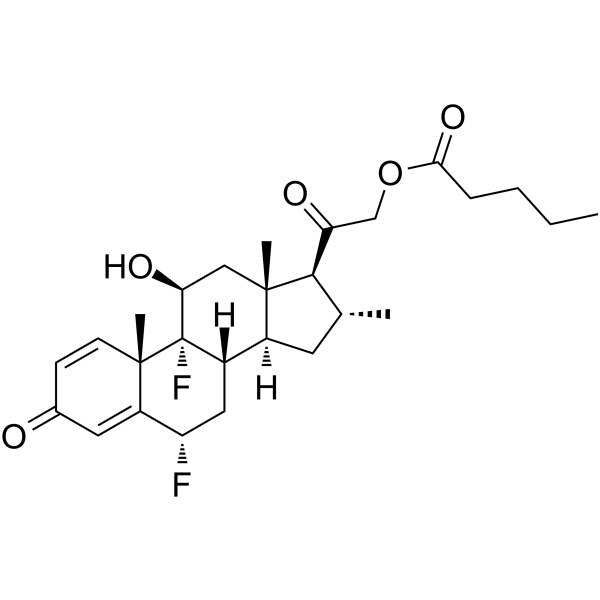
Physicochemical Properties
| Molecular Formula | C27H36O5F2 |
| Molecular Weight | 478.56854 |
| Exact Mass | 478.253 |
| CAS # | 59198-70-8 |
| Related CAS # | 15845-96-2 (pivalate);2607-06-9;59198-70-8 (valerate); |
| PubChem CID | 91670 |
| Appearance | White to off-white solid powder |
| Density | 1.2±0.1 g/cm3 |
| Boiling Point | 578.5±50.0 °C at 760 mmHg |
| Melting Point | 220ºC |
| Flash Point | 303.7±30.1 °C |
| Vapour Pressure | 0.0±3.6 mmHg at 25°C |
| Index of Refraction | 1.538 |
| LogP | 4.65 |
| Hydrogen Bond Donor Count | 1 |
| Hydrogen Bond Acceptor Count | 7 |
| Rotatable Bond Count | 7 |
| Heavy Atom Count | 34 |
| Complexity | 943 |
| Defined Atom Stereocenter Count | 9 |
| SMILES | CCCCC(=O)OCC(=O)[C@H]1[C@@H](C[C@@H]2[C@@]1(C[C@@H]([C@]3([C@H]2C[C@@H](C4=CC(=O)C=C[C@@]43C)F)F)O)C)C |
| InChi Key | HHJIUUAMYGBVSD-YTFFSALGSA-N |
| InChi Code | InChI=1S/C27H36F2O5/c1-5-6-7-23(33)34-14-21(31)24-15(2)10-17-18-12-20(28)19-11-16(30)8-9-26(19,4)27(18,29)22(32)13-25(17,24)3/h8-9,11,15,17-18,20,22,24,32H,5-7,10,12-14H2,1-4H3/t15-,17+,18+,20+,22+,24-,25+,26+,27+/m1/s1 |
| Chemical Name | [2-[(6S,8S,9R,10S,11S,13S,14S,16R,17S)-6,9-difluoro-11-hydroxy-10,13,16-trimethyl-3-oxo-7,8,11,12,14,15,16,17-octahydro-6H-cyclopenta[a]phenanthren-17-yl]-2-oxoethyl] pentanoate |
| HS Tariff Code | 2934.99.9001 |
| Storage |
Powder-20°C 3 years 4°C 2 years In solvent -80°C 6 months -20°C 1 month |
| Shipping Condition | Room temperature (This product is stable at ambient temperature for a few days during ordinary shipping and time spent in Customs) |
Biological Activity
| ln Vitro |
Difluocortolone valerate is an effective corticosteroid that has been esterified with valerate. Difluocordol valerate aids in lowering redness, swelling, and itching [1]. 1. For in vitro cytotoxicity evaluation of Diflucortolone Valerate, cultured skin epithelial cells were used. The cells were adjusted to a certain concentration and seeded in 96-well plates, followed by incubation at 37°C with 5% CO₂ for 24 hours to allow adherence. Then, the original medium was removed, and fresh medium containing Diflucortolone Valerate at different concentrations (e.g., 0.1 μg/mL, 1 μg/mL, 10 μg/mL) was added to the wells (3 replicate wells per concentration), with a drug-free blank control group set up simultaneously. After continuous incubation for 48 hours, a cell viability detection reagent (e.g., MTT) was added, and the absorbance of each well was measured at a specific wavelength (e.g., 570 nm) using a microplate reader after 4 hours of incubation. The results showed that Diflucortolone Valerate had no significant effect on cell viability (survival rate > 90%) when the concentration was lower than 5 μg/mL; when the concentration reached 20 μg/mL, the cell survival rate decreased to approximately 75%, showing a concentration-dependent cytotoxic effect. [2] 2. In the in vitro irritation test of Diflucortolone Valerate formulations (ointment, fatty ointment, cream), the extracts of different formulations were prepared and co-cultured with human skin fibroblasts. After 72 hours of incubation, the cell morphology was observed under a microscope, and the secretion levels of inflammatory factors (e.g., IL-6, TNF-α) were detected by enzyme-linked immunosorbent assay (ELISA). The results showed that the extracts of all Diflucortolone Valerate formulations did not cause obvious changes in fibroblast morphology (no shrinkage, fragmentation), and the levels of IL-6 and TNF-α were not significantly different from those of the control group, indicating no obvious in vitro skin irritation. [2] |
| ln Vivo |
DL50 levels are almost non-toxic after a single oral dosage (more than 4 g/kg in mice, around 3.1 g/kg in rats, and more than 1 g/kg in dogs). When administered intraperitoneally (mouse LD50 roughly 450 mg/kg, rat approximately 98 mg/kg), it is very active (mouse LD50 approximately 180 mg/kg, rat approximately 13 mg/kg). may have harmful repercussions [2]. 1. Acute toxicity test of Diflucortolone Valerate in mice: Healthy ICR mice (male and female, weight 20-25 g) were randomly divided into 5 groups (n=10 per group). Diflucortolone Valerate ointment was applied to the depilated back skin (area 2 cm×2 cm) of mice at doses of 50 mg/kg, 100 mg/kg, 200 mg/kg, 400 mg/kg, and 800 mg/kg, respectively, with a blank ointment control group. After administration, the general condition of mice (mental state, diet, drinking water, feces) was observed continuously for 14 days, and the body weight was recorded every 2 days. No mice died in any dose group during the observation period, and there were no abnormal manifestations such as listlessness, reduced food intake, or weight loss. The body weight growth rate of each dose group was consistent with that of the control group, indicating that the acute toxicity of Diflucortolone Valerate via cutaneous administration was low, and the median lethal dose (LD₅₀) could not be determined (greater than 800 mg/kg). [2] 2. Subchronic toxicity test of Diflucortolone Valerate in rats: SPF-grade SD rats (male and female, weight 180-220 g) were randomly divided into 4 groups (n=15 per group): blank control group, Diflucortolone Valerate low-dose group (10 mg/kg), medium-dose group (30 mg/kg), and high-dose group (90 mg/kg). The drug was prepared into ointment, fatty ointment, and cream formulations, and administered by cutaneous application on the depilated back (area 3 cm×3 cm) once a day for 28 consecutive days. During administration, the general condition of rats was observed daily; blood samples were collected on day 14 and day 28 for routine blood (white blood cell count, red blood cell count, hemoglobin, platelet count) and biochemical (alanine aminotransferase, aspartate aminotransferase, blood creatinine, urea nitrogen, total cholesterol) tests; after the last administration, rats were sacrificed, major organs (liver, kidney, heart, lung, spleen) were dissected and weighed to calculate organ coefficients, and tissue sections were prepared for pathological examination. The results showed that there were no significant differences in routine blood and biochemical indicators between each dose group and the control group; the organ coefficients of major organs were within the normal range, and no pathological changes such as hepatocyte necrosis, renal tubular damage, or myocardial degeneration were found in pathological sections. [2] |
| Cell Assay |
1. Cell viability assay for Diflucortolone Valerate: First, skin epithelial cells were and cultured in complete medium (containing 10% fetal bovine serum and 1% penicillin-streptomycin) at 37°C with 5% CO₂. When the cells reached 80%-90% confluence, they were digested with trypsin, centrifuged, and resuspended to adjust the cell concentration to 5×10⁴ cells/mL. Then, 100 μL of cell suspension was added to each well of a 96-well plate, and the plate was placed in the incubator for 24 hours to allow cells to adhere. After adherence, the medium in each well was aspirated, and 100 μL of medium containing Diflucortolone Valerate at concentrations of 0.1 μg/mL, 1 μg/mL, 5 μg/mL, 10 μg/mL, 20 μg/mL, and 50 μg/mL was added, with 3 replicate wells for each concentration. A control group with medium only (without drug) was also set up. After incubating for 48 hours, 10 μL of MTT solution (5 mg/mL) was added to each well, and the incubation was continued for 4 hours. Then, the supernatant was carefully aspirated, 150 μL of dimethyl sulfoxide was added to each well, and the plate was shaken for 10 minutes to fully dissolve the formazan crystals. Finally, the absorbance value (OD) of each well at 570 nm was measured using a microplate reader, and the cell survival rate was calculated according to the formula: Cell survival rate (%) = (OD value of drug group / OD value of control group) × 100%. [2] 2. Inflammatory factor detection assay in fibroblasts: Human skin fibroblasts were cultured to the logarithmic growth phase, digested, and seeded in 24-well plates at a density of 2×10⁵ cells/well. After 24 hours of adherence, the medium was replaced with serum-free medium, and the extracts of Diflucortolone Valerate ointment, fatty ointment, and cream (prepared by dissolving the formulations in physiological saline and filtering through a 0.22 μm membrane) were added to the corresponding wells, with a blank extract control group (without drug) set up. After 72 hours of incubation, the supernatant in each well was collected and centrifuged at 3000 rpm for 10 minutes to remove cell debris. The concentrations of IL-6 and TNF-α in the supernatant were detected using commercial ELISA kits according to the kit instructions, and the absorbance was measured at 450 nm with a microplate reader to calculate the content of inflammatory factors. [2] |
| Animal Protocol |
1. Acute toxicity test protocol in mice: - Animal selection: Healthy ICR mice, half male and half female, aged 6-8 weeks, weight 20-25 g, purchased from a qualified animal facility, and acclimatized for 3 days before the experiment (temperature 22±2°C, humidity 50±5%, 12-hour light/dark cycle, free access to food and water). - Drug preparation: Diflucortolone Valerate was mixed with a blank ointment matrix (e.g.,凡士林) to prepare ointments with concentrations of 5%, 10%, 20%, 40%, and 80% (corresponding to doses of 50 mg/kg, 100 mg/kg, 200 mg/kg, 400 mg/kg, 800 mg/kg based on mouse weight). - Administration method: The back hair of mice was removed using an electric shaver (depilation area 2 cm×2 cm), and the skin was checked to ensure no damage. Then, 0.1 mL of the corresponding concentration of Diflucortolone Valerate ointment was evenly applied to the depilated area, and the area was covered with a non-irritating adhesive film to prevent the mice from licking the drug. The film was removed after 4 hours, and the skin was gently wiped with physiological saline to remove residual drug. The control group was treated with the same amount of blank ointment. - Observation and detection: After administration, the general state of mice (activity, mental state, diet, drinking water, feces color and shape) was observed at 1 hour, 4 hours, 8 hours, 12 hours, and 24 hours on the first day, and then once a day for 14 consecutive days. The body weight of each mouse was measured every 2 days. At the end of the observation period, all mice were sacrificed by cervical dislocation, and the skin at the administration site was checked for redness, swelling, erosion, or other abnormalities. [2] 2. Subchronic toxicity test protocol in rats: - Animal selection: SPF-grade SD rats, half male and half female, aged 8-10 weeks, weight 180-220 g, acclimatized for 5 days before the experiment (environmental conditions same as mice, free access to food and water). - Drug preparation: Diflucortolone Valerate was prepared into ointment, fatty ointment, and cream formulations with concentrations of 1%, 3%, and 9% (corresponding to doses of 10 mg/kg, 30 mg/kg, 90 mg/kg based on rat weight) using appropriate matrices (ointment matrix:凡士林 + liquid paraffin; fatty ointment matrix: mineral oil + beeswax; cream matrix: water + oil + emulsifier). - Administration method: The back hair of rats was removed (depilation area 3 cm×3 cm) once a week to maintain a hairless state. Each day, 0.2 mL of the corresponding Diflucortolone Valerate formulation was evenly applied to the depilated skin, and the skin was gently rubbed for 1 minute to promote drug absorption. The control group was treated with the corresponding blank formulation. Administration was performed once a day, at the same time each day, for 28 consecutive days. - Observation and detection: Daily observation included general condition (activity, mental state, coat luster, food intake, water intake, feces). Body weight was measured once a week. On day 14 and day 28 of administration, 5 rats per group (half male and half female) were selected, anesthetized by intraperitoneal injection of pentobarbital sodium, and blood was collected from the abdominal aorta for routine blood test (using an automatic blood cell analyzer) and biochemical test (using an automatic biochemical analyzer). After the last administration (day 28), all remaining rats were anesthetized and sacrificed, major organs (liver, kidney, heart, lung, spleen, adrenal gland) were dissected, trimmed of adipose tissue, washed with physiological saline, blotted dry with filter paper, and weighed to calculate organ coefficients (organ weight/body weight × 1000‰). The organs were then fixed in 10% neutral formalin solution for 48 hours, embedded in paraffin, sectioned (thickness 5 μm), stained with hematoxylin-eosin (HE), and observed under a light microscope for pathological changes. [2] |
| Toxicity/Toxicokinetics |
1. In vitro toxicity: Diflucortolone Valerate showed low cytotoxicity to skin epithelial cells; at concentrations ≤5 μg/mL, the cell survival rate was >90%, and only when the concentration exceeded 20 μg/mL did the cell survival rate decrease significantly (to ~75%). The extracts of Diflucortolone Valerate formulations (ointment, fatty ointment, cream) did not induce the secretion of inflammatory factors (IL-6, TNF-α) in fibroblasts, indicating no in vitro skin irritation. [2] 2. In vivo acute toxicity: In mice, cutaneous administration of Diflucortolone Valerate ointment at doses up to 800 mg/kg did not cause death or abnormal clinical symptoms (e.g., listlessness, reduced food intake) within 14 days; the body weight growth was normal, and the skin at the administration site had no redness, swelling, or erosion, indicating low acute toxicity (LD₅₀ > 800 mg/kg). [2] 3. In vivo subchronic toxicity: In rats, cutaneous administration of Diflucortolone Valerate (10 mg/kg, 30 mg/kg, 90 mg/kg) for 28 days had no significant effects on routine blood indicators (white blood cell count, red blood cell count, hemoglobin, platelet count) and biochemical indicators (alanine aminotransferase, aspartate aminotransferase, blood creatinine, urea nitrogen); the organ coefficients of major organs (liver, kidney, heart, etc.) were normal, and no pathological damage was found in tissue sections. Different formulations (ointment, fatty ointment, cream) showed no significant differences in toxicity. [2] 4. Skin irritation in animals: During the acute and subchronic toxicity tests, the skin of mice and rats at the administration site of Diflucortolone Valerate (all formulations) showed no signs of irritation such as redness, swelling, itching, erosion, or scabbing, which was consistent with the in vitro non-irritating results. [2] |
| References |
[1]. Double-blind, Multicentre Analysis of the Efficacy of Borage Oil in Patients With Atopic Eczema. Br J Dermatol. 1999 Apr;140(4):685-8. [2]. [Toxicological Examination of Pure Diflucortolone Valerate and Its Formulations as Ointment, Fatty Ointment and Cream in Animal Experiments (Author's Transl)]. Arzneimittelforschung. 1976;26(7b):1476-9. |
| Additional Infomation |
Diflucortolone valerate is a corticosteroid hormone. 1. Diflucortolone Valerate is a topical glucocorticoid drug, and this study focused on the toxicological evaluation of its pure form and three common topical formulations (ointment, fatty ointment, cream) to provide safety data for clinical application. [2] 2. The toxicological tests confirmed that Diflucortolone Valerate has good safety when administered cutaneously, with low acute and subchronic toxicity and no obvious skin irritation, supporting its potential use in the treatment of skin diseases (e.g., eczema, dermatitis) requiring topical glucocorticoids. [2] |
Solubility Data
| Solubility (In Vitro) | DMSO : ~100 mg/mL (~208.96 mM) |
| Solubility (In Vivo) |
Solubility in Formulation 1: ≥ 2.5 mg/mL (5.22 mM) (saturation unknown) in 10% DMSO + 90% Corn Oil (add these co-solvents sequentially from left to right, and one by one), clear solution. For example, if 1 mL of working solution is to be prepared, you can add 100 μL of 25.0 mg/mL clear DMSO stock solution to 900 μL of corn oil and mix evenly. Solubility in Formulation 2: 2.08 mg/mL (4.35 mM) in 10% DMSO + 40% PEG300 + 5% Tween80 + 45% Saline (add these co-solvents sequentially from left to right, and one by one), suspension solution; with ultrasonication. For example, if 1 mL of working solution is to be prepared, you can add 100 μL of 20.8 mg/mL clear DMSO stock solution to 400 μL PEG300 and mix evenly; then add 50 μL Tween-80 to the above solution and mix evenly; then add 450 μL normal saline to adjust the volume to 1 mL. Preparation of saline: Dissolve 0.9 g of sodium chloride in 100 mL ddH₂ O to obtain a clear solution. (Please use freshly prepared in vivo formulations for optimal results.) |
| Preparing Stock Solutions | 1 mg | 5 mg | 10 mg | |
| 1 mM | 2.0896 mL | 10.4478 mL | 20.8956 mL | |
| 5 mM | 0.4179 mL | 2.0896 mL | 4.1791 mL | |
| 10 mM | 0.2090 mL | 1.0448 mL | 2.0896 mL |