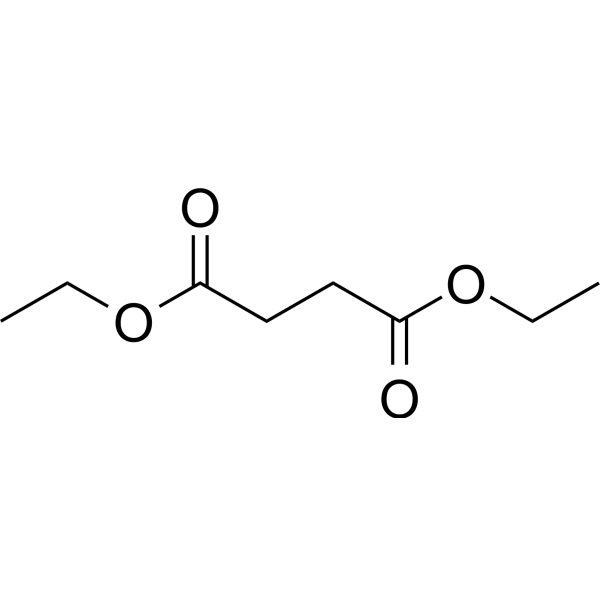
Physicochemical Properties
| Molecular Formula | C8H14O4 |
| Molecular Weight | 174.1944 |
| Exact Mass | 174.089 |
| CAS # | 123-25-1 |
| Related CAS # | Diethyl succinate-13C4;1628796-56-4;Diethyl succinate-d4;52089-62-0 |
| PubChem CID | 31249 |
| Appearance | Colorless to light yellow liquid |
| Density | 1.0±0.1 g/cm3 |
| Boiling Point | 218.4±8.0 °C at 760 mmHg |
| Melting Point | -20 °C |
| Flash Point | 90.6±0.0 °C |
| Vapour Pressure | 0.1±0.4 mmHg at 25°C |
| Index of Refraction | 1.423 |
| LogP | 1.26 |
| Hydrogen Bond Donor Count | 0 |
| Hydrogen Bond Acceptor Count | 4 |
| Rotatable Bond Count | 7 |
| Heavy Atom Count | 12 |
| Complexity | 135 |
| Defined Atom Stereocenter Count | 0 |
| SMILES | O(C([H])([H])C([H])([H])[H])C(C([H])([H])C([H])([H])C(=O)OC([H])([H])C([H])([H])[H])=O |
| InChi Key | DKMROQRQHGEIOW-UHFFFAOYSA-N |
| InChi Code | InChI=1S/C8H14O4/c1-3-11-7(9)5-6-8(10)12-4-2/h3-6H2,1-2H3 |
| Chemical Name | diethyl butanedioate |
| HS Tariff Code | 2934.99.9001 |
| Storage |
Powder-20°C 3 years 4°C 2 years In solvent -80°C 6 months -20°C 1 month |
| Shipping Condition | Room temperature (This product is stable at ambient temperature for a few days during ordinary shipping and time spent in Customs) |
Biological Activity
| Targets | The compound Diethyl succinate (specifically, hyperpolarized diethyl 1-¹³C 2,3-d₂ succinate) acts as a metabolic substrate for the Tricarboxylic Acid (TCA) cycle. After cellular uptake and hydrolysis by esterases, it is metabolized by TCA cycle enzymes, including succinate dehydrogenase. [1] |
| ln Vivo |
After intravenous (i.v.) or intraperitoneal (i.p.) injection of hyperpolarized diethyl succinate (10-20 μmol) into normal mice, downstream TCA cycle metabolites (malate, succinate, fumarate, aspartate) were detected in vivo within seconds using ¹³C magnetic resonance spectroscopy (MRS), demonstrating its metabolism in real-time. [1] The metabolic profile of hyperpolarized diethyl succinate was altered following pre-treatment of mice with 3-nitropropionate (an irreversible inhibitor of succinate dehydrogenase), evidenced by a significant reduction in the downstream succinate resonance in ¹³C MRS. [1] ¹³C magnetic resonance imaging (MRI) using a True FISP sequence showed that after i.v. injection, the hyperpolarized compound and its metabolites were initially localized in the cardiovascular region (heart) and later accumulated in the bladder/ureters. After i.p. injection, the signal remained primarily within the peritoneal cavity. [1] |
| Animal Protocol |
Hyperpolarized diethyl succinate was generated via parahydrogen-induced polarization (PHIP) of diethyl 1-¹³C 2,3-d₂ fumarate in an aqueous catalyst solution (20 mM final concentration in 9:1 H₂O:D₂O, pH ~6 after hydrogenation). [1] For in vivo studies, male BALB/c mice were anesthetized. A 0.5 mL aliquot of the hyperpolarized solution (containing 10 μmol of compound for i.v. or 20 μmol for i.p.) was injected via tail vein catheter or directly into the peritoneal cavity. [1] ¹³C MRS data were acquired starting immediately after injection, using a single 30° pulse every 5-9 seconds for about 1 minute. ¹³C MRI was performed using a True FISP sequence (flip angles of 40°, 60°, or 80°) with images acquired every 9 seconds. [1] For inhibition studies, mice were pre-treated with an i.p. injection of 200 μL of a 5 mg/mL (42 mM) 3-nitropropionate solution (pH 8.5) and imaged 20 minutes later. [1] |
| ADME/Pharmacokinetics |
After injection, hyperpolarized diethyl succinate is believed to enter cells, where its ester groups are hydrolyzed by intracellular esterases to form succinate, which then enters the TCA cycle for metabolism. [1] The in vivo spin-lattice relaxation time (T₁) of the hyperpolarized ¹³C label in the carbonyl group of diethyl succinate was measured to be 38 ± 4 seconds (in a 9:1 H₂O:D₂O solvent system), allowing signal detection for over 3 minutes. [1] Real-time ¹³C MRS showed metabolic products appearing within 5 seconds of injection and persisting for approximately 1 minute. [1] |
| Toxicity/Toxicokinetics |
Diethyl succinate is described in the literature as being non-toxic and is often used in fragrances and flavorings. [1] In the described experiments, the hydrogenation catalyst (a rhodium complex) was co-injected with the hyperpolarized compound (2.75-5.5 μmol per injection). The animals tolerated multiple injections without reported acute adverse effects in this study. [1] The authors note that for potential clinical translation, methods to remove the catalyst prior to injection would need to be developed. [1] |
| References |
[1]. Real-time molecular imaging of tricarboxylic acid cycle metabolism in vivo by hyperpolarized 1-(13)C diethyl succinate. J Am Chem Soc. 2012 Jan 18;134(2):934-43. |
| Additional Infomation |
Diethyl succinate is a fatty acid ester. Diethyl succinate has been reported in Opuntia ficus-indica, Couroupita guianensis, and other organisms with data available. Diethyl butanedioate is a metabolite found in or produced by Saccharomyces cerevisiae. See also: Butanedioic acid, di-C8-26-alkyl esters (annotation moved to). Diethyl succinate is a neutral molecule suitable for hyperpolarization at near-physiological pH (pH ~6 in final injectate), unlike succinic acid which requires extreme pH for optimal polarization. [1] The PHIP hyperpolarization process for diethyl succinate is rapid (~4 seconds for polarization transfer, with an injectable sample generated every 3-4 minutes), significantly faster than Dynamic Nuclear Polarization (DNP) methods which can take 90 minutes or more. [1] Compared to hyperpolarized 1-¹³C pyruvate (which visualizes single-step metabolism), hyperpolarized diethyl succinate allows real-time imaging of multiple steps within the TCA cycle. [1] The compound has potential as a diagnostic imaging agent for real-time assessment of TCA cycle metabolism in diseases such as cancer and neurodegenerative disorders. [1] |
Solubility Data
| Solubility (In Vitro) | DMSO : ≥ 250 mg/mL (~1435.21 mM) |
| Solubility (In Vivo) |
Solubility in Formulation 1: ≥ 2.08 mg/mL (11.94 mM) (saturation unknown) in 10% DMSO + 90% (20% SBE-β-CD in Saline) (add these co-solvents sequentially from left to right, and one by one), clear solution. For example, if 1 mL of working solution is to be prepared, you can add 100 μL of 20.8 mg/mL clear DMSO stock solution to 900 μL of 20% SBE-β-CD physiological saline solution and mix evenly. Preparation of 20% SBE-β-CD in Saline (4°C,1 week): Dissolve 2 g SBE-β-CD in 10 mL saline to obtain a clear solution. (Please use freshly prepared in vivo formulations for optimal results.) |
| Preparing Stock Solutions | 1 mg | 5 mg | 10 mg | |
| 1 mM | 5.7409 mL | 28.7043 mL | 57.4086 mL | |
| 5 mM | 1.1482 mL | 5.7409 mL | 11.4817 mL | |
| 10 mM | 0.5741 mL | 2.8704 mL | 5.7409 mL |