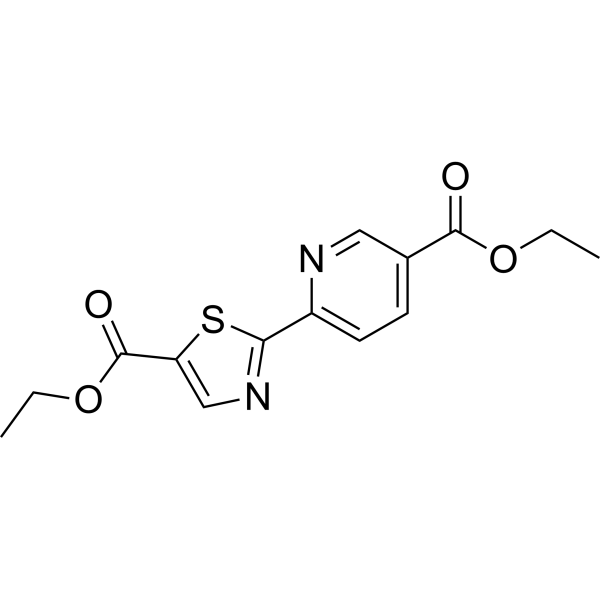
Physicochemical Properties
| Molecular Formula | C14H14N2O4S |
| Molecular Weight | 306.336962223053 |
| Exact Mass | 306.067 |
| CAS # | 1821370-70-0 |
| PubChem CID | 122554535 |
| Appearance | Off-white to light yellow solid powder |
| LogP | 2.4 |
| Hydrogen Bond Donor Count | 0 |
| Hydrogen Bond Acceptor Count | 7 |
| Rotatable Bond Count | 7 |
| Heavy Atom Count | 21 |
| Complexity | 380 |
| Defined Atom Stereocenter Count | 0 |
| SMILES | S1C(C(=O)OCC)=CN=C1C1C=CC(C(=O)OCC)=CN=1 |
| InChi Key | NSMODRMOSSBWGQ-UHFFFAOYSA-N |
| InChi Code | InChI=1S/C14H14N2O4S/c1-3-19-13(17)9-5-6-10(15-7-9)12-16-8-11(21-12)14(18)20-4-2/h5-8H,3-4H2,1-2H3 |
| Chemical Name | ethyl 2-(5-ethoxycarbonylpyridin-2-yl)-1,3-thiazole-5-carboxylate |
| Synonyms | Diethyl pythiDC; Diethyl-pythiDC |
| HS Tariff Code | 2934.99.9001 |
| Storage |
Powder-20°C 3 years 4°C 2 years In solvent -80°C 6 months -20°C 1 month |
| Shipping Condition | Room temperature (This product is stable at ambient temperature for a few days during ordinary shipping and time spent in Customs) |
Biological Activity
| ln Vitro | When hyl-pythiDC is added to food, it inhibits CP4H activity in cells at a level that keeps iron deficiency from occurring. Bis-heteroaryldiamino simulated salt was applied to MDA-MB-231 cells, and the effects on cell culture toxicity and iron deficiency markers were assessed. At high micromolar concentrations, none of the esterified diheteroaryldiamino compounds demonstrated lethal action. Strong iron deficiency phenotypes were seen in those receiving EDHB treatment. At doses up to 500 μM, cells treated with Dieth-pythiDC (hyl pythiDC added to the diet) seem normal. Dieth-pythiDC treatment and low dieth-pymDC levels had no effect on TfR, HIF-1α, or ferritin levels [1]. |
| References |
[1]. Selective Inhibition of Collagen Prolyl 4-Hydroxylase in Human Cells. ACS Chem Biol. 2016 Jan 15;11(1):193-9. |
Solubility Data
| Solubility (In Vitro) | DMSO : ~33.33 mg/mL (~108.80 mM) |
| Solubility (In Vivo) |
Solubility in Formulation 1: 2.5 mg/mL (8.16 mM) in 10% DMSO + 40% PEG300 + 5% Tween80 + 45% Saline (add these co-solvents sequentially from left to right, and one by one), suspension solution; with sonication. For example, if 1 mL of working solution is to be prepared, you can add 100 μL of 25.0 mg/mL clear DMSO stock solution to 400 μL PEG300 and mix evenly; then add 50 μL Tween-80 to the above solution and mix evenly; then add 450 μL normal saline to adjust the volume to 1 mL. Preparation of saline: Dissolve 0.9 g of sodium chloride in 100 mL ddH₂ O to obtain a clear solution. Solubility in Formulation 2: ≥ 2.5 mg/mL (8.16 mM) (saturation unknown) in 10% DMSO + 90% Corn Oil (add these co-solvents sequentially from left to right, and one by one), clear solution. For example, if 1 mL of working solution is to be prepared, you can add 100 μL of 25.0 mg/mL clear DMSO stock solution to 900 μL of corn oil and mix evenly. Solubility in Formulation 3: 33.33 mg/mL (108.80 mM) in Corn Oil (add these co-solvents sequentially from left to right, and one by one), clear solution; with ultrasonication. (Please use freshly prepared in vivo formulations for optimal results.) |
| Preparing Stock Solutions | 1 mg | 5 mg | 10 mg | |
| 1 mM | 3.2643 mL | 16.3217 mL | 32.6435 mL | |
| 5 mM | 0.6529 mL | 3.2643 mL | 6.5287 mL | |
| 10 mM | 0.3264 mL | 1.6322 mL | 3.2643 mL |