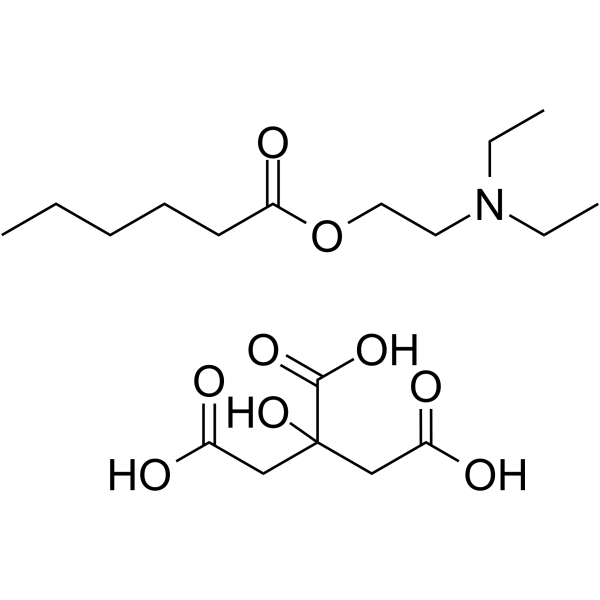
Physicochemical Properties
| Molecular Formula | C12H25NO2.C6H8O7 |
| Molecular Weight | 407.45592 |
| Exact Mass | 407.216 |
| CAS # | 220439-24-7 |
| PubChem CID | 71440642 |
| Appearance | White to off-white solid powder |
| LogP | 1.203 |
| Hydrogen Bond Donor Count | 4 |
| Hydrogen Bond Acceptor Count | 10 |
| Rotatable Bond Count | 15 |
| Heavy Atom Count | 28 |
| Complexity | 383 |
| Defined Atom Stereocenter Count | 0 |
| SMILES | CCCCCC(OCCN(CC)CC)=O.OC(CC(C(O)=O)(O)CC(O)=O)=O |
| InChi Key | WSEXJHALMDNMRG-UHFFFAOYSA-N |
| InChi Code | InChI=1S/C12H25NO2.C6H8O7/c1-4-7-8-9-12(14)15-11-10-13(5-2)6-3;7-3(8)1-6(13,5(11)12)2-4(9)10/h4-11H2,1-3H3;13H,1-2H2,(H,7,8)(H,9,10)(H,11,12) |
| Chemical Name | 2-(diethylamino)ethyl hexanoate;2-hydroxypropane-1,2,3-tricarboxylic acid |
| HS Tariff Code | 2934.99.9001 |
| Storage |
Powder-20°C 3 years 4°C 2 years In solvent -80°C 6 months -20°C 1 month Note: Please store this product in a sealed and protected environment (e.g. under nitrogen), avoid exposure to moisture and light. |
| Shipping Condition | Room temperature (This product is stable at ambient temperature for a few days during ordinary shipping and time spent in Customs) |
Biological Activity
| ln Vitro | As a plant growth regulator, diethylaminoethyl caprocitrate is used to promote adventitious buds' regeneration [1]. Cadmium is efficiently extracted with EDTA and diethyl aminoethylhexanoate (DA-6, 1 μM). Metal toxicity is decreased by diethyl aminoethylhexanoate because it fixes more cadmium in the cell wall and decreases cadmium mobility in the buds. In addition, the negative effects of EDTA on plant growth can be mitigated by combining aminoethylhexanoic acid/gibberellic acid 3 with EDTA [2]. |
| References |
[1]. Chen XL, et al. An uncommon plant growth regulator, diethyl aminoethyl hexanoate, is highly effective in tissue cultures of the important medicinal plant purple coneflower (Echinacea purpurea L.). Biomed Res Int. 2013;2013:540316. [2]. He S, et al. Synergetic effects of DA-6/GA₃ with EDTA on plant growth, extraction and detoxification of Cd by Lolium perenne. Chemosphere. 2014 Dec;117:132-8. |
Solubility Data
| Solubility (In Vitro) | DMSO : ~100 mg/mL (~245.42 mM) |
| Solubility (In Vivo) |
Solubility in Formulation 1: ≥ 5 mg/mL (12.27 mM) (saturation unknown) in 10% DMSO + 40% PEG300 + 5% Tween80 + 45% Saline (add these co-solvents sequentially from left to right, and one by one), clear solution. For example, if 1 mL of working solution is to be prepared, you can add 100 μL of 50.0 mg/mL clear DMSO stock solution to 400 μL PEG300 and mix evenly; then add 50 μL Tween-80 to the above solution and mix evenly; then add 450 μL normal saline to adjust the volume to 1 mL. Preparation of saline: Dissolve 0.9 g of sodium chloride in 100 mL ddH₂ O to obtain a clear solution. Solubility in Formulation 2: ≥ 5 mg/mL (12.27 mM) (saturation unknown) in 10% DMSO + 90% (20% SBE-β-CD in Saline) (add these co-solvents sequentially from left to right, and one by one), clear solution. For example, if 1 mL of working solution is to be prepared, you can add 100 μL of 50.0 mg/mL clear DMSO stock solution to 900 μL of 20% SBE-β-CD physiological saline solution and mix evenly. Preparation of 20% SBE-β-CD in Saline (4°C,1 week): Dissolve 2 g SBE-β-CD in 10 mL saline to obtain a clear solution. Solubility in Formulation 3: ≥ 5 mg/mL (12.27 mM) (saturation unknown) in 10% DMSO + 90% Corn Oil (add these co-solvents sequentially from left to right, and one by one), clear solution. For example, if 1 mL of working solution is to be prepared, you can add 100 μL of 50.0 mg/mL clear DMSO stock solution to 900 μL of corn oil and mix evenly. (Please use freshly prepared in vivo formulations for optimal results.) |
| Preparing Stock Solutions | 1 mg | 5 mg | 10 mg | |
| 1 mM | 2.4542 mL | 12.2711 mL | 24.5423 mL | |
| 5 mM | 0.4908 mL | 2.4542 mL | 4.9085 mL | |
| 10 mM | 0.2454 mL | 1.2271 mL | 2.4542 mL |