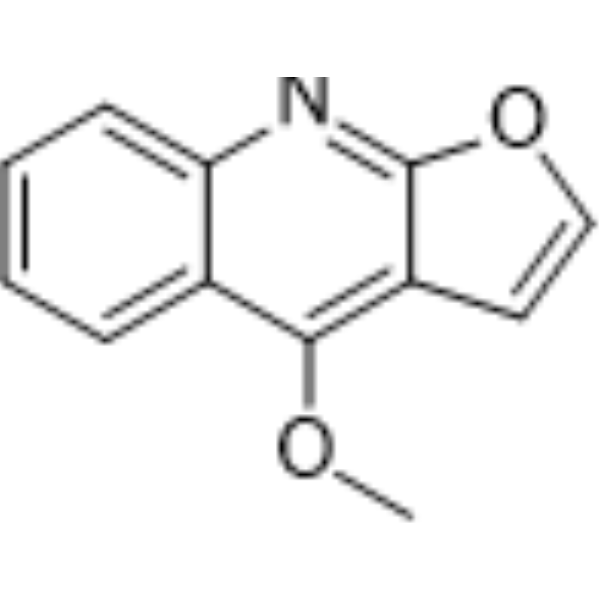
Physicochemical Properties
| Molecular Formula | C12H9NO2 |
| Molecular Weight | 199.2 |
| Exact Mass | 199.063 |
| CAS # | 484-29-7 |
| PubChem CID | 68085 |
| Appearance | White to yellow solid powder |
| Density | 1.3±0.1 g/cm3 |
| Boiling Point | 343.2±22.0 °C at 760 mmHg |
| Melting Point | 133.5ºC |
| Flash Point | 161.4±22.3 °C |
| Vapour Pressure | 0.0±0.7 mmHg at 25°C |
| Index of Refraction | 1.672 |
| LogP | 2.94 |
| Hydrogen Bond Donor Count | 0 |
| Hydrogen Bond Acceptor Count | 3 |
| Rotatable Bond Count | 1 |
| Heavy Atom Count | 15 |
| Complexity | 234 |
| Defined Atom Stereocenter Count | 0 |
| InChi Key | WIONIXOBNMDJFJ-UHFFFAOYSA-N |
| InChi Code | InChI=1S/C12H9NO2/c1-14-11-8-4-2-3-5-10(8)13-12-9(11)6-7-15-12/h2-7H,1H3 |
| Chemical Name | 4-methoxyfuro[2,3-b]quinoline |
| HS Tariff Code | 2934.99.9001 |
| Storage |
Powder-20°C 3 years 4°C 2 years In solvent -80°C 6 months -20°C 1 month |
| Shipping Condition | Room temperature (This product is stable at ambient temperature for a few days during ordinary shipping and time spent in Customs) |
Biological Activity
| ln Vitro | Peanut beer is susceptible to the bactericidal effects of dictamine (MIC: 64 μg/mL)[1]. In the HaCaT inflammation model, dictamine (2 μg/mL, 24 hours) can lower ROS and mitochondrial ROS as well as the production of TNF-α and IL-1β. Dictamine (0-100 μM, 12 hours) can induce cell lysis, migration, and temporary expansion of HCT116 cells, as well as HIF-1α and Slug mRNA cell proliferation [3]. |
| ln Vivo | In the oxazolone-induced atopic dermatitis model, becamide (2 μg/mL, 200 μL, once day for 14 days) attenuates skin edema and the epidermis [2]. In the HCT116 xenograft model, becamide (50 and 100 mg/kg, lateral, three times weekly) suppresses tumor development [3]. When administered topically, becamide (1 and 5 mg/kg, 200 μL) can enhance 2,4-dinitrophenol |
| Cell Assay |
Western Blot Analysis[3] Cell Types: HCT116 Cell Tested Concentrations: 0-100 μM Incubation Duration: 12 hrs (hours) Experimental Results: Inhibition of HIF-1α (synthesis but not degradation) and Slug protein accumulation under hypoxic conditions. |
| Animal Protocol |
Animal/Disease Models: HCT116 xenograft tumor model [3] Doses: 50 and 100 mg/kg Route of Administration: po, 3 times a week. Experimental Results: Inhibit tumor growth. Reduce HIF-1α and Slug protein levels in tumor tissues. |
| Toxicity/Toxicokinetics |
Toxicity Summary Dictamnine has been shown to be phototoxic to human cell lines (namely Jurkat T cells and HaCaT keratinocytes). Although it is less phototoxic than the structurally related furocoumarins 5-methoxypsoralen and 8-methoxypsoralen, "it may play a major role in the elicitation of phytophotodermatitis because of its abundance in plants of the Rutaceae family." (A15434) |
| References |
[1]. Global gene expression profile of Saccharomyces cerevisiae induced by dictamnine. Yeast. 2008 Sep;25(9):631-41. [2]. Dihydroartemisinine enhances dictamnine-induced apoptosis via a caspase dependent pathway in human lung adenocarcinoma A549 cells. Asian Pac J Cancer Prev. 2013;14(10):5895-900. [3]. Dictamnine delivered by PLGA nanocarriers ameliorated inflammation in an oxazolone-induced dermatitis mouse model. J Control Release. 2021 Jan 10;329:731-742. [4]. Dictamnine promotes apoptosis and inhibits epithelial-mesenchymal transition, migration, invasion and proliferation by downregulating the HIF-1α and Slug signaling pathways. Chem Biol Interact. 2018 Dec 25;296:134-144. [5]. Dictamnine ameliorates chronic itch in DNFB-induced atopic dermatitis mice via inhibiting MrgprA3. Biochem Pharmacol. 2023 Feb;208:115368. |
| Additional Infomation |
Dictamnine is an oxacycle, an organonitrogen heterocyclic compound, an organic heterotricyclic compound and an alkaloid antibiotic. Dictamnine has been reported in Melicope triphylla, Zanthoxylum simulans, and other organisms with data available. A furoquinoline alkaloid, dictamnine, is very common within the family Rutaceae. It is the main alkaloid in the roots of Dictamnus albus and responsible for the mutagenicity of the drug derived from crude extracts. Dictamnine was also reported to be a phototoxic and photomutagenic compound. It participates in the severe skin phototoxicity of the plant. |
Solubility Data
| Solubility (In Vitro) | DMSO : ~50 mg/mL (~250.99 mM) |
| Solubility (In Vivo) |
Solubility in Formulation 1: ≥ 2.5 mg/mL (12.55 mM) (saturation unknown) in 10% DMSO + 40% PEG300 + 5% Tween80 + 45% Saline (add these co-solvents sequentially from left to right, and one by one), clear solution. For example, if 1 mL of working solution is to be prepared, you can add 100 μL of 25.0 mg/mL clear DMSO stock solution to 400 μL PEG300 and mix evenly; then add 50 μL Tween-80 to the above solution and mix evenly; then add 450 μL normal saline to adjust the volume to 1 mL. Preparation of saline: Dissolve 0.9 g of sodium chloride in 100 mL ddH₂ O to obtain a clear solution. Solubility in Formulation 2: ≥ 2.5 mg/mL (12.55 mM) (saturation unknown) in 10% DMSO + 90% (20% SBE-β-CD in Saline) (add these co-solvents sequentially from left to right, and one by one), clear solution. For example, if 1 mL of working solution is to be prepared, you can add 100 μL of 25.0 mg/mL clear DMSO stock solution to 900 μL of 20% SBE-β-CD physiological saline solution and mix evenly. Preparation of 20% SBE-β-CD in Saline (4°C,1 week): Dissolve 2 g SBE-β-CD in 10 mL saline to obtain a clear solution. Solubility in Formulation 3: ≥ 2.5 mg/mL (12.55 mM) (saturation unknown) in 10% DMSO + 90% Corn Oil (add these co-solvents sequentially from left to right, and one by one), clear solution. For example, if 1 mL of working solution is to be prepared, you can add 100 μL of 25.0 mg/mL clear DMSO stock solution to 900 μL of corn oil and mix evenly. (Please use freshly prepared in vivo formulations for optimal results.) |
| Preparing Stock Solutions | 1 mg | 5 mg | 10 mg | |
| 1 mM | 5.0201 mL | 25.1004 mL | 50.2008 mL | |
| 5 mM | 1.0040 mL | 5.0201 mL | 10.0402 mL | |
| 10 mM | 0.5020 mL | 2.5100 mL | 5.0201 mL |