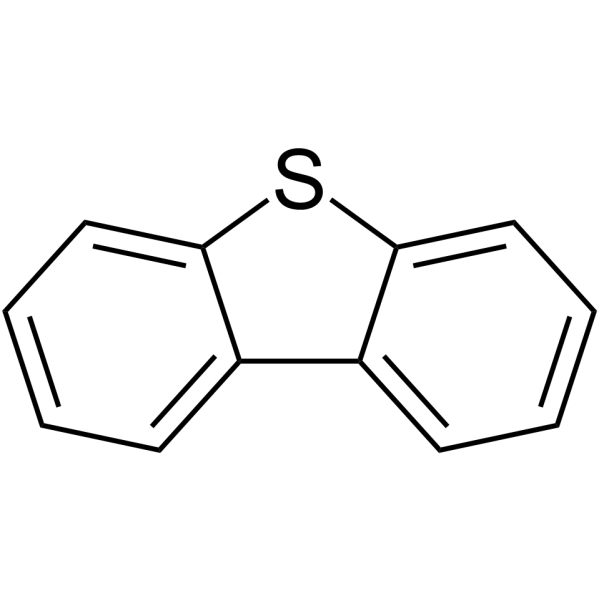
Physicochemical Properties
| Molecular Formula | C12H8S |
| Molecular Weight | 184.2569 |
| Exact Mass | 184.034 |
| CAS # | 132-65-0 |
| Related CAS # | Dibenzothiophene-d8;33262-29-2 |
| PubChem CID | 3023 |
| Appearance | Colorless crystals |
| Density | 1.3±0.1 g/cm3 |
| Boiling Point | 332-333 ºC |
| Melting Point | 97-100 °C(lit.) |
| Flash Point | 170 ºC |
| Vapour Pressure | 0.0±0.7 mmHg at 25°C |
| Index of Refraction | 1.756 |
| LogP | 4.38 |
| Hydrogen Bond Donor Count | 0 |
| Hydrogen Bond Acceptor Count | 1 |
| Rotatable Bond Count | 0 |
| Heavy Atom Count | 13 |
| Complexity | 170 |
| Defined Atom Stereocenter Count | 0 |
| SMILES | S1C2=C([H])C([H])=C([H])C([H])=C2C2=C([H])C([H])=C([H])C([H])=C12 |
| InChi Key | IYYZUPMFVPLQIF-UHFFFAOYSA-N |
| InChi Code | InChI=1S/C12H8S/c1-3-7-11-9(5-1)10-6-2-4-8-12(10)13-11/h1-8H |
| Chemical Name | dibenzothiophene |
| HS Tariff Code | 2934.99.9001 |
| Storage |
Powder-20°C 3 years 4°C 2 years In solvent -80°C 6 months -20°C 1 month Note: This product requires protection from light (avoid light exposure) during transportation and storage. |
| Shipping Condition | Room temperature (This product is stable at ambient temperature for a few days during ordinary shipping and time spent in Customs) |
Biological Activity
| ADME/Pharmacokinetics |
Absorption, Distribution and Excretion Large rainbow trout (400 g) were exposed to food pellets spiked with four polycyclic aromatic compounds (PACs). Muscle, liver, internal organs, fatty tissue, and blood were analyzed after 5, 10, 15, and 19 weeks for PAC, lipid, and moisture content. At all collection times, concentrations expressed on a per gram basis were higher in fatty tissue and internal organs, followed by liver and muscle, and lowest levels were observed in blood. When examining the tissue burden, the highest bioaccumulations of carbazole, dibenzofuran, dibenzothiophene, and fluorene were in muscle and internal organs, intermediate in fatty tissue, and lowest in blood and liver. Carbazole with the lowest log K(OW) showed the lowest concentration within any tissue. Levels in tissues were significantly correlated to log K(OW) (> 5% level of significance), especially with longer exposure, and were more highly correlated when examining muscle, fatty tissue, and internal organs (> 0.05%). Different tissues displayed different time trends, and ratios between organs help determine the length of exposure. The most striking change in levels observed with time was in internal organs relative to other tissues, particularly when compared to daily exposure. The elimination of contaminants in feces and gallbladder bile was also compared, because they represent additional tools to assess recent exposure. Metabolism / Metabolites Beijerinckia B8/36 when grown with succinate in the presence of dibenzothiophene, accumulated (+)-cis-1,2-dihydroxy-1,2-dihydrodibenzothiophene and dibenzothiophene-5-oxide in the culture medium. Each metabolite was isolated in crystalline form and characterized by a variety of chemical techniques, cis-Naphthalene dihydrodiol dehydrogenase, isolated from Pseudomonas putida, oxidized (+)-cis-1,2-dihydroxy-1,2-dihydrodibenzothiophene to a compound that was tentatively identified as 1,2-dihydroxydibenzothiophene. ... The microbial transformation of dibenzothiophene (DBT) is of interest in the potential desulfurization of oil. /The authors/ isolated three soil Pseudomonas species which oxidized DBT to characteristic water-soluble, sulfur-containing products. Two of /the/ isolates harbored a 55-megadalton plasmid; growth in the presence of novobiocin resulted in both loss of the plasmid and loss of the ability to oxidize DBT. Reintroduction of the plasmid restored the ability to oxidize DBT to water-soluble products. The products resulting from the oxidation of DBT were characterized and included 3-hydroxy-2-formyl benzothiophene, 3-oxo-[3'-hydroxy-thionaphthenyl-(2)-methylene]-dihydrothionaph thene, and the hemiacetal and trans forms of 4-[2-(3-hydroxy)-thianaphthenyl]-2-oxo-3-butenoic acid. The products of DBT oxidation were inhibitory to cell growth and further DBT oxidation. DBT oxidation in our soil isolates was induced by naphthalene or salicylate and to a much lesser extent by DBT and was repressed by succinate. Various microorganisms were screened for their ability to desulfurize dibenzothiophene (DBT) via a sulfur-specific pathway. Based on the desulfurization activity, strain G3 was selected as the best strain. From taxonomical studies, the strain was shown to belong to the genus Mycobacterium. Dibenzothiophene was degraded by both growing and resting cells of this strain, and 2-hydroxybiphenyl was detected as a dead-end product. Strain G3 could also desulfurize 4,6-dimethylDBT. Sulfate ion repressed the expression of the DBT desulfurizing enzyme(s). Accumulation of 2-hydroxybiphenyl produced severe inhibitory effects on both cell growth and DBT desulfurization. Resting cells of this strain could desulfurize about 250 ppm of DBT or 4,6-dimethylDBT within 12 hr. The microbial degradation of organic sulfur compounds was studied in the anaerobic conditions using Desulfovibrio desulfuricans M6, a sulfate-reducing bacterium isolated from soil. Biphenyl was the major dibenzothiophene degradation product. The metabolic pathway of the PAH fluorene and the cometabolic pathway of the PAHs phenanthrene, fluoranthene, anthracene and dibenzothiophene in Sphingomonas sp. LB126 were examined. ...For dibenzothiophene the metabolites dibenzothiophene-5-oxide and dibenzothiophene-5,5-dioxide were identified; these compounds appeared to be the products of a dead-end pathway. Since apart from dibenzothiophene no metabolites were found in very high concentrations for any of the other substrates, complete degradation is suggested, even for the cometabolic degradation of phenanthrene, fluoranthene and anthracene. |
| Toxicity/Toxicokinetics |
Interactions Heterocyclic derivatives of polycyclic aromatic hydrocarbons (PAHs) are often significant components of environmental contaminant mixtures; however, their contribution to the toxicity of these mixtures is not well characterized. These heterocycles commonly co-occur in PAH mixtures, which contain agonists for the aryl hydrocarbon receptor (AHR). /The/ goal for these studies was to explore the effects of two PAH heterocycles, carbazole (CB) and dibenzothiophene (DBT), alone and in combination with a PAH-type agonist for the AHR (beta-naphthoflavone [BNF]) on AHR-mediated cytochrome P4501A (CYP1A) activity and on fish embryotoxicity. Embryos of Fundulus heteroclitus were exposed to CB or DBT, with and without coexposure to BNE Carbazole alone slightly induced, whereas DBT alone slightly reduced, in ovo CYP1A-mediated ethoxyresorufin-O-deethylase (EROD) activity compared to control values. However, exposure to CB or DBT reduced in ovo EROD activity in embryos coexposed to BNE Carbazole and DBT were characterized in vitro as noncompetitive CYP1A inhibitors. Carbazole and DBT enhanced the embryotoxicity of BNF, although neither compound was embryotoxic by itself. The co-occurrence of CB and DBT with PAH-type AHR inducers in contaminated ecosystems may increase the toxicity of PAH-type AHR agonists in these settings and may need to be considered when estimating the embryotoxicity of PAH mixtures. Non-Human Toxicity Values LD50 Mouse oral 470 mg/kg /from table/ |
| Additional Infomation |
Dibenzothiophene is a mancude organic heterotricyclic parent that consists of a thiophene ring flanked by two benzene rings ortho-fused across the 2,3- and 4,5-positions. It has a role as a keratolytic drug. It is a member of dibenzothiophenes and a mancude organic heterotricyclic parent. Dibenzothiophene has been reported in Rosa with data available. Dibenzothiophene is a sulfur-containing polycyclic aromatic hydrocarbon (PAH) derivate consisting of 3 fused rings with keratolytic activity. Dibenzothiophene is a component of petroleum oils. |
Solubility Data
| Solubility (In Vitro) | DMSO : ~75 mg/mL (~407.03 mM) |
| Solubility (In Vivo) |
Solubility in Formulation 1: 3.75 mg/mL (20.35 mM) in 10% DMSO + 40% PEG300 + 5% Tween80 + 45% Saline (add these co-solvents sequentially from left to right, and one by one), suspension solution; with sonication. For example, if 1 mL of working solution is to be prepared, you can add 100 μL of 37.5 mg/mL clear DMSO stock solution to 400 μL PEG300 and mix evenly; then add 50 μL Tween-80 to the above solution and mix evenly; then add 450 μL normal saline to adjust the volume to 1 mL. Preparation of saline: Dissolve 0.9 g of sodium chloride in 100 mL ddH₂ O to obtain a clear solution. Solubility in Formulation 2: 3.75 mg/mL (20.35 mM) in 10% DMSO + 90% (20% SBE-β-CD in Saline) (add these co-solvents sequentially from left to right, and one by one), suspension solution; with ultrasonication. For example, if 1 mL of working solution is to be prepared, you can add 100 μL of 37.5 mg/mL clear DMSO stock solution to 900 μL of 20% SBE-β-CD physiological saline solution and mix evenly. Preparation of 20% SBE-β-CD in Saline (4°C,1 week): Dissolve 2 g SBE-β-CD in 10 mL saline to obtain a clear solution. Solubility in Formulation 3: 3.75 mg/mL (20.35 mM) in 10% DMSO + 90% Corn Oil (add these co-solvents sequentially from left to right, and one by one), clear solution; with ultrasonication. For example, if 1 mL of working solution is to be prepared, you can add 100 μL of 37.5 mg/mL clear DMSO stock solution to 900 μL of corn oil and mix evenly. (Please use freshly prepared in vivo formulations for optimal results.) |
| Preparing Stock Solutions | 1 mg | 5 mg | 10 mg | |
| 1 mM | 5.4271 mL | 27.1356 mL | 54.2711 mL | |
| 5 mM | 1.0854 mL | 5.4271 mL | 10.8542 mL | |
| 10 mM | 0.5427 mL | 2.7136 mL | 5.4271 mL |