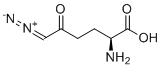
Physicochemical Properties
| Molecular Formula | C6H9N3O3 |
| Molecular Weight | 171.15 |
| Exact Mass | 171.064 |
| Elemental Analysis | C, 42.11; H, 5.30; N, 24.55; O, 28.04 |
| CAS # | 157-03-9 |
| Related CAS # | 157-03-9; |
| PubChem CID | 9087 |
| Appearance | Off-white to light yellow solid powder |
| Density | 1.3994 (rough estimate) |
| Boiling Point | 301.12°C (rough estimate) |
| Melting Point | -145ºC (dec.) |
| Index of Refraction | 1.5800 (estimate) |
| LogP | -3.5 |
| Hydrogen Bond Donor Count | 2 |
| Hydrogen Bond Acceptor Count | 5 |
| Rotatable Bond Count | 5 |
| Heavy Atom Count | 12 |
| Complexity | 232 |
| Defined Atom Stereocenter Count | 1 |
| SMILES | C(C[C@@H](C(=O)O)N)C(=O)C=[N+]=[N-] |
| InChi Key | YCWQAMGASJSUIP-YFKPBYRVSA-N |
| InChi Code | InChI=1S/C6H9N3O3/c7-5(6(11)12)2-1-4(10)3-9-8/h3,5H,1-2,7H2,(H,11,12)/t5-/m0/s1 |
| Chemical Name | (2S)-2-amino-6-diazo-5-oxohexanoic acid |
| Synonyms | Diazooxonorleucine; BRN 1725815; BRN1725815; BRN-1725815; NSC-7365; NSC7365; NSC 7365; DON |
| HS Tariff Code | 2934.99.9001 |
| Storage |
Powder-20°C 3 years 4°C 2 years In solvent -80°C 6 months -20°C 1 month Note: Please store this product in a sealed and protected environment, avoid exposure to moisture. |
| Shipping Condition | Room temperature (This product is stable at ambient temperature for a few days during ordinary shipping and time spent in Customs) |
Biological Activity
| Targets | cKGA (IC50 = 1 mM) |
| ln Vitro | Diazooxonorleucine shows a dose-dependent statistically positive increase in structural aberrations at 4 and 20 hours without S9 and at 4 hours with S9, according to the results of the in vitro chromosome aberration assay. |
| ln Vivo | Diazooxonorleucine is assessed for its in vivo clastogenic activity by looking for micronuclei in polychromatic erythrocyte (PCE) cells in bone marrow taken from male mice given intravenous doses of 500, 100, 10, 1, and 0.1 mg/kg one day and 48 hours later. Following a dose of 500, 100, and 10 mg/kg for 24 and 48 hours, the in vivo micronucleus assay shows a statistically significant response for micronucleus formation.[2] |
| Cell Assay | CHO cells are subjected to both the vehicle and nine different dose levels of the test article, which range from 0.1712 to 1712 μg/mL when an S9 reaction mixture is present or not. |
| Animal Protocol |
6-week-old male ICR mice 500 mg/kg, 100 mg/kg, 10 mg/kg, 1 mg/kg, 0.1 mg/kg IV |
| References |
[1]. Sci Rep . 2014 Jan 23:4:3827. [2]. Toxicol Mech Methods . 2017 Sep;27(7):518-527. |
| Additional Infomation |
6-diazo-5-oxo-L-norleucine is a non-proteinogenic L-alpha-amino acid that is L-norleucine which is substituted at position 5 by an oxo group and at position 6 by a diazo group. It is as inhibitor of various glutamine-utilising enzymes. It has a role as a bacterial metabolite, an analgesic, an antibacterial agent, an antiviral agent, an antineoplastic agent, an EC 6.3.5.5 [carbamoyl-phosphate synthase (glutamine-hydrolysing)] inhibitor, an EC 6.3.4.2 [CTP synthase (glutamine hydrolyzing)] inhibitor, an EC 6.3.5.3 (phosphoribosylformylglycinamidine synthase) inhibitor, an EC 6.3.5.2 [GMP synthase (glutamine-hydrolysing)] inhibitor, an antimetabolite, a glutamine antagonist, an apoptosis inducer, an EC 2.4.2.14 (amidophosphoribosyltransferase) inhibitor, an EC 3.5.1.2 (glutaminase) inhibitor, an EC 6.3.5.1 [NAD(+) synthase (glutamine-hydrolysing)] inhibitor and an EC 6.3.5.4 [asparagine synthase (glutamine-hydrolysing)] inhibitor. It is a non-proteinogenic L-alpha-amino acid, a diazo compound and a ketone. It is a tautomer of a 6-diazo-5-oxo-L-norleucine zwitterion. 6-diazo-5-oxo-L-norleucine is a broad-acting glutamine antagonist. Diazooxonorleucine is an L-glutamine diazo analogue amino acid antibiotic isolated from a species of the bacterial genus Streptomyces with potential antineoplastic activity. Diazooxonorleucine inhibits several glutamine-dependent biosynthetic pathways involved in the syntheses of D-glucosamine phosphate, purines and pyrimidines. This agent inhibits phosphate-activated glutaminase, a key enzyme for the synthesis of releasable glutamine, depleting cells of this essential amino acid and reducing their capacity to proliferate. An amino acid that inhibits phosphate-activated glutaminase and interferes with glutamine metabolism. It is an antineoplastic antibiotic produced by an unidentified species of Streptomyces from Peruvian soil. (From Merck Index, 11th ed) |
Solubility Data
| Solubility (In Vitro) | DMSO: ~34 mg/mL (~198.7 mM) |
| Solubility (In Vivo) |
Note: Listed below are some common formulations that may be used to formulate products with low water solubility (e.g. < 1 mg/mL), you may test these formulations using a minute amount of products to avoid loss of samples. Injection Formulations (e.g. IP/IV/IM/SC) Injection Formulation 1: DMSO : Tween 80: Saline = 10 : 5 : 85 (i.e. 100 μL DMSO stock solution → 50 μL Tween 80 → 850 μL Saline) *Preparation of saline: Dissolve 0.9 g of sodium chloride in 100 mL ddH ₂ O to obtain a clear solution. Injection Formulation 2: DMSO : PEG300 :Tween 80 : Saline = 10 : 40 : 5 : 45 (i.e. 100 μL DMSO → 400 μLPEG300 → 50 μL Tween 80 → 450 μL Saline) Injection Formulation 3: DMSO : Corn oil = 10 : 90 (i.e. 100 μL DMSO → 900 μL Corn oil) Example: Take the Injection Formulation 3 (DMSO : Corn oil = 10 : 90) as an example, if 1 mL of 2.5 mg/mL working solution is to be prepared, you can take 100 μL 25 mg/mL DMSO stock solution and add to 900 μL corn oil, mix well to obtain a clear or suspension solution (2.5 mg/mL, ready for use in animals). Injection Formulation 4: DMSO : 20% SBE-β-CD in saline = 10 : 90 [i.e. 100 μL DMSO → 900 μL (20% SBE-β-CD in saline)] *Preparation of 20% SBE-β-CD in Saline (4°C,1 week): Dissolve 2 g SBE-β-CD in 10 mL saline to obtain a clear solution. Injection Formulation 5: 2-Hydroxypropyl-β-cyclodextrin : Saline = 50 : 50 (i.e. 500 μL 2-Hydroxypropyl-β-cyclodextrin → 500 μL Saline) Injection Formulation 6: DMSO : PEG300 : castor oil : Saline = 5 : 10 : 20 : 65 (i.e. 50 μL DMSO → 100 μLPEG300 → 200 μL castor oil → 650 μL Saline) Injection Formulation 7: Ethanol : Cremophor : Saline = 10: 10 : 80 (i.e. 100 μL Ethanol → 100 μL Cremophor → 800 μL Saline) Injection Formulation 8: Dissolve in Cremophor/Ethanol (50 : 50), then diluted by Saline Injection Formulation 9: EtOH : Corn oil = 10 : 90 (i.e. 100 μL EtOH → 900 μL Corn oil) Injection Formulation 10: EtOH : PEG300:Tween 80 : Saline = 10 : 40 : 5 : 45 (i.e. 100 μL EtOH → 400 μLPEG300 → 50 μL Tween 80 → 450 μL Saline) Oral Formulations Oral Formulation 1: Suspend in 0.5% CMC Na (carboxymethylcellulose sodium) Oral Formulation 2: Suspend in 0.5% Carboxymethyl cellulose Example: Take the Oral Formulation 1 (Suspend in 0.5% CMC Na) as an example, if 100 mL of 2.5 mg/mL working solution is to be prepared, you can first prepare 0.5% CMC Na solution by measuring 0.5 g CMC Na and dissolve it in 100 mL ddH2O to obtain a clear solution; then add 250 mg of the product to 100 mL 0.5% CMC Na solution, to make the suspension solution (2.5 mg/mL, ready for use in animals). Oral Formulation 3: Dissolved in PEG400 Oral Formulation 4: Suspend in 0.2% Carboxymethyl cellulose Oral Formulation 5: Dissolve in 0.25% Tween 80 and 0.5% Carboxymethyl cellulose Oral Formulation 6: Mixing with food powders Note: Please be aware that the above formulations are for reference only. InvivoChem strongly recommends customers to read literature methods/protocols carefully before determining which formulation you should use for in vivo studies, as different compounds have different solubility properties and have to be formulated differently. (Please use freshly prepared in vivo formulations for optimal results.) |
| Preparing Stock Solutions | 1 mg | 5 mg | 10 mg | |
| 1 mM | 5.8428 mL | 29.2141 mL | 58.4283 mL | |
| 5 mM | 1.1686 mL | 5.8428 mL | 11.6857 mL | |
| 10 mM | 0.5843 mL | 2.9214 mL | 5.8428 mL |