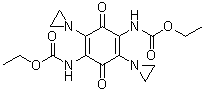
Physicochemical Properties
| Molecular Formula | C16H20N4O6 |
| Exact Mass | 364.138 |
| CAS # | 57998-68-2 |
| PubChem CID | 42616 |
| Appearance | Light yellow to brown solid powder |
| Density | 1.45g/cm3 |
| Boiling Point | 469ºC at 760mmHg |
| Flash Point | 237.4ºC |
| Index of Refraction | 1.62 |
| LogP | 0.342 |
| Hydrogen Bond Donor Count | 2 |
| Hydrogen Bond Acceptor Count | 8 |
| Rotatable Bond Count | 8 |
| Heavy Atom Count | 26 |
| Complexity | 671 |
| Defined Atom Stereocenter Count | 0 |
| SMILES | CCOC(=O)NC1=C(C(=O)C(=C(C1=O)N2CC2)NC(=O)OCC)N3CC3 |
| InChi Key | WVYXNIXAMZOZFK-UHFFFAOYSA-N |
| InChi Code | InChI=1S/C16H20N4O6/c1-3-25-15(23)17-9-11(19-5-6-19)14(22)10(18-16(24)26-4-2)12(13(9)21)20-7-8-20/h3-8H2,1-2H3,(H,17,23)(H,18,24) |
| Chemical Name | ethyl N-[2,5-bis(aziridin-1-yl)-4-(ethoxycarbonylamino)-3,6-dioxocyclohexa-1,4-dien-1-yl]carbamate |
| Synonyms | Aziridinyl Benzoquinone Aziridinylbenzoquinone carbamic acid. AZQ. CI904 aziridinylbenzoquinone |
| HS Tariff Code | 2934.99.9001 |
| Storage |
Powder-20°C 3 years 4°C 2 years In solvent -80°C 6 months -20°C 1 month |
| Shipping Condition | Room temperature (This product is stable at ambient temperature for a few days during ordinary shipping and time spent in Customs) |
Biological Activity
| ln Vivo | Diazinonide, which is consistent with 1,3-bis (2-athymic mice), chloroethyl)-1-nitrosourea, or procarbazine, has broad-spectrum diazinonoid activity against primary nervous system tumors (6.75 mg/m2 daily for 5 days or a single dose of 26 mg/m2) [1]. |
| Animal Protocol |
Animal/Disease Models: Homozygous nu/nu BALB/c athymic mice [1] Doses: 6.75mg/m2 or 26 mg/m2 Doses: 6.75mg/m2 daily for 5 days or a single dose of 26 mg/m² Experimental Results: demonstrated rapid clearance from plasma of athymic mice with a half-life of approximately 11.5 minutes. Significant growth delays were produced. Median growth delay was Dramatically increased, as was the number of tumor regressions. |
| Toxicity/Toxicokinetics |
Toxicity Data Mouse(iv): LD50 10300 ug/kg |
| References | [1]. S C Schold Jr, et al. Treatment of human glioma and medulloblastoma tumor lines in athymic mice with diaziquone and diaziquone-based drug combinations. Cancer Res. 1984 Jun;44(6):2352-7. |
| Additional Infomation |
Diaziquone is a 1,4-benzoquinone that is substituted at positions 2 and 5 have been replaced by aziridin-1-yl groups and at positions 3 and 6 by (ethoxycarbonyl)amino groups. It has a role as an antineoplastic agent and an alkylating agent. It is a carbamate ester, a member of aziridines, an enamine and a member of 1,4-benzoquinones. Diaziquone is a water-soluble, synthetic aziridinylbenzoquinone with potential antineoplastic activity. Bioactivation of aziridinylbenzoquinone RH1 occurs through the two-electron reduction of the quinone to the hydroquinone by the two-electron quinone reductase DT-diaphorase (DTD). The resultant hydroquinone selectively alkylates and cross-links DNA at the 5'-GNC-3' sequence, inihibiting DNA replication, inducing apoptosis, and inhibiting tumor cell proliferation. DTD is over-expressed in many tumors relative to normal tissue, including lung, colon, breast and liver tumors. |
Solubility Data
| Solubility (In Vivo) |
Note: Listed below are some common formulations that may be used to formulate products with low water solubility (e.g. < 1 mg/mL), you may test these formulations using a minute amount of products to avoid loss of samples. Injection Formulations (e.g. IP/IV/IM/SC) Injection Formulation 1: DMSO : Tween 80: Saline = 10 : 5 : 85 (i.e. 100 μL DMSO stock solution → 50 μL Tween 80 → 850 μL Saline) *Preparation of saline: Dissolve 0.9 g of sodium chloride in 100 mL ddH ₂ O to obtain a clear solution. Injection Formulation 2: DMSO : PEG300 :Tween 80 : Saline = 10 : 40 : 5 : 45 (i.e. 100 μL DMSO → 400 μLPEG300 → 50 μL Tween 80 → 450 μL Saline) Injection Formulation 3: DMSO : Corn oil = 10 : 90 (i.e. 100 μL DMSO → 900 μL Corn oil) Example: Take the Injection Formulation 3 (DMSO : Corn oil = 10 : 90) as an example, if 1 mL of 2.5 mg/mL working solution is to be prepared, you can take 100 μL 25 mg/mL DMSO stock solution and add to 900 μL corn oil, mix well to obtain a clear or suspension solution (2.5 mg/mL, ready for use in animals). Injection Formulation 4: DMSO : 20% SBE-β-CD in saline = 10 : 90 [i.e. 100 μL DMSO → 900 μL (20% SBE-β-CD in saline)] *Preparation of 20% SBE-β-CD in Saline (4°C,1 week): Dissolve 2 g SBE-β-CD in 10 mL saline to obtain a clear solution. Injection Formulation 5: 2-Hydroxypropyl-β-cyclodextrin : Saline = 50 : 50 (i.e. 500 μL 2-Hydroxypropyl-β-cyclodextrin → 500 μL Saline) Injection Formulation 6: DMSO : PEG300 : castor oil : Saline = 5 : 10 : 20 : 65 (i.e. 50 μL DMSO → 100 μLPEG300 → 200 μL castor oil → 650 μL Saline) Injection Formulation 7: Ethanol : Cremophor : Saline = 10: 10 : 80 (i.e. 100 μL Ethanol → 100 μL Cremophor → 800 μL Saline) Injection Formulation 8: Dissolve in Cremophor/Ethanol (50 : 50), then diluted by Saline Injection Formulation 9: EtOH : Corn oil = 10 : 90 (i.e. 100 μL EtOH → 900 μL Corn oil) Injection Formulation 10: EtOH : PEG300:Tween 80 : Saline = 10 : 40 : 5 : 45 (i.e. 100 μL EtOH → 400 μLPEG300 → 50 μL Tween 80 → 450 μL Saline) Oral Formulations Oral Formulation 1: Suspend in 0.5% CMC Na (carboxymethylcellulose sodium) Oral Formulation 2: Suspend in 0.5% Carboxymethyl cellulose Example: Take the Oral Formulation 1 (Suspend in 0.5% CMC Na) as an example, if 100 mL of 2.5 mg/mL working solution is to be prepared, you can first prepare 0.5% CMC Na solution by measuring 0.5 g CMC Na and dissolve it in 100 mL ddH2O to obtain a clear solution; then add 250 mg of the product to 100 mL 0.5% CMC Na solution, to make the suspension solution (2.5 mg/mL, ready for use in animals). Oral Formulation 3: Dissolved in PEG400 Oral Formulation 4: Suspend in 0.2% Carboxymethyl cellulose Oral Formulation 5: Dissolve in 0.25% Tween 80 and 0.5% Carboxymethyl cellulose Oral Formulation 6: Mixing with food powders Note: Please be aware that the above formulations are for reference only. InvivoChem strongly recommends customers to read literature methods/protocols carefully before determining which formulation you should use for in vivo studies, as different compounds have different solubility properties and have to be formulated differently. (Please use freshly prepared in vivo formulations for optimal results.) |