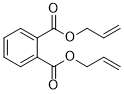
Diallyl phthalate is a novel and potent bioactive compound that inhibits algae growth
Physicochemical Properties
| Molecular Formula | C14H14O4 |
| Molecular Weight | 246.25856 |
| Exact Mass | 246.089 |
| CAS # | 131-17-9 |
| PubChem CID | 8560 |
| Appearance | Nearly colorless, oily liquid |
| Density | 1.1±0.1 g/cm3 |
| Boiling Point | 329.1±0.0 °C at 760 mmHg |
| Melting Point | -70 °C |
| Flash Point | 164.8±20.7 °C |
| Vapour Pressure | 0.0±0.7 mmHg at 25°C |
| Index of Refraction | 1.524 |
| LogP | 3.29 |
| Hydrogen Bond Donor Count | 0 |
| Hydrogen Bond Acceptor Count | 4 |
| Rotatable Bond Count | 8 |
| Heavy Atom Count | 18 |
| Complexity | 290 |
| Defined Atom Stereocenter Count | 0 |
| SMILES | C=CCOC(=O)C1=CC=CC=C1C(=O)OCC=C |
| InChi Key | QUDWYFHPNIMBFC-UHFFFAOYSA-N |
| InChi Code | InChI=1S/C14H14O4/c1-3-9-17-13(15)11-7-5-6-8-12(11)14(16)18-10-4-2/h3-8H,1-2,9-10H2 |
| Chemical Name | bis(prop-2-enyl) benzene-1,2-dicarboxylate |
| Synonyms | Diallyl phthalate NSC-7667 NSC 7667 NSC7667 |
| HS Tariff Code | 2934.99.9001 |
| Storage |
Powder-20°C 3 years 4°C 2 years In solvent -80°C 6 months -20°C 1 month |
| Shipping Condition | Room temperature (This product is stable at ambient temperature for a few days during ordinary shipping and time spent in Customs) |
Biological Activity
| ADME/Pharmacokinetics |
Absorption, Distribution and Excretion Thirty minutes after rats and mice were treated orally with (14)C-labeled diallyl phthalate (DAP), the highest levels of radioactivity were found in small intestine, liver, dermis, muscles, blood, and kidneys. After 24 hr, about 6-7% of the radioactivity was present in rats and 1-3% in mice. In rats, 60% of the radioactivity was found in urine and 30% was exhaled as CO2. In mice, 91% was present in urine, and only 8% was detected as CO2. Metabolism / Metabolites Fischer 344 rats and B6C3F1 mice were given 14(C) diallyl phthalate, 1, 10, or 100 mg/kg po or 10 mg/kg iv, and placed in metabolism cages for 24 hr. In rats, 25-30% of the diallyl phthalate was excreted as carbon dioxide, and 50-70% appeared in the urine within 24 hr. In mice, 6-12% of the diallyl phthalate was excreted as carbon dioxide, and 80-90% was excreted in the urine within 24 hr. Monoallyl phthalate (MAP), allyl alcohol, 3-hydroxypropylmercapturic acid (HPMA), and an unidentified polar metabolite (PM) were found in the urine of rats and mice dosed with diallyl phthalate. The polar metabolite was present in the urine of rats dosed with diallyl phthalate or allyl alcohol, indicating that the compound is a metabolite of allyl alcohol. There was no difference between the species in the quantity of allyl alcohol excreted, but mice excreted more monoallyl phthalate (39 vs 33%), 3-hydroxypropylmercapturic acid (28 vs 17%), and polar metabolite (20 vs 8%) than rats. The following metabolic pathway is suggested for diallyl phthalate (DAP). First, the diester is hydrolyzed to monoallyl phthalate (MAP) and allyl alcohol (AA). AA can be oxidized to acrolein and acrylic acid and further metabolized to CO2. Allyl alcohol and acrolein can also react with reduced glutathione to form 3-hydroxypropylmercapturic acid. Alternatively, allyl alcohol and acrolein can be oxidized to the epoxides glycidol and glycidaldehyde. These epoxides can be hydrolyzed to glycerin and glyceraldehyde or conjugated with reduced glutathione. It is not clear whether DAP is metabolized by this pathway in vivo. However, some of the products of the aforementioned reactions (e.g., monoallyl phthalate, 3-hydroxypropylmercapturic acid, allyl alcohol) as well as an unidentified polar metabolite have been detected in urine of rats and mice treated with DAP. ... Diallyl phthalate (DAP) is more hepatotoxic to rats than to mice, and demonstrated the same species difference in toxicity for allyl alcohol (AA). The data suggest that the toxicity of diallyl phthalate probably results from allyl alcohol cleaved from diallyl phthalate. To determine if the species difference in susceptibility to hepatotoxicity resulted from differences in the disposition and metabolism of diallyl phthalate, Fischer 344 rats and B6C3F1 mice were given 14(C) diallyl phthalate, 1, 10, or 100 mg/kg po or 10 mg/kg iv, and placed in metabolism cages for 24 hr. In rats, 25-30% of the diallyl phthalate was excreted as carbon dioxide, and 50-70% appeared in the urine within 24 hr. In mice, 6-12% of the diallyl phthalate was excreted as carbon dioxide, and 80-90% was excreted in the urine within 24 hr. Monoallyl phthalate (MAP), allyl alcohol, 3-hydroxypropylmercapturic acid (HPMA), and an unidentified polar metabolite (PM) were found in the urine of rats and mice dosed with diallyl phthalate. The polar metabolite was present in the urine of rats dosed with diallyl phthalate or allyl alcohol, indicating that the compound is a metabolite of allyl alcohol. There was no difference between the species in the quantity of allyl alcohol excreted, but mice excreted more monoallyl phthalate (39 vs 33%), 3-hydroxypropylmercapturic acid (28 vs 17%), and polar metabolite (20 vs 8%) than rats. Phthalate esters are first hydrolyzed to their monoester derivative. Once formed, the monoester derivative can be further hydrolyzed in vivo to phthalic acid or conjugated to glucuronide, both of which can then be excreted. The terminal or next-to-last carbon atom in the monoester can also be oxidized to an alcohol, which can be excreted as is or first oxidized to an aldehyde, ketone, or carboxylic acid. The monoester and oxidative metabolites are excreted in the urine and faeces. (A2884) |
| Toxicity/Toxicokinetics |
Toxicity Summary Phthalate esters are endocrine disruptors. They decrease foetal testis testosterone production and reduce the expression of steroidogenic genes by decreasing mRNA expression. Some phthalates have also been shown to reduce the expression of insulin-like peptide 3 (insl3), an important hormone secreted by the Leydig cell necessary for development of the gubernacular ligament. Animal studies have shown that these effects disrupt reproductive development and can cause a number of malformations in affected young. (A2883) Toxicity Data LC50 (rat) = 5,200 mg/m3/1h LD50: 656 mg/kg (Oral, Rat) (T13) LD50: 3.8-3.9 g/kg (Dermal, Rabbit) (T29) LD50: 700 mg/kg (Intraperitoneal, Mouse) (A724) Non-Human Toxicity Values LD50 Rat oral 656 mg/kg LD50 Rabbit oral 1.7 g/kg /From table/ LD50 Rabbit dermal 3400 mg/kg /From table/ LD50 Mouse ip 700 mg/kg For more Non-Human Toxicity Values (Complete) data for DIALLYL PHTHALATE (7 total), please visit the HSDB record page. |
| Additional Infomation |
Diallyl phthalate is a clear pale-yellow liquid. Odorless. (NTP, 1992) Diallyl phthalate is a phthalate ester. Phthalate esters are esters of phthalic acid and are mainly used as plasticizers, primarily used to soften polyvinyl chloride. They are found in a number of products, including glues, building materials, personal care products, detergents and surfactants, packaging, children's toys, paints, pharmaceuticals, food products, and textiles. Phthalates are hazardous due to their ability to act as endocrine disruptors. They are being phased out of many products in the United States and European Union due to these health concerns. (L1903) |
Solubility Data
| Solubility (In Vitro) | May dissolve in DMSO (in most cases), if not, try other solvents such as H2O, Ethanol, or DMF with a minute amount of products to avoid loss of samples |
| Solubility (In Vivo) |
Note: Listed below are some common formulations that may be used to formulate products with low water solubility (e.g. < 1 mg/mL), you may test these formulations using a minute amount of products to avoid loss of samples. Injection Formulations (e.g. IP/IV/IM/SC) Injection Formulation 1: DMSO : Tween 80: Saline = 10 : 5 : 85 (i.e. 100 μL DMSO stock solution → 50 μL Tween 80 → 850 μL Saline) *Preparation of saline: Dissolve 0.9 g of sodium chloride in 100 mL ddH ₂ O to obtain a clear solution. Injection Formulation 2: DMSO : PEG300 :Tween 80 : Saline = 10 : 40 : 5 : 45 (i.e. 100 μL DMSO → 400 μLPEG300 → 50 μL Tween 80 → 450 μL Saline) Injection Formulation 3: DMSO : Corn oil = 10 : 90 (i.e. 100 μL DMSO → 900 μL Corn oil) Example: Take the Injection Formulation 3 (DMSO : Corn oil = 10 : 90) as an example, if 1 mL of 2.5 mg/mL working solution is to be prepared, you can take 100 μL 25 mg/mL DMSO stock solution and add to 900 μL corn oil, mix well to obtain a clear or suspension solution (2.5 mg/mL, ready for use in animals). Injection Formulation 4: DMSO : 20% SBE-β-CD in saline = 10 : 90 [i.e. 100 μL DMSO → 900 μL (20% SBE-β-CD in saline)] *Preparation of 20% SBE-β-CD in Saline (4°C,1 week): Dissolve 2 g SBE-β-CD in 10 mL saline to obtain a clear solution. Injection Formulation 5: 2-Hydroxypropyl-β-cyclodextrin : Saline = 50 : 50 (i.e. 500 μL 2-Hydroxypropyl-β-cyclodextrin → 500 μL Saline) Injection Formulation 6: DMSO : PEG300 : castor oil : Saline = 5 : 10 : 20 : 65 (i.e. 50 μL DMSO → 100 μLPEG300 → 200 μL castor oil → 650 μL Saline) Injection Formulation 7: Ethanol : Cremophor : Saline = 10: 10 : 80 (i.e. 100 μL Ethanol → 100 μL Cremophor → 800 μL Saline) Injection Formulation 8: Dissolve in Cremophor/Ethanol (50 : 50), then diluted by Saline Injection Formulation 9: EtOH : Corn oil = 10 : 90 (i.e. 100 μL EtOH → 900 μL Corn oil) Injection Formulation 10: EtOH : PEG300:Tween 80 : Saline = 10 : 40 : 5 : 45 (i.e. 100 μL EtOH → 400 μLPEG300 → 50 μL Tween 80 → 450 μL Saline) Oral Formulations Oral Formulation 1: Suspend in 0.5% CMC Na (carboxymethylcellulose sodium) Oral Formulation 2: Suspend in 0.5% Carboxymethyl cellulose Example: Take the Oral Formulation 1 (Suspend in 0.5% CMC Na) as an example, if 100 mL of 2.5 mg/mL working solution is to be prepared, you can first prepare 0.5% CMC Na solution by measuring 0.5 g CMC Na and dissolve it in 100 mL ddH2O to obtain a clear solution; then add 250 mg of the product to 100 mL 0.5% CMC Na solution, to make the suspension solution (2.5 mg/mL, ready for use in animals). Oral Formulation 3: Dissolved in PEG400 Oral Formulation 4: Suspend in 0.2% Carboxymethyl cellulose Oral Formulation 5: Dissolve in 0.25% Tween 80 and 0.5% Carboxymethyl cellulose Oral Formulation 6: Mixing with food powders Note: Please be aware that the above formulations are for reference only. InvivoChem strongly recommends customers to read literature methods/protocols carefully before determining which formulation you should use for in vivo studies, as different compounds have different solubility properties and have to be formulated differently. (Please use freshly prepared in vivo formulations for optimal results.) |
| Preparing Stock Solutions | 1 mg | 5 mg | 10 mg | |
| 1 mM | 4.0607 mL | 20.3037 mL | 40.6075 mL | |
| 5 mM | 0.8121 mL | 4.0607 mL | 8.1215 mL | |
| 10 mM | 0.4061 mL | 2.0304 mL | 4.0607 mL |