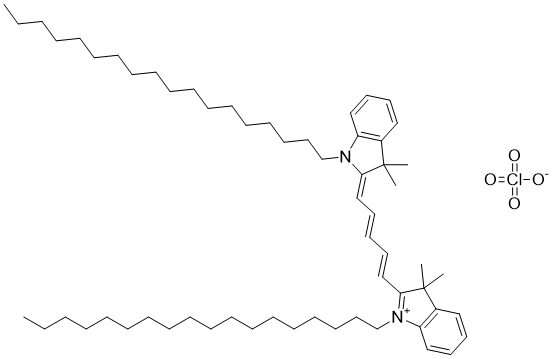
Physicochemical Properties
| Molecular Formula | C61H99N2+.O4CL- |
| Molecular Weight | 959.902760000001 |
| Exact Mass | 958.729 |
| CAS # | 127274-91-3 |
| PubChem CID | 16212738 |
| Appearance | Solid powder |
| LogP | 19.618 |
| Hydrogen Bond Donor Count | 0 |
| Hydrogen Bond Acceptor Count | 5 |
| Rotatable Bond Count | 37 |
| Heavy Atom Count | 68 |
| Complexity | 1280 |
| Defined Atom Stereocenter Count | 0 |
| SMILES | CCCCCCCCCCCCCCCCCCN\1C2=CC=CC=C2C(/C1=C\C=C\C=C\C3=[N+](C4=CC=CC=C4C3(C)C)CCCCCCCCCCCCCCCCCC)(C)C.[O-]Cl(=O)(=O)=O |
| InChi Key | ZQSBJPAQPRVNHU-UHFFFAOYSA-M |
| InChi Code | InChI=1S/C61H99N2.ClHO4/c1-7-9-11-13-15-17-19-21-23-25-27-29-31-33-35-44-52-62-56-48-42-40-46-54(56)60(3,4)58(62)50-38-37-39-51-59-61(5,6)55-47-41-43-49-57(55)63(59)53-45-36-34-32-30-28-26-24-22-20-18-16-14-12-10-8-2;2-1(3,4)5/h37-43,46-51H,7-36,44-45,52-53H2,1-6H3;(H,2,3,4,5)/q+1;/p-1 |
| Chemical Name | (2E)-2-[(2E,4E)-5-(3,3-dimethyl-1-octadecylindol-1-ium-2-yl)penta-2,4-dienylidene]-3,3-dimethyl-1-octadecylindole;perchlorate |
| Synonyms | DiD perchlorate |
| HS Tariff Code | 2934.99.9001 |
| Storage |
Powder-20°C 3 years 4°C 2 years In solvent -80°C 6 months -20°C 1 month Note: (1). This product requires protection from light (avoid light exposure) during transportation and storage.(2). Please store this product in a sealed and protected environment (e.g. under nitrogen), avoid exposure to moisture.(3). This product is not stable in solution, please use freshly prepared working solution for optimal results. |
| Shipping Condition | Room temperature (This product is stable at ambient temperature for a few days during ordinary shipping and time spent in Customs) |
Biological Activity
| ln Vitro | First general protocol. As stock solutions, use dimethylimide (DMF) and dimethylimine (DMSO or 1–5 mM ethanol DMSO). DMF ethanol is the solvent. Stock remedies has to be used right away. Aliquot any excess solution, then freeze it at -20°C. The solution can be frozen and then thawed again for up to six months. 2) Prepare the working solution: To make a 1~5 μM working solution, add the storage solution to an appropriate buffer (serum, HBSS, or PBS). We advise against keeping the tank in storage for longer than a day. Note: The working solution's ultimate concentration ought to be determined by 2. 1) Centrifuge suspension cells at 1000 g for three to five minutes at 4°C; discard supernatant. Use PBS to wash twice, for five minutes each time. 1) Add 1 mL of Di working solution and stain for 5–30 minutes. The cell density is 1×10⁶/mL. 3) Remove the supernatant after centrifuging at 400 g for three to four minutes at 4°C. 4) Use PBS to wash twice, for five minutes each time. 5) Re-suspend the cells in PBS or serum-free culture media. Utilize a flow cytometer or a fluorescence microscope to observe 3. Sterile coverslips are used to cultivate adherent cells. Second, add the spinal cord coverslip. Third, add 100 μL of working solution. Shake gently to cover all the cells. Fourth, work longitudinally for five to thirty minutes. 4) Wash for five minutes on medium two times. observation using flow cytometry or fluorescence microscopy. |
| ln Vivo | Following the injection of labeled cells, a bright DiD perchlorate (DiD) highlighted cell was discovered 15–40 μm from the intima a few days later. Consequently, the dispersion of the effects of DiD perchlorate labeling on cell division was consistent with the appearance of cell clusters with gradually decreasing staining intensity [3]. |
| References |
[1]. Multicolor "DiOlistic" labeling of the nervous system using lipophilic dye combinations. Neuron. 2000 Aug;27(2):219-25. [2]. A novel method for monitoring tumor dormancy using fluorescent dye DiD. Cytometry A. 2014 Jun; 85(6): 548–555. [3]. In Vivo Tracking of Human Adipose-derived Mesenchymal Stem Cells in a Rat Knee Osteoarthritis Model with Fluorescent Lipophilic Membrane Dye. J Vis Exp. 2017; (128): 56273. [4]. Live-animal tracking of individual haematopoietic stem/progenitor cells in their niche. |
| Additional Infomation | DilC18(5) dye is a Cy5 dye and an organic perchlorate salt. It has a role as a fluorochrome. It contains a dilC18(5)(1+). |
Solubility Data
| Solubility (In Vitro) | DMSO : ~25 mg/mL (~26.04 mM) |
| Solubility (In Vivo) |
Solubility in Formulation 1: ≥ 1.67 mg/mL (1.74 mM) (saturation unknown) in 10% DMSO + 40% PEG300 + 5% Tween80 + 45% Saline (add these co-solvents sequentially from left to right, and one by one), clear solution. For example, if 1 mL of working solution is to be prepared, you can add 100 μL of 16.7 mg/mL clear DMSO stock solution to 400 μL PEG300 and mix evenly; then add 50 μL Tween-80 to the above solution and mix evenly; then add 450 μL normal saline to adjust the volume to 1 mL. Preparation of saline: Dissolve 0.9 g of sodium chloride in 100 mL ddH₂ O to obtain a clear solution. Solubility in Formulation 2: ≥ 1.67 mg/mL (1.74 mM) (saturation unknown) in 10% DMSO + 90% (20% SBE-β-CD in Saline) (add these co-solvents sequentially from left to right, and one by one), clear solution. For example, if 1 mL of working solution is to be prepared, you can add 100 μL of 16.7 mg/mL clear DMSO stock solution to 900 μL of 20% SBE-β-CD physiological saline solution and mix evenly. Preparation of 20% SBE-β-CD in Saline (4°C,1 week): Dissolve 2 g SBE-β-CD in 10 mL saline to obtain a clear solution. Solubility in Formulation 3: ≥ 1.67 mg/mL (1.74 mM) (saturation unknown) in 10% DMSO + 90% Corn Oil (add these co-solvents sequentially from left to right, and one by one), clear solution. For example, if 1 mL of working solution is to be prepared, you can add 100 μL of 16.7 mg/mL clear DMSO stock solution to 900 μL of corn oil and mix evenly. (Please use freshly prepared in vivo formulations for optimal results.) |
| Preparing Stock Solutions | 1 mg | 5 mg | 10 mg | |
| 1 mM | 1.0418 mL | 5.2089 mL | 10.4178 mL | |
| 5 mM | 0.2084 mL | 1.0418 mL | 2.0836 mL | |
| 10 mM | 0.1042 mL | 0.5209 mL | 1.0418 mL |