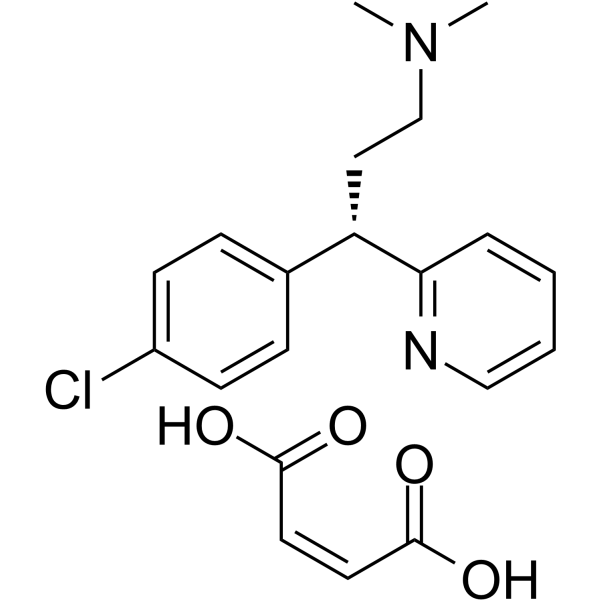
Physicochemical Properties
| Molecular Formula | C16H19N2CL.C4H4O4 |
| Molecular Weight | 390.86062 |
| Exact Mass | 390.135 |
| CAS # | 2438-32-6 |
| Related CAS # | 2438-32-6;25523-97-1; |
| PubChem CID | 5281070 |
| Appearance | White to off-white solid powder |
| Boiling Point | 379ºC at 760 mmHg |
| Melting Point | 112-115ºC(lit.) |
| Flash Point | 183ºC |
| Vapour Pressure | 6.04E-06mmHg at 25°C |
| LogP | 3.53 |
| Hydrogen Bond Donor Count | 2 |
| Hydrogen Bond Acceptor Count | 6 |
| Rotatable Bond Count | 7 |
| Heavy Atom Count | 27 |
| Complexity | 368 |
| Defined Atom Stereocenter Count | 1 |
| SMILES | CN(C)CC[C@@H](C1=CC=C(C=C1)Cl)C2=CC=CC=N2.C(=C\C(=O)O)\C(=O)O |
| InChi Key | DBAKFASWICGISY-DASCVMRKSA-N |
| InChi Code | InChI=1S/C16H19ClN2.C4H4O4/c1-19(2)12-10-15(16-5-3-4-11-18-16)13-6-8-14(17)9-7-13;5-3(6)1-2-4(7)8/h3-9,11,15H,10,12H2,1-2H3;1-2H,(H,5,6)(H,7,8)/b;2-1-/t15-;/m0./s1 |
| Chemical Name | (Z)-but-2-enedioic acid;(3S)-3-(4-chlorophenyl)-N,N-dimethyl-3-pyridin-2-ylpropan-1-amine |
| HS Tariff Code | 2934.99.9001 |
| Storage |
Powder-20°C 3 years 4°C 2 years In solvent -80°C 6 months -20°C 1 month Note: Please store this product in a sealed and protected environment, avoid exposure to moisture. |
| Shipping Condition | Room temperature (This product is stable at ambient temperature for a few days during ordinary shipping and time spent in Customs) |
Biological Activity
| ADME/Pharmacokinetics |
Absorption, Distribution and Excretion Oral bioavailability in rats 40.5% Renal excretion 321L 9.8L/h Metabolism / Metabolites Hepatic metabolism. Major metabolism by CYP 2D6 and minor metabolism by 3A4, 2C11 and 2B1. Biological Half-Life 20-30 h |
| Toxicity/Toxicokinetics |
Effects During Pregnancy and Lactation ◉ Summary of Use during Lactation Small, occasional doses of dexchlorpheniramine would not be expected to cause any adverse effects in breastfed infants. Larger doses or more prolonged use might cause effects in the infant or decrease the milk supply, particularly in combination with a sympathomimetic such as pseudoephedrine or before lactation is well established. Single bedtime doses after the last feeding of the day may be adequate for many women and will minimize any effects of the drug. The nonsedating antihistamines are preferred alternatives. ◉ Effects in Breastfed Infants Relevant published information on dexchlorpheniramine was not found as of the revision date. In one telephone follow-up study, mothers reported irritability and colicky symptoms 10% of infants exposed to various antihistamines and drowsiness was reported in 1.6% of infants. None of the reactions required medical attention. In this study, no side effects were reported among 5 infants exposed to chlorpheniramine in breastmilk. ◉ Effects on Lactation and Breastmilk Antihistamines in relatively high doses given by injection can decrease basal serum prolactin in nonlactating women and in early postpartum women. However, suckling-induced prolactin secretion is not affected by antihistamine pretreatment of postpartum mothers. Whether lower oral doses of antihistamines have the same effect on serum prolactin or whether the effects on prolactin have any consequences on breastfeeding success have not been studied. The prolactin level in a mother with established lactation may not affect her ability to breastfeed. Protein Binding Dexchlorpheniramine is bound to total plasma proteins 38%, to albumin 20% and to alpha-glycoprotein acid 23%. |
| Additional Infomation |
Dexchlorpheniramine maleate is an organic molecular entity. Dexchlorpheniramine is the S-enantiomer of chlorpheniramine which is a 1st generation anti-histamine. Dexchlorpheniramine has more pharmacological activity than the R and so is more potent than the racemic mixture. Dexchlorpheniramine Maleate is the maleate salt form of dexchlorpheniramine, an alkylamine, and first-generation histamine antagonist with anti-allergic activity. Dexchlorpheniramine maleate competitively blocks H1 receptors, thereby preventing the actions of histamine on bronchial smooth muscle, capillaries and gastrointestinal (GI) smooth muscle. This prevents histamine-induced bronchoconstriction, vasodilation, increased capillary permeability, and GI smooth muscle spasms. See also: Dexchlorpheniramine (has active moiety) ... View More ... Drug Indication Dexchlorpheniramine can be used in the treatment of perennial and seasonal allergic rhinitis, vasomotor rhiniti, allergic conjunctivitis due to inhalant allergens and foods, mild uncomplicated allergic skin manifestations of urticaria and angioedema, amelioration of allergic reactions to blood or plasma, and dermographism. Mechanism of Action Competes with histamine for H1-receptor sites on effector cells in the gastrointestinal tract, blood vessels, and respiratory tract. Dexchlorpheniramine is the predominant active isomer of chlorpheniramine and is approximately twice as active as the racemic compound. Pharmacodynamics In allergic reactions, an allergen binds to IgE antibodies on mast cells and basophils. Once this occurs IgE receptors crosslink with each other triggering a series of events that eventually leads to cell-degranulation and the release of histamine (and other chemical mediators) from the mast cell or basophil. Histamine can react with local or widespread tissues through histamine receptors. Histamine, acting on H1-receptors, produces pruritis, vasodilatation, hypotension, flushing, headache, tachycardia, and bronchoconstriction. Histamine also increases vascular permeability and potentiates pain. Dexchlorpheniramine, is a histamine H1 antagonist of the alkylamine class. It competes with histamine for the normal H1-receptor sites on effector cells of the gastrointestinal tract, blood vessels and respiratory tract. It provides effective, temporary relief of sneezing, watery and itchy eyes, and runny nose due to hay fever and other upper respiratory allergies. |
Solubility Data
| Solubility (In Vitro) |
DMSO : ≥ 100 mg/mL (~255.85 mM) H2O : ≥ 100 mg/mL (~255.85 mM) |
| Solubility (In Vivo) |
Solubility in Formulation 1: ≥ 2.5 mg/mL (6.40 mM) (saturation unknown) in 10% DMSO + 40% PEG300 + 5% Tween80 + 45% Saline (add these co-solvents sequentially from left to right, and one by one), clear solution. For example, if 1 mL of working solution is to be prepared, you can add 100 μL of 25.0 mg/mL clear DMSO stock solution to 400 μL PEG300 and mix evenly; then add 50 μL Tween-80 to the above solution and mix evenly; then add 450 μL normal saline to adjust the volume to 1 mL. Preparation of saline: Dissolve 0.9 g of sodium chloride in 100 mL ddH₂ O to obtain a clear solution. Solubility in Formulation 2: ≥ 2.5 mg/mL (6.40 mM) (saturation unknown) in 10% DMSO + 90% (20% SBE-β-CD in Saline) (add these co-solvents sequentially from left to right, and one by one), clear solution. For example, if 1 mL of working solution is to be prepared, you can add 100 μL of 25.0 mg/mL clear DMSO stock solution to 900 μL of 20% SBE-β-CD physiological saline solution and mix evenly. Preparation of 20% SBE-β-CD in Saline (4°C,1 week): Dissolve 2 g SBE-β-CD in 10 mL saline to obtain a clear solution. Solubility in Formulation 3: 100 mg/mL (255.85 mM) in PBS (add these co-solvents sequentially from left to right, and one by one), clear solution; with ultrasonication. (Please use freshly prepared in vivo formulations for optimal results.) |
| Preparing Stock Solutions | 1 mg | 5 mg | 10 mg | |
| 1 mM | 2.5585 mL | 12.7923 mL | 25.5846 mL | |
| 5 mM | 0.5117 mL | 2.5585 mL | 5.1169 mL | |
| 10 mM | 0.2558 mL | 1.2792 mL | 2.5585 mL |