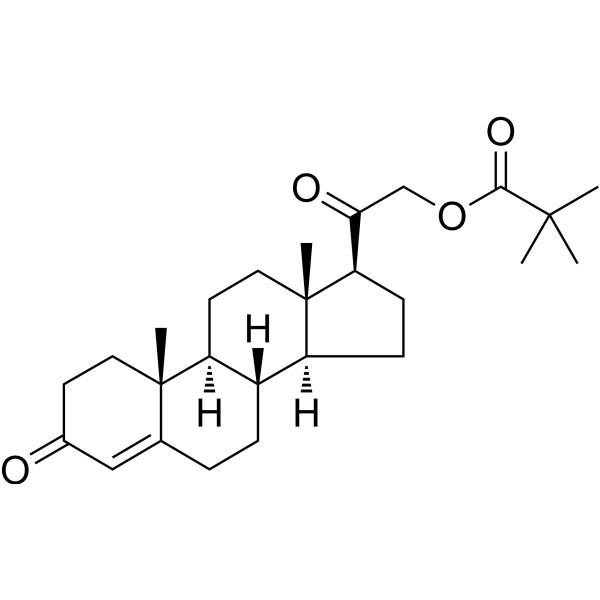
Physicochemical Properties
| Molecular Formula | C26H38O4 |
| Molecular Weight | 414.58 |
| Exact Mass | 414.277 |
| CAS # | 808-48-0 |
| Related CAS # | 808-48-0 (pivalate);56-47-3 (acetate); |
| PubChem CID | 11876263 |
| Appearance | White to off-white solid powder |
| Density | 1.111 g/cm3 |
| Boiling Point | 529.012ºC at 760 mmHg |
| Melting Point | 198-204ºC |
| Index of Refraction | 1.534 |
| LogP | 5.292 |
| Hydrogen Bond Donor Count | 0 |
| Hydrogen Bond Acceptor Count | 4 |
| Rotatable Bond Count | 5 |
| Heavy Atom Count | 30 |
| Complexity | 787 |
| Defined Atom Stereocenter Count | 6 |
| SMILES | C[C@]12CC[C@H]3[C@H]([C@@H]1CC[C@@H]2C(=O)COC(=O)C(C)(C)C)CCC4=CC(=O)CC[C@]34C |
| InChi Key | VVOIQBFMTVCINR-WWMZEODYSA-N |
| InChi Code | InChI=1S/C26H38O4/c1-24(2,3)23(29)30-15-22(28)21-9-8-19-18-7-6-16-14-17(27)10-12-25(16,4)20(18)11-13-26(19,21)5/h14,18-21H,6-13,15H2,1-5H3/t18-,19-,20-,21+,25-,26-/m0/s1 |
| Chemical Name | [2-[(8S,9S,10R,13S,14S,17S)-10,13-dimethyl-3-oxo-1,2,6,7,8,9,11,12,14,15,16,17-dodecahydrocyclopenta[a]phenanthren-17-yl]-2-oxoethyl] 2,2-dimethylpropanoate |
| HS Tariff Code | 2934.99.9001 |
| Storage |
Powder-20°C 3 years 4°C 2 years In solvent -80°C 6 months -20°C 1 month |
| Shipping Condition | Room temperature (This product is stable at ambient temperature for a few days during ordinary shipping and time spent in Customs) |
Biological Activity
| ln Vivo | For the majority of dogs with PH, a beginning dose of 1.5 mg/kg of deoxycorticosterone pivalate (DOCP) effectively controls clinical symptoms and serum electrolyte concentrations. Additional dose reductions are frequently needed to maintain an injection interval of 28-30 days. Animals that are growing and young seem to need bigger amounts [1]. |
| Toxicity/Toxicokinetics |
Protein Binding 90% |
| References |
[1]. Evaluation of a low-dose desoxycorticosterone pivalate treatment protocol for long-term management of dogs with primary hypoadrenocorticism. J Vet Intern Med. 2019 May;33(3):1266-1271. [2]. Masticatory Muscle Myositis: Pathogenesis, Diagnosis, and Treatment. |
| Additional Infomation |
11-deoxycorticosterone pivalate is a pivalate ester and a mineralocorticoid. It is functionally related to a corticosterone. Desoxycorticosterone pivalate is a mineralocorticoid hormone and an analog of desoxycorticosterone. It is white, odorless, and stable in air. It is practically insoluble in water, sparingly soluble in acetone, slightly soluble in methanol, ether and vegetable oils. Federal (U.S.A.) law restricts this drug to use by or on the order of a licensed veterinarian. See also: Desoxycortone (has active moiety). Drug Indication Examined for treatment of adrenocortical insufficiency especially in multiple sclerosis, congenital cerebral palsy, polyarteritis nodosa, and rheumatoid arthritis. Currently only approved in treating cats and dogs for the treatment of Addison's disease. For use as replacement therapy for mineralocorticoid deficiency in dogs with primary hypoadrenocorticism (Addison's disease). Mechanism of Action Desoxycorticosterone Pivalate binds to the mineralocorticoid receptor. Mineralocorticoids are a family of steroids, secreted by the adrenal cortex, necessary for the regulation of a number of metabolic processes including electrolyte regulation. Desoxycorticosterone pivalate exerts its effect through its interaction with the mineralocorticoid receptor (MR), whereby it reacts with the receptor proteins to form a steroid-receptor complex. This complex moves into the nucleus, where it binds to chromatin which results in genetic transcription of cellular DNA to messenger RNA. The steroid hormones appear to induce transcription and synthesis of specific proteins, which produce the physiological effects seen after administration. Pharmacodynamics Used to treat adrenocortical insufficiency, desoxycorticosterone pivalate is a mineralocorticoid hormone and an analogue of desoxycorticosterone. It primarily acts on the metabolism of sodium, potassium and water. When the drug is given, there is decreased excretion of sodium accompanied by increased excretion of potassium; the concentration of sodium in the blood is thereby increased whereas that of potassium is decreased. There is a concomitant increase in the volume of blood and extracellular fluids, with a fall in hematocrit. It increases the rate of renal tubular absorption of sodium. |
Solubility Data
| Solubility (In Vitro) | DMSO : ~5 mg/mL (~12.06 mM) |
| Solubility (In Vivo) |
Note: Listed below are some common formulations that may be used to formulate products with low water solubility (e.g. < 1 mg/mL), you may test these formulations using a minute amount of products to avoid loss of samples. Injection Formulations (e.g. IP/IV/IM/SC) Injection Formulation 1: DMSO : Tween 80: Saline = 10 : 5 : 85 (i.e. 100 μL DMSO stock solution → 50 μL Tween 80 → 850 μL Saline) *Preparation of saline: Dissolve 0.9 g of sodium chloride in 100 mL ddH ₂ O to obtain a clear solution. Injection Formulation 2: DMSO : PEG300 :Tween 80 : Saline = 10 : 40 : 5 : 45 (i.e. 100 μL DMSO → 400 μLPEG300 → 50 μL Tween 80 → 450 μL Saline) Injection Formulation 3: DMSO : Corn oil = 10 : 90 (i.e. 100 μL DMSO → 900 μL Corn oil) Example: Take the Injection Formulation 3 (DMSO : Corn oil = 10 : 90) as an example, if 1 mL of 2.5 mg/mL working solution is to be prepared, you can take 100 μL 25 mg/mL DMSO stock solution and add to 900 μL corn oil, mix well to obtain a clear or suspension solution (2.5 mg/mL, ready for use in animals). Injection Formulation 4: DMSO : 20% SBE-β-CD in saline = 10 : 90 [i.e. 100 μL DMSO → 900 μL (20% SBE-β-CD in saline)] *Preparation of 20% SBE-β-CD in Saline (4°C,1 week): Dissolve 2 g SBE-β-CD in 10 mL saline to obtain a clear solution. Injection Formulation 5: 2-Hydroxypropyl-β-cyclodextrin : Saline = 50 : 50 (i.e. 500 μL 2-Hydroxypropyl-β-cyclodextrin → 500 μL Saline) Injection Formulation 6: DMSO : PEG300 : castor oil : Saline = 5 : 10 : 20 : 65 (i.e. 50 μL DMSO → 100 μLPEG300 → 200 μL castor oil → 650 μL Saline) Injection Formulation 7: Ethanol : Cremophor : Saline = 10: 10 : 80 (i.e. 100 μL Ethanol → 100 μL Cremophor → 800 μL Saline) Injection Formulation 8: Dissolve in Cremophor/Ethanol (50 : 50), then diluted by Saline Injection Formulation 9: EtOH : Corn oil = 10 : 90 (i.e. 100 μL EtOH → 900 μL Corn oil) Injection Formulation 10: EtOH : PEG300:Tween 80 : Saline = 10 : 40 : 5 : 45 (i.e. 100 μL EtOH → 400 μLPEG300 → 50 μL Tween 80 → 450 μL Saline) Oral Formulations Oral Formulation 1: Suspend in 0.5% CMC Na (carboxymethylcellulose sodium) Oral Formulation 2: Suspend in 0.5% Carboxymethyl cellulose Example: Take the Oral Formulation 1 (Suspend in 0.5% CMC Na) as an example, if 100 mL of 2.5 mg/mL working solution is to be prepared, you can first prepare 0.5% CMC Na solution by measuring 0.5 g CMC Na and dissolve it in 100 mL ddH2O to obtain a clear solution; then add 250 mg of the product to 100 mL 0.5% CMC Na solution, to make the suspension solution (2.5 mg/mL, ready for use in animals). Oral Formulation 3: Dissolved in PEG400 Oral Formulation 4: Suspend in 0.2% Carboxymethyl cellulose Oral Formulation 5: Dissolve in 0.25% Tween 80 and 0.5% Carboxymethyl cellulose Oral Formulation 6: Mixing with food powders Note: Please be aware that the above formulations are for reference only. InvivoChem strongly recommends customers to read literature methods/protocols carefully before determining which formulation you should use for in vivo studies, as different compounds have different solubility properties and have to be formulated differently. (Please use freshly prepared in vivo formulations for optimal results.) |
| Preparing Stock Solutions | 1 mg | 5 mg | 10 mg | |
| 1 mM | 2.4121 mL | 12.0604 mL | 24.1208 mL | |
| 5 mM | 0.4824 mL | 2.4121 mL | 4.8242 mL | |
| 10 mM | 0.2412 mL | 1.2060 mL | 2.4121 mL |