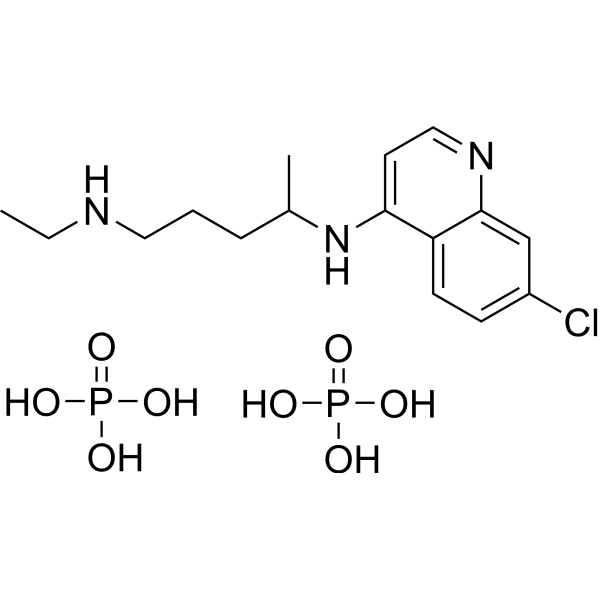
Physicochemical Properties
| Molecular Formula | C16H28CLN3O8P2 |
| Molecular Weight | 487.809345245361 |
| Exact Mass | 487.104 |
| CAS # | 247912-76-1 |
| Related CAS # | Desethyl chloroquine;1476-52-4 |
| PubChem CID | 49849615 |
| Appearance | White to off-white solid powder |
| LogP | 2.685 |
| Hydrogen Bond Donor Count | 8 |
| Hydrogen Bond Acceptor Count | 11 |
| Rotatable Bond Count | 7 |
| Heavy Atom Count | 30 |
| Complexity | 324 |
| Defined Atom Stereocenter Count | 0 |
| InChi Key | PIKNKEKUPZTKFZ-UHFFFAOYSA-N |
| InChi Code | InChI=1S/C16H22ClN3.2H3O4P/c1-3-18-9-4-5-12(2)20-15-8-10-19-16-11-13(17)6-7-14(15)16;2*1-5(2,3)4/h6-8,10-12,18H,3-5,9H2,1-2H3,(H,19,20);2*(H3,1,2,3,4) |
| Chemical Name | 4-N-(7-chloroquinolin-4-yl)-1-N-ethylpentane-1,4-diamine;phosphoric acid |
| HS Tariff Code | 2934.99.9001 |
| Storage |
Powder-20°C 3 years 4°C 2 years In solvent -80°C 6 months -20°C 1 month Note: (1). This product requires protection from light (avoid light exposure) during transportation and storage.(2). Please store this product in a sealed and protected environment (e.g. under nitrogen), avoid exposure to moisture. |
| Shipping Condition | Room temperature (This product is stable at ambient temperature for a few days during ordinary shipping and time spent in Customs) |
Biological Activity
| ln Vivo | Chloroquine was intraperitoneally injected into wild-type and Huntington's disease (Q175/Q175)-infected mice. The amounts of chloroquine and its metabolites in the blood, brain, and muscle tissue were compared using LC-MS/MS. Four to twenty-four hours following the last dosage, brain tissue has lower (5–15M) but more stable chloroquine concentrations than blood or muscle. Within 24 hours following injection, levels of the active chloroquine metabolite desethylchloroquine dropped in muscle and blood, while within the same period, levels in the brain were both slightly elevated and lowered [3]. |
| References |
[1]. Comparison of the partitioning in vitro of chloroquine and its desethyl metabolites between the erythrocytes and plasma of healthy subjects and those with falciparum malaria. Afr J Med Med Sci. 1989 Jun;18(2):95-100. [2]. Assessment of chloroquine treatment for modulating autophagy flux in brain of WT and HD mice. J Huntingtons Dis. 2014;3(2):159-74. [3]. Chloroquine promotes IL-17 production by CD4+ T cells via p38-dependent IL-23 release by monocyte-derived Langerhans-like cells. J Immunol. 2014 Dec 15;193(12):6135-43. |
Solubility Data
| Solubility (In Vitro) |
H2O : ~20 mg/mL (~41.00 mM) DMSO : ~2.63 mg/mL (~5.39 mM) |
| Solubility (In Vivo) |
Solubility in Formulation 1: ≥ 2.5 mg/mL (5.12 mM) (saturation unknown) in 10% DMSO + 40% PEG300 + 5% Tween80 + 45% Saline (add these co-solvents sequentially from left to right, and one by one), clear solution. For example, if 1 mL of working solution is to be prepared, you can add 100 μL of 25.0 mg/mL clear DMSO stock solution to 400 μL PEG300 and mix evenly; then add 50 μL Tween-80 to the above solution and mix evenly; then add 450 μL normal saline to adjust the volume to 1 mL. Preparation of saline: Dissolve 0.9 g of sodium chloride in 100 mL ddH₂ O to obtain a clear solution. Solubility in Formulation 2: ≥ 2.5 mg/mL (5.12 mM) (saturation unknown) in 10% DMSO + 90% (20% SBE-β-CD in Saline) (add these co-solvents sequentially from left to right, and one by one), clear solution. For example, if 1 mL of working solution is to be prepared, you can add 100 μL of 25.0 mg/mL clear DMSO stock solution to 900 μL of 20% SBE-β-CD physiological saline solution and mix evenly. Preparation of 20% SBE-β-CD in Saline (4°C,1 week): Dissolve 2 g SBE-β-CD in 10 mL saline to obtain a clear solution. Solubility in Formulation 3: 50 mg/mL (102.50 mM) in PBS (add these co-solvents sequentially from left to right, and one by one), clear solution; with ultrasonication. (Please use freshly prepared in vivo formulations for optimal results.) |
| Preparing Stock Solutions | 1 mg | 5 mg | 10 mg | |
| 1 mM | 2.0500 mL | 10.2499 mL | 20.4998 mL | |
| 5 mM | 0.4100 mL | 2.0500 mL | 4.1000 mL | |
| 10 mM | 0.2050 mL | 1.0250 mL | 2.0500 mL |