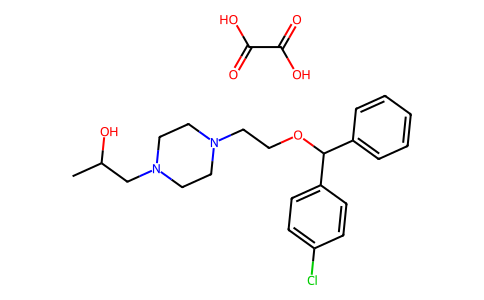
Physicochemical Properties
| Molecular Formula | C13H17N |
| Molecular Weight | 187.286 |
| Exact Mass | 187.136 |
| CAS # | 2323-36-6 |
| PubChem CID | 5195 |
| Appearance | Typically exists as solid at room temperature |
| Density | 0.954g/cm3 |
| Boiling Point | 272.5ºC at 760mmHg |
| Melting Point | 141-142ºC |
| Flash Point | 108.4ºC |
| LogP | 2.182 |
| Hydrogen Bond Donor Count | 0 |
| Hydrogen Bond Acceptor Count | 1 |
| Rotatable Bond Count | 4 |
| Heavy Atom Count | 14 |
| Complexity | 195 |
| Defined Atom Stereocenter Count | 0 |
| SMILES | CC(CN1CCN(CCOC(C2C=CC(Cl)=CC=2)C2C=CC=CC=2)CC1)O.OC(C(=O)O)=O |
| InChi Key | MEZLKOACVSPNER-UHFFFAOYSA-N |
| InChi Code | InChI=1S/C13H17N/c1-4-10-14(3)12(2)11-13-8-6-5-7-9-13/h1,5-9,12H,10-11H2,2-3H3 |
| Chemical Name | N-methyl-1-phenyl-N-prop-2-ynylpropan-2-amine |
| Synonyms | (+-)-Deprenyl; Deprenil; Deprenyl |
| HS Tariff Code | 2934.99.9001 |
| Storage |
Powder-20°C 3 years 4°C 2 years In solvent -80°C 6 months -20°C 1 month |
| Shipping Condition | Room temperature (This product is stable at ambient temperature for a few days during ordinary shipping and time spent in Customs) |
Biological Activity
| ADME/Pharmacokinetics |
Metabolism / Metabolites Half Life: 1.2-2 hours |
| Toxicity/Toxicokinetics |
Toxicity Summary Although the mechanisms for selegiline's beneficial action in the treatment of Parkinson's disease are not fully understood, the selective, irreversible inhibition of monoamine oxidase type B (MAO-B) is thought to be of primary importance. MAO-B is involved in the oxidative deamination of dopamine in the brain. Selegiline binds to MAO-B within the nigrostriatal pathways in the central nervous system, thus blocking microsomal metabolism of dopamine and enhancing the dopaminergic activity in the substantial nigra. Selegiline may also increase dopaminergic activity through mechanisms other than inhibition of MAO-B. At higher doses, selegiline can also inhibit monozmine oxidase type A (MAO-A), allowing it to be used for the treatment of depression. MAO's activity is inhibited when selegiline binds to the isoalloxazine flavin adenine dinucleotide (FAD) at its active center Toxicity Data LD50: 63 mg/kg (Intravenous, Rat) (A308) |
| Additional Infomation |
Selegiline is a phenethylamine alkaloid, a tertiary amine and a terminal acetylenic compound. It is a conjugate base of a selegiline(1+). A selective, irreversible inhibitor of Type B monoamine oxidase. It is used in newly diagnosed patients with Parkinson's disease. It may slow progression of the clinical disease and delay the requirement for levodopa therapy. It also may be given with levodopa upon onset of disability. (From AMA Drug Evaluations Annual, 1994, p385) The compound without isomeric designation is Deprenyl. [PubChem] A selective, irreversible inhibitor of Type B monoamine oxidase that is used for the treatment of newly diagnosed patients with PARKINSON DISEASE, and for the treatment of depressive disorders. The compound without isomeric designation is Deprenyl. See also: Selegiline (annotation moved to). |
Solubility Data
| Solubility (In Vitro) | May dissolve in DMSO (in most cases), if not, try other solvents such as H2O, Ethanol, or DMF with a minute amount of products to avoid loss of samples |
| Solubility (In Vivo) |
Note: Listed below are some common formulations that may be used to formulate products with low water solubility (e.g. < 1 mg/mL), you may test these formulations using a minute amount of products to avoid loss of samples. Injection Formulations (e.g. IP/IV/IM/SC) Injection Formulation 1: DMSO : Tween 80: Saline = 10 : 5 : 85 (i.e. 100 μL DMSO stock solution → 50 μL Tween 80 → 850 μL Saline) *Preparation of saline: Dissolve 0.9 g of sodium chloride in 100 mL ddH ₂ O to obtain a clear solution. Injection Formulation 2: DMSO : PEG300 :Tween 80 : Saline = 10 : 40 : 5 : 45 (i.e. 100 μL DMSO → 400 μLPEG300 → 50 μL Tween 80 → 450 μL Saline) Injection Formulation 3: DMSO : Corn oil = 10 : 90 (i.e. 100 μL DMSO → 900 μL Corn oil) Example: Take the Injection Formulation 3 (DMSO : Corn oil = 10 : 90) as an example, if 1 mL of 2.5 mg/mL working solution is to be prepared, you can take 100 μL 25 mg/mL DMSO stock solution and add to 900 μL corn oil, mix well to obtain a clear or suspension solution (2.5 mg/mL, ready for use in animals). Injection Formulation 4: DMSO : 20% SBE-β-CD in saline = 10 : 90 [i.e. 100 μL DMSO → 900 μL (20% SBE-β-CD in saline)] *Preparation of 20% SBE-β-CD in Saline (4°C,1 week): Dissolve 2 g SBE-β-CD in 10 mL saline to obtain a clear solution. Injection Formulation 5: 2-Hydroxypropyl-β-cyclodextrin : Saline = 50 : 50 (i.e. 500 μL 2-Hydroxypropyl-β-cyclodextrin → 500 μL Saline) Injection Formulation 6: DMSO : PEG300 : castor oil : Saline = 5 : 10 : 20 : 65 (i.e. 50 μL DMSO → 100 μLPEG300 → 200 μL castor oil → 650 μL Saline) Injection Formulation 7: Ethanol : Cremophor : Saline = 10: 10 : 80 (i.e. 100 μL Ethanol → 100 μL Cremophor → 800 μL Saline) Injection Formulation 8: Dissolve in Cremophor/Ethanol (50 : 50), then diluted by Saline Injection Formulation 9: EtOH : Corn oil = 10 : 90 (i.e. 100 μL EtOH → 900 μL Corn oil) Injection Formulation 10: EtOH : PEG300:Tween 80 : Saline = 10 : 40 : 5 : 45 (i.e. 100 μL EtOH → 400 μLPEG300 → 50 μL Tween 80 → 450 μL Saline) Oral Formulations Oral Formulation 1: Suspend in 0.5% CMC Na (carboxymethylcellulose sodium) Oral Formulation 2: Suspend in 0.5% Carboxymethyl cellulose Example: Take the Oral Formulation 1 (Suspend in 0.5% CMC Na) as an example, if 100 mL of 2.5 mg/mL working solution is to be prepared, you can first prepare 0.5% CMC Na solution by measuring 0.5 g CMC Na and dissolve it in 100 mL ddH2O to obtain a clear solution; then add 250 mg of the product to 100 mL 0.5% CMC Na solution, to make the suspension solution (2.5 mg/mL, ready for use in animals). Oral Formulation 3: Dissolved in PEG400 Oral Formulation 4: Suspend in 0.2% Carboxymethyl cellulose Oral Formulation 5: Dissolve in 0.25% Tween 80 and 0.5% Carboxymethyl cellulose Oral Formulation 6: Mixing with food powders Note: Please be aware that the above formulations are for reference only. InvivoChem strongly recommends customers to read literature methods/protocols carefully before determining which formulation you should use for in vivo studies, as different compounds have different solubility properties and have to be formulated differently. (Please use freshly prepared in vivo formulations for optimal results.) |
| Preparing Stock Solutions | 1 mg | 5 mg | 10 mg | |
| 1 mM | 5.3393 mL | 26.6966 mL | 53.3931 mL | |
| 5 mM | 1.0679 mL | 5.3393 mL | 10.6786 mL | |
| 10 mM | 0.5339 mL | 2.6697 mL | 5.3393 mL |