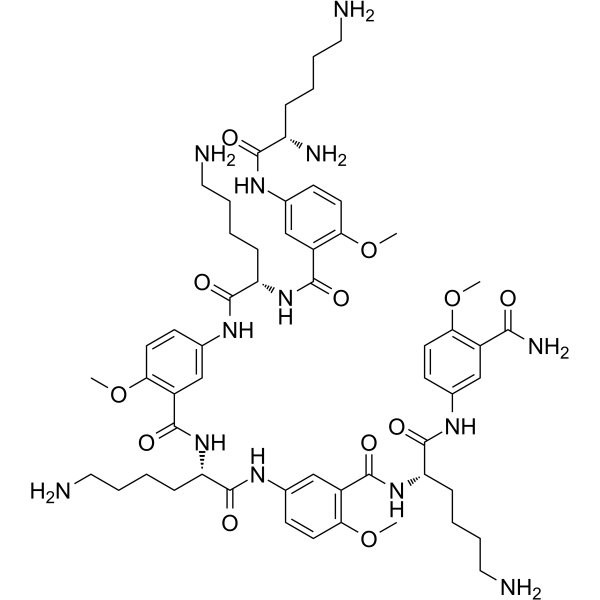
Physicochemical Properties
| Molecular Formula | C56H79N13O12 |
| Molecular Weight | 1126.30637288094 |
| Exact Mass | 1125.6 |
| CAS # | 872454-31-4 |
| Related CAS # | 1294448-66-0 (5HCl);872454-31-4; |
| PubChem CID | 51349239 |
| Appearance | Typically exists as solid at room temperature |
| LogP | 11.521 |
| Hydrogen Bond Donor Count | 13 |
| Hydrogen Bond Acceptor Count | 17 |
| Rotatable Bond Count | 35 |
| Heavy Atom Count | 81 |
| Complexity | 1980 |
| Defined Atom Stereocenter Count | 4 |
| SMILES | O=C([C@H](CCCCN)NC(C1C(=CC=C(C=1)NC([C@H](CCCCN)NC(C1=C(C=CC(=C1)NC([C@H](CCCCN)N)=O)OC)=O)=O)OC)=O)NC1C=CC(=C(C=1)C(N[C@H](C(NC1C=CC(=C(C(N)=O)C=1)OC)=O)CCCCN)=O)OC |
| InChi Key | PWFIFNGOPQUNIT-ITMZJIMRSA-N |
| InChi Code | InChI=1S/C56H79N13O12/c1-78-45-21-17-33(29-37(45)49(62)70)64-54(75)42(14-6-10-26-58)67-51(72)39-31-35(19-23-47(39)80-3)66-56(77)44(16-8-12-28-60)69-52(73)40-32-36(20-24-48(40)81-4)65-55(76)43(15-7-11-27-59)68-50(71)38-30-34(18-22-46(38)79-2)63-53(74)41(61)13-5-9-25-57/h17-24,29-32,41-44H,5-16,25-28,57-61H2,1-4H3,(H2,62,70)(H,63,74)(H,64,75)(H,65,76)(H,66,77)(H,67,72)(H,68,71)(H,69,73)/t41-,42-,43-,44-/m0/s1 |
| Chemical Name | N-[(2S)-6-amino-1-[3-[[(2S)-6-amino-1-[3-[[(2S)-6-amino-1-(3-carbamoyl-4-methoxyanilino)-1-oxohexan-2-yl]carbamoyl]-4-methoxyanilino]-1-oxohexan-2-yl]carbamoyl]-4-methoxyanilino]-1-oxohexan-2-yl]-5-[[(2S)-2,6-diaminohexanoyl]amino]-2-methoxybenzamide |
| HS Tariff Code | 2934.99.9001 |
| Storage |
Powder-20°C 3 years 4°C 2 years In solvent -80°C 6 months -20°C 1 month |
| Shipping Condition | Room temperature (This product is stable at ambient temperature for a few days during ordinary shipping and time spent in Customs) |
Biological Activity
| ln Vitro | Delparantag is intended to restore coagulation by selectively attaching to pentasaccharides and interfering with UFH and LMWH's ability to bind to antithrombin [1]. Protamine was gravimetrically less effective than Delparantag (PMX-60056) in neutralizing anti-Xa and anti-IIa activity in heparinized plasma. Heparin is totally neutralized by delparantag at a weight ratio of about 2:1. Applying 50 mg/mL of Delparantag resulted in a considerable reduction of residual anti-IIa and anti-Xa activity. In plasma that has been anticoagulated with enoxaparin, delparantag neutralizes anti-Xa activity in a concentration-dependent manner. At dosages greater than 25 mg/mL, neutralizer supplementation considerably reduces Delparantag's residual anti-Xa activity [2]. |
| ln Vivo | The antithrombotic, anticoagulant, and hemorrhagic effects of heparin are neutralized by treatment with Delparantag (PMX-60056; 0.5 mg/kg, 1.0 mg/kg, or 2.0 mg/kg; IV; once; male Sprague-Dawley rats); it is also associated with sulfate Protamine, which is equally effective and may be marginally more effective against LMWH [2]. Delparantag's removal from plasma half-life takes three to five minutes [1]. |
| Animal Protocol |
Animal/Disease Models: Male SD (SD (Sprague-Dawley)) rats (250-275 g) injected with UFH or LMWH (2.0 mg/kg) [2] Doses: 0.5 mg/kg, 1.0 mg/kg or 2.0 mg/kg Experimental Results: Compared with fish sperm sulfate Albumin neutralizes the antithrombotic, anticoagulant, and hemorrhagic effects of heparin as effectively as heparin and may be more effective than LMWH. |
| References |
[1]. Mahan CE. A 1-year drug utilization evaluation of protamine in hospitalized patients to identify possible future roles of heparin and low molecular weight heparin reversal agents. J Thromb Thrombolysis. 2014 Apr;37(3):271-8. [2]. In vivo neutralization of unfractionated heparin and low-molecular-weight heparin by a novel salicylamide derivative. Clin Appl Thromb Hemost. 2010 Aug;16(4):377-86. |
| Additional Infomation |
Delparantag is an amidobenzoic acid. Delparantag has been used in trials studying the treatment of Angioplasty, Coronary Artery Disease (CAD), and Percutaneous Coronary Intervention. |
Solubility Data
| Solubility (In Vitro) | May dissolve in DMSO (in most cases), if not, try other solvents such as H2O, Ethanol, or DMF with a minute amount of products to avoid loss of samples |
| Solubility (In Vivo) |
Note: Listed below are some common formulations that may be used to formulate products with low water solubility (e.g. < 1 mg/mL), you may test these formulations using a minute amount of products to avoid loss of samples. Injection Formulations (e.g. IP/IV/IM/SC) Injection Formulation 1: DMSO : Tween 80: Saline = 10 : 5 : 85 (i.e. 100 μL DMSO stock solution → 50 μL Tween 80 → 850 μL Saline) *Preparation of saline: Dissolve 0.9 g of sodium chloride in 100 mL ddH ₂ O to obtain a clear solution. Injection Formulation 2: DMSO : PEG300 :Tween 80 : Saline = 10 : 40 : 5 : 45 (i.e. 100 μL DMSO → 400 μLPEG300 → 50 μL Tween 80 → 450 μL Saline) Injection Formulation 3: DMSO : Corn oil = 10 : 90 (i.e. 100 μL DMSO → 900 μL Corn oil) Example: Take the Injection Formulation 3 (DMSO : Corn oil = 10 : 90) as an example, if 1 mL of 2.5 mg/mL working solution is to be prepared, you can take 100 μL 25 mg/mL DMSO stock solution and add to 900 μL corn oil, mix well to obtain a clear or suspension solution (2.5 mg/mL, ready for use in animals). Injection Formulation 4: DMSO : 20% SBE-β-CD in saline = 10 : 90 [i.e. 100 μL DMSO → 900 μL (20% SBE-β-CD in saline)] *Preparation of 20% SBE-β-CD in Saline (4°C,1 week): Dissolve 2 g SBE-β-CD in 10 mL saline to obtain a clear solution. Injection Formulation 5: 2-Hydroxypropyl-β-cyclodextrin : Saline = 50 : 50 (i.e. 500 μL 2-Hydroxypropyl-β-cyclodextrin → 500 μL Saline) Injection Formulation 6: DMSO : PEG300 : castor oil : Saline = 5 : 10 : 20 : 65 (i.e. 50 μL DMSO → 100 μLPEG300 → 200 μL castor oil → 650 μL Saline) Injection Formulation 7: Ethanol : Cremophor : Saline = 10: 10 : 80 (i.e. 100 μL Ethanol → 100 μL Cremophor → 800 μL Saline) Injection Formulation 8: Dissolve in Cremophor/Ethanol (50 : 50), then diluted by Saline Injection Formulation 9: EtOH : Corn oil = 10 : 90 (i.e. 100 μL EtOH → 900 μL Corn oil) Injection Formulation 10: EtOH : PEG300:Tween 80 : Saline = 10 : 40 : 5 : 45 (i.e. 100 μL EtOH → 400 μLPEG300 → 50 μL Tween 80 → 450 μL Saline) Oral Formulations Oral Formulation 1: Suspend in 0.5% CMC Na (carboxymethylcellulose sodium) Oral Formulation 2: Suspend in 0.5% Carboxymethyl cellulose Example: Take the Oral Formulation 1 (Suspend in 0.5% CMC Na) as an example, if 100 mL of 2.5 mg/mL working solution is to be prepared, you can first prepare 0.5% CMC Na solution by measuring 0.5 g CMC Na and dissolve it in 100 mL ddH2O to obtain a clear solution; then add 250 mg of the product to 100 mL 0.5% CMC Na solution, to make the suspension solution (2.5 mg/mL, ready for use in animals). Oral Formulation 3: Dissolved in PEG400 Oral Formulation 4: Suspend in 0.2% Carboxymethyl cellulose Oral Formulation 5: Dissolve in 0.25% Tween 80 and 0.5% Carboxymethyl cellulose Oral Formulation 6: Mixing with food powders Note: Please be aware that the above formulations are for reference only. InvivoChem strongly recommends customers to read literature methods/protocols carefully before determining which formulation you should use for in vivo studies, as different compounds have different solubility properties and have to be formulated differently. (Please use freshly prepared in vivo formulations for optimal results.) |
| Preparing Stock Solutions | 1 mg | 5 mg | 10 mg | |
| 1 mM | 0.8879 mL | 4.4393 mL | 8.8786 mL | |
| 5 mM | 0.1776 mL | 0.8879 mL | 1.7757 mL | |
| 10 mM | 0.0888 mL | 0.4439 mL | 0.8879 mL |