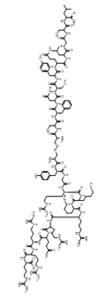
Delcasertib (also known as KAI-9803 and BMS-875944) is a potent and selective δ-protein kinase C (δPKC) inhibitor that is composed of a peptide derived from the δV1-1 portion of δPKC (termed 'cargo peptide'), conjugated reversibly to the cell-penetrating peptide 11-amino acid, arginine-rich sequence of the HIV type 1 transactivator protein (TAT₄₇₋₅₇; termed 'carrier peptide') via a disulfide bond. KAI-9803 administration at the end of ischemia has been found to reduce cardiac damage caused by ischemia-reperfusion in a rat model of acute myocardial infarction. In the study presented here, we examined the TAT₄₇₋₅₇-mediated distribution of KAI-9803 in rats after a single intravenous bolus administration (1 mg/kg). ¹⁴C-KAI-9803 was rapidly delivered to many tissues, including the heart (1.21 μg eq/g tissue), while being quickly cleared from the systemic circulation. The microautoradiography analysis showed that ¹⁴C-KAI-9803 was effectively delivered into various cells, including cardiac myocytes and cardiac endothelial cells within 1 min after dosing. The tissue distribution of ¹²⁵I-labeled KAI-9803 was compared to that of ¹²⁵I-labeled cargo peptide; this comparison demonstrated that the distribution of KAI-9803 to tissues such as the liver, kidney, and heart was facilitated by the reversible conjugation to TAT₄₇₋₅₇. In an in vitro cardiomyocyte study, the extent of ¹²⁵I-KAI-9803 internalization was greater at 37°C than that at 4°C, whereas the internalization of the ¹²⁵I-cargo peptide at 37°C was not observed, indicating that the uptake of ¹²⁵I-KAI-9803 into the cardiomyocytes was mediated by the TAT₄₇₋₅₇ carrier. Our studies demonstrated that after a single intravenous administration, KAI-9803 can be delivered into the target cells in the liver, kidney, and heart by a TAT₄₇₋₅₇-mediated mechanism.
Physicochemical Properties
| Molecular Formula | C120H199N45O34S2 |
| Molecular Weight | 2880.27518010139 |
| Exact Mass | 2879.47 |
| CAS # | 949100-39-4 |
| Related CAS # | Delcasertib hydrochloride |
| PubChem CID | 56843747 |
| Appearance | White to off-white solid powder |
| LogP | -19.7 |
| Hydrogen Bond Donor Count | 53 |
| Hydrogen Bond Acceptor Count | 46 |
| Rotatable Bond Count | 108 |
| Heavy Atom Count | 201 |
| Complexity | 6270 |
| Defined Atom Stereocenter Count | 21 |
| SMILES | S(C[C@@H](C(N[C@@H](CC1C=CC(=CC=1)O)C(NCC(N[C@@H](CCCNC(=N)N)C(N[C@H](C(N[C@H](C(N[C@H](C(N[C@H](C(N[C@H](C(N[C@H](C(N[C@H](C(N[C@H](C(=O)O)CCCNC(=N)N)=O)CCCNC(=N)N)=O)CCCNC(=N)N)=O)CCC(N)=O)=O)CCCNC(=N)N)=O)CCCNC(=N)N)=O)CCCCN)=O)CCCCN)=O)=O)=O)=O)N)SC[C@@H](C(N[C@@H](CO)C(N[C@@H](CC1C=CC=CC=1)C(N[C@@H](CC(N)=O)C(N[C@@H](CO)C(N[C@@H](CC1C=CC(=CC=1)O)C(N[C@@H](CCC(=O)O)C(N[C@H](C(NCC(N[C@@H](CO)C(N[C@H](C(=O)O)CC(C)C)=O)=O)=O)CC(C)C)=O)=O)=O)=O)=O)=O)=O)N |
| InChi Key | XPXZTVWPRKJTAA-PJKOMPQUSA-N |
| InChi Code | InChI=1S/C120H199N45O34S2/c1-61(2)48-80(96(179)145-55-92(174)148-86(56-166)110(193)163-85(114(198)199)49-62(3)4)159-106(189)78(37-39-93(175)176)156-107(190)83(52-65-30-34-67(170)35-31-65)161-112(195)88(58-168)165-109(192)84(53-90(126)172)162-108(191)82(50-63-18-6-5-7-19-63)160-111(194)87(57-167)164-95(178)69(124)60-201-200-59-68(123)94(177)158-81(51-64-28-32-66(169)33-29-64)97(180)146-54-91(173)147-70(22-12-42-139-115(127)128)98(181)149-71(20-8-10-40-121)99(182)150-72(21-9-11-41-122)100(183)151-73(23-13-43-140-116(129)130)101(184)152-75(25-15-45-142-118(133)134)103(186)155-77(36-38-89(125)171)105(188)154-74(24-14-44-141-117(131)132)102(185)153-76(26-16-46-143-119(135)136)104(187)157-79(113(196)197)27-17-47-144-120(137)138/h5-7,18-19,28-35,61-62,68-88,166-170H,8-17,20-27,36-60,121-124H2,1-4H3,(H2,125,171)(H2,126,172)(H,145,179)(H,146,180)(H,147,173)(H,148,174)(H,149,181)(H,150,182)(H,151,183)(H,152,184)(H,153,185)(H,154,188)(H,155,186)(H,156,190)(H,157,187)(H,158,177)(H,159,189)(H,160,194)(H,161,195)(H,162,191)(H,163,193)(H,164,178)(H,165,192)(H,175,176)(H,196,197)(H,198,199)(H4,127,128,139)(H4,129,130,140)(H4,131,132,141)(H4,133,134,142)(H4,135,136,143)(H4,137,138,144)/t68-,69-,70-,71-,72-,73-,74-,75-,76-,77-,78-,79-,80-,81-,82-,83-,84-,85-,86-,87-,88-/m0/s1 |
| Chemical Name | (2S)-2-[[(2S)-2-[[2-[[(2S)-2-[[(2S)-2-[[(2S)-2-[[(2S)-2-[[(2S)-4-amino-2-[[(2S)-2-[[(2S)-2-[[(2R)-2-amino-3-[[(2R)-2-amino-3-[[(2S)-1-[[2-[[(2S)-1-[[(2S)-6-amino-1-[[(2S)-6-amino-1-[[(2S)-1-[[(2S)-1-[[(2S)-5-amino-1-[[(2S)-5-carbamimidamido-1-[[(2S)-5-carbamimidamido-1-[[(1S)-4-carbamimidamido-1-carboxybutyl]amino]-1-oxopentan-2-yl]amino]-1-oxopentan-2-yl]amino]-1,5-dioxopentan-2-yl]amino]-5-carbamimidamido-1-oxopentan-2-yl]amino]-5-carbamimidamido-1-oxopentan-2-yl]amino]-1-oxohexan-2-yl]amino]-1-oxohexan-2-yl]amino]-5-carbamimidamido-1-oxopentan-2-yl]amino]-2-oxoethyl]amino]-3-(4-hydroxyphenyl)-1-oxopropan-2-yl]amino]-3-oxopropyl]disulfanyl]propanoyl]amino]-3-hydroxypropanoyl]amino]-3-phenylpropanoyl]amino]-4-oxobutanoyl]amino]-3-hydroxypropanoyl]amino]-3-(4-hydroxyphenyl)propanoyl]amino]-4-carboxybutanoyl]amino]-4-methylpentanoyl]amino]acetyl]amino]-3-hydroxypropanoyl]amino]-4-methylpentanoic acid |
| Synonyms | KAI-9803; BMS-875944; KAI 9803; BMS 875944; KAI9803; BMS875944 |
| HS Tariff Code | 2934.99.9001 |
| Storage |
Powder-20°C 3 years 4°C 2 years In solvent -80°C 6 months -20°C 1 month Note: Please store this product in a sealed and protected environment, avoid exposure to moisture. |
| Shipping Condition | Room temperature (This product is stable at ambient temperature for a few days during ordinary shipping and time spent in Customs) |
Biological Activity
| ln Vitro | Delcasertib (KAI-9803) is composed of an 11-amino acid cell-penetrating peptide, HIV type 1 transactivator protein (TAT47-57; referred to as the "carrier peptide"), which is a selective inhibitory peptide of delta-protein kinase C (δPKC) that is derived from the deltaV1-1 moiety of deltaPKC and reversibly conjugated to a peptide that is reversibly conjugated to a cell-penetrating peptide [1]. |
| ln Vivo | In mouse liver, kidney, lung, heart, and brain, delcasertib (KAI-9803, single intraperitoneal injection) specifically inhibits PKC translocation [1]. Research has indicated that administering Delcasertib (KAI-9803) towards the end of ischemia can lessen the damage that ischemia-reperfusion causes to the heart in a rat model of acute myocardial infarction [1]. Patients having angioplasty following an acute myocardial infarction have been examined for the prevention of reperfusion injury with delcasertib (KAI-9803) [2]. |
| Animal Protocol |
Animal/Disease Models: Sixweeks old male Crl:CD(SD) rats [1]. Doses: 1 mg/kg (pharmacokinetic/PK/PK analysis). Route of Administration: Through the femoral vein. Experimental Results: Reversible conjugation to TAT47-57 promoted distribution to tissues such as liver, kidney, and heart. |
| References |
[1]. Distribution of KAI-9803, a novel δ-protein kinase C inhibitor, after intravenous administration to rats. Drug Metab Dispos. 2011 Oct;39(10):1946-53. [2]. Intracoronary KAI-9803 as an adjunct to primary percutaneous coronary intervention for acute ST-segment elevation myocardial infarction. Circulation. 2008 Feb 19;117(7):886-96. |
| Additional Infomation |
Drug Indication Investigated for use/treatment in myocardial infarction. |
Solubility Data
| Solubility (In Vitro) | DMSO : ≥ 100 mg/mL (~34.72 mM) |
| Solubility (In Vivo) |
Solubility in Formulation 1: ≥ 7.69 mg/mL (2.67 mM) (saturation unknown) in 10% DMSO + 40% PEG300 + 5% Tween80 + 45% Saline (add these co-solvents sequentially from left to right, and one by one), clear solution. For example, if 1 mL of working solution is to be prepared, you can add 100 μL of 76.9 mg/mL clear DMSO stock solution to 400 μL PEG300 and mix evenly; then add 50 μL Tween-80 to the above solution and mix evenly; then add 450 μL normal saline to adjust the volume to 1 mL. Preparation of saline: Dissolve 0.9 g of sodium chloride in 100 mL ddH₂ O to obtain a clear solution. Solubility in Formulation 2: ≥ 2.5 mg/mL (0.87 mM) (saturation unknown) in 10% DMSO + 90% (20% SBE-β-CD in Saline) (add these co-solvents sequentially from left to right, and one by one), clear solution. For example, if 1 mL of working solution is to be prepared, you can add 100 μL of 25.0 mg/mL clear DMSO stock solution to 900 μL of 20% SBE-β-CD physiological saline solution and mix evenly. Preparation of 20% SBE-β-CD in Saline (4°C,1 week): Dissolve 2 g SBE-β-CD in 10 mL saline to obtain a clear solution. Solubility in Formulation 3: ≥ 2.5 mg/mL (0.87 mM) (saturation unknown) in 10% DMSO + 90% Corn Oil (add these co-solvents sequentially from left to right, and one by one), clear solution. For example, if 1 mL of working solution is to be prepared, you can add 100 μL of 25.0 mg/mL clear DMSO stock solution to 900 μL of corn oil and mix evenly. (Please use freshly prepared in vivo formulations for optimal results.) |
| Preparing Stock Solutions | 1 mg | 5 mg | 10 mg | |
| 1 mM | 0.3472 mL | 1.7359 mL | 3.4719 mL | |
| 5 mM | 0.0694 mL | 0.3472 mL | 0.6944 mL | |
| 10 mM | 0.0347 mL | 0.1736 mL | 0.3472 mL |