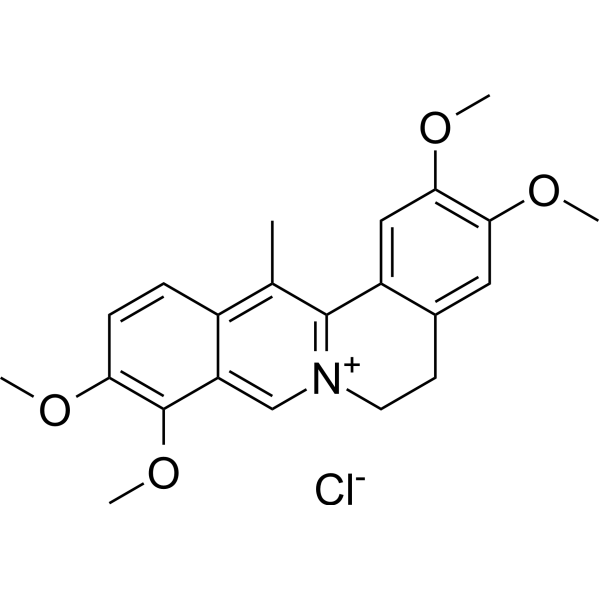
Physicochemical Properties
| Molecular Formula | C22H24CLNO4 |
| Molecular Weight | 401.8833 |
| Exact Mass | 401.139 |
| CAS # | 10605-03-5 |
| Related CAS # | Dehydrocorydaline;30045-16-0;Dehydrocorydaline (hydroxyl);Dehydrocorydaline nitrate;13005-09-9 |
| PubChem CID | 160950 |
| Appearance | Light yellow to yellow solid powder |
| Density | 1.23g/cm3 |
| Boiling Point | 607.6ºC at 760 mmHg |
| Flash Point | 179.9ºC |
| Vapour Pressure | 1.05E-14mmHg at 25°C |
| Index of Refraction | 1.615 |
| LogP | 0.697 |
| Hydrogen Bond Donor Count | 0 |
| Hydrogen Bond Acceptor Count | 5 |
| Rotatable Bond Count | 4 |
| Heavy Atom Count | 28 |
| Complexity | 503 |
| Defined Atom Stereocenter Count | 0 |
| InChi Key | WXOSEFNJXIPZNV-UHFFFAOYSA-M |
| InChi Code | InChI=1S/C22H24NO4.ClH/c1-13-15-6-7-18(24-2)22(27-5)17(15)12-23-9-8-14-10-19(25-3)20(26-4)11-16(14)21(13)23;/h6-7,10-12H,8-9H2,1-5H3;1H/q+1;/p-1 |
| Chemical Name | 2,3,9,10-tetramethoxy-13-methyl-5,6-dihydroisoquinolino[2,1-b]isoquinolin-7-ium;chloride |
| HS Tariff Code | 2934.99.9001 |
| Storage |
Powder-20°C 3 years 4°C 2 years In solvent -80°C 6 months -20°C 1 month Note: Please store this product in a sealed and protected environment, avoid exposure to moisture. |
| Shipping Condition | Room temperature (This product is stable at ambient temperature for a few days during ordinary shipping and time spent in Customs) |
Biological Activity
| ln Vitro | Myogenin, MyoD, and myosin heavy chain are among the muscle-specific proteins whose expression levels rise when 500 nM DeHydrocorydaline is administered to C2C12 myoblasts. Treatment with dehydrocorydaline increased the activation of p38 MAPK and the binding of MyoD with E protein. Moreover, dehydrocordinine therapy corrected myoblast differentiation abnormalities and differentiation-induced p38 MAPK activation in C2C12 myoblasts caused by the loss of the early myogenic receptor protein Cdo [2]. DeHydrocorydaline markedly and dose-dependently decreased MCF-7 cell growth, which was reversible with the caspase-8 inhibitor Z-IETD-FMK. DNA fragmentation is increased by dehydrocordinine, but it has no effect on ΔΨm. DeHydrocorydaline exhibited a dose-dependent increase in Bax protein expression and a decrease in Bcl-2 protein expression, according to Western blotting study. Additionally, dehydrocorydaline activated caspase-7,-8 and cleaved PARP without influencing caspase-9. According to these findings, deHydrocorydaline prevents the growth of MCF-7 cells by controlling Bax/Bcl-2, turning on caspase, and cleaving PARP-mediated apoptosis [1]. |
| ln Vivo | In the acetate-induced writhing test, dehydrocordine (3.6, 6, or 10 mg/kg, i.p.) demonstrated dose-dependent antinociceptive effects and markedly reduced the formalin-induced pain responses in mice. Dehydrocordine decreased the expression of TNF-α, IL-1β, IL-6, and caspase 6 (CASP6) in the spinal cord during the formalin test. These results support the antinociceptive effects of dehydrocorydaline in mice [4]. |
| References |
[1]. Dehydrocorydaline inhibits breast cancer cells proliferation by inducing apoptosis in MCF-7 cells. Am J Chin Med. 2012;40(1):177-85. [2]. Dehydrocorydaline promotes myogenic differentiation via p38 MAPK activation. Mol Med Rep. 2016 Oct;14(4):3029-36. [3]. Screening of a library of traditional Chinese medicines to identify anti-malarial compounds and extracts. Malar J. 2018 Jun 25;17(1):244. [4]. Antinociceptive effects of dehydrocorydaline in mouse models of inflammatory pain involve the opioid receptor and inflammatory cytokines. Sci Rep. 2016 Jun 7;6:27129. |
Solubility Data
| Solubility (In Vitro) | DMSO : ~25 mg/mL (~62.21 mM) |
| Solubility (In Vivo) |
Solubility in Formulation 1: ≥ 2.5 mg/mL (6.22 mM) (saturation unknown) in 10% DMSO + 40% PEG300 + 5% Tween80 + 45% Saline (add these co-solvents sequentially from left to right, and one by one), clear solution. For example, if 1 mL of working solution is to be prepared, you can add 100 μL of 25.0 mg/mL clear DMSO stock solution to 400 μL PEG300 and mix evenly; then add 50 μL Tween-80 to the above solution and mix evenly; then add 450 μL normal saline to adjust the volume to 1 mL. Preparation of saline: Dissolve 0.9 g of sodium chloride in 100 mL ddH₂ O to obtain a clear solution. Solubility in Formulation 2: ≥ 2.5 mg/mL (6.22 mM) (saturation unknown) in 10% DMSO + 90% (20% SBE-β-CD in Saline) (add these co-solvents sequentially from left to right, and one by one), clear solution. For example, if 1 mL of working solution is to be prepared, you can add 100 μL of 25.0 mg/mL clear DMSO stock solution to 900 μL of 20% SBE-β-CD physiological saline solution and mix evenly. Preparation of 20% SBE-β-CD in Saline (4°C,1 week): Dissolve 2 g SBE-β-CD in 10 mL saline to obtain a clear solution. Solubility in Formulation 3: ≥ 2.5 mg/mL (6.22 mM) (saturation unknown) in 10% DMSO + 90% Corn Oil (add these co-solvents sequentially from left to right, and one by one), clear solution. For example, if 1 mL of working solution is to be prepared, you can add 100 μL of 25.0 mg/mL clear DMSO stock solution to 900 μL of corn oil and mix evenly. (Please use freshly prepared in vivo formulations for optimal results.) |
| Preparing Stock Solutions | 1 mg | 5 mg | 10 mg | |
| 1 mM | 2.4883 mL | 12.4415 mL | 24.8830 mL | |
| 5 mM | 0.4977 mL | 2.4883 mL | 4.9766 mL | |
| 10 mM | 0.2488 mL | 1.2442 mL | 2.4883 mL |