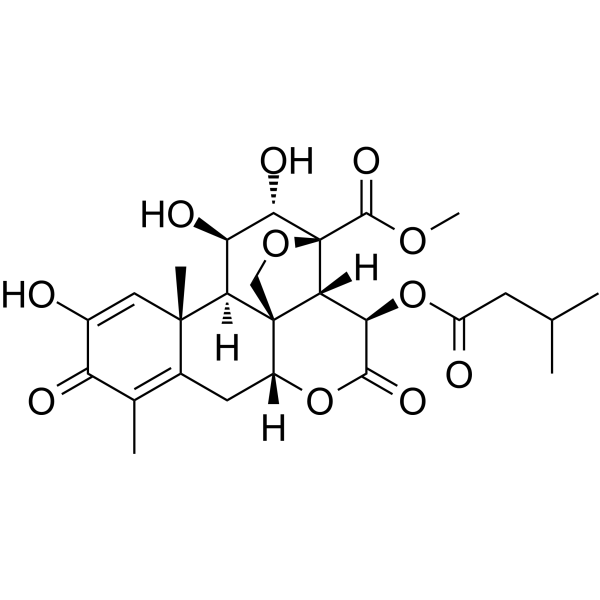
Physicochemical Properties
| Molecular Formula | C26H32O11 |
| Molecular Weight | 520.52600 |
| Exact Mass | 520.194 |
| CAS # | 73435-47-9 |
| PubChem CID | 21125878 |
| Appearance | Typically exists as solid at room temperature |
| LogP | 0.517 |
| Hydrogen Bond Donor Count | 3 |
| Hydrogen Bond Acceptor Count | 11 |
| Rotatable Bond Count | 6 |
| Heavy Atom Count | 37 |
| Complexity | 1150 |
| Defined Atom Stereocenter Count | 9 |
| SMILES | O1C([H])([H])[C@@]23[C@@]4([H])C([H])([H])C5=C(C([H])([H])[H])C(C(=C([H])[C@]5(C([H])([H])[H])[C@@]2([H])[C@]([H])([C@@]([H])([C@]1(C(=O)OC([H])([H])[H])[C@]3([H])[C@]([H])(C(=O)O4)OC(C([H])([H])C([H])(C([H])([H])[H])C([H])([H])[H])=O)O[H])O[H])O[H])=O |
| Synonyms | Dehydrobruceine A; 73435-47-9; Methyl (1R,2S,3R,6R,13S,14R,15R,16S,17S)-11,15,16-trihydroxy-9,13-dimethyl-3-(3-methylbutanoyloxy)-4,10-dioxo-5,18-dioxapentacyclo[12.5.0.01,6.02,17.08,13]nonadeca-8,11-diene-17-carboxylate; |
| HS Tariff Code | 2934.99.9001 |
| Storage |
Powder-20°C 3 years 4°C 2 years In solvent -80°C 6 months -20°C 1 month |
| Shipping Condition | Room temperature (This product is stable at ambient temperature for a few days during ordinary shipping and time spent in Customs) |
Biological Activity
| Targets | Plasmodium Trypanosoma; antitrypanosomal agent |
| ln Vitro | The medicinal plant Brucea javanica (L.) Merr. (Simaroubaceae) is widely distributed throughout Asia where its bitter fruits have been used in traditional medicine for various ailments. Fifteen C-20 quassinoids were isolated from the fruits of B. javanica and examined for their in vitro antitrypanosomal activities against trypomastigotes of Trypanosoma evansi. Bruceine A, bruceantinol, bruceine C, brusatol, and bruceine B showed strong antitrypanosomal activities with IC(50) values in the range of 2.9-17.8nM, which compared well with the standard trypanocidal drugs diminazene aceturate (IC(50)=8.8nM) and suramin (IC(50)=43.2nM). However, dehydrobruceine A, dehydrobruceine B, and dehydrobrusatol were about 2100, 900, and 1200 times less active, respectively, than bruceine A, bruceine B, and brusatol. The relationship of the structure and antitrypanosomal activity of these quassinoid compounds suggested that the presence of a diosphenol moiety in ring A and the nature of the C-15 side chain are important for their activities against T. evansi. This is the first report on the antitrypanosomal activity of isolated quassinoids [1]. |
| Enzyme Assay |
In vitro test for antitrypanosomal activity [1] In vitro antitrypanosomal tests were performed in a 96-well microtiter plate using the 15 quassinoids described above and two standard trypanocidal drugs, diminazene aceturate and suramin. Bruceine D and diminazene aceturate were dissolved in distilled water and other quassinoids and suramin were dissolved in dimethyl sulfoxide (DMSO). Two-fold serial dilutions of these compounds were prepared in HMI-9 medium in the presence or absence of 0.5% DMSO. Trypomastigotes of T. evansi were incubated in each well at a concentration of 5 × 10⁴ cell/ml in 200 μl of medium in the presence of two-fold serial dilutions of each compound. The plates were incubated at 37 °C in 5% CO2 in air for 72 h and the number of motile parasites was counted using a Neubauer hemocytometer. To determine the 50% inhibitory concentration (IC50) on parasite growth for each compound, triplicate assays of the compounds at each concentration were prepared. The IC50 value was calculated by computerized probit analysis. All tests were performed independently two to three times. |
| References |
[1]. In vitro antitrypanosomal activities of quassinoid compounds from the fruits of a medicinal plant, Brucea javanica. Vet Parasitol. 2008 Dec 20;158(4):288-94. |
| Additional Infomation |
methyl (1R,2S,3R,6R,13S,14R,15R,16S,17S)-11,15,16-trihydroxy-9,13-dimethyl-3-(3-methylbutanoyloxy)-4,10-dioxo-5,18-dioxapentacyclo[12.5.0.01,6.02,17.08,13]nonadeca-8,11-diene-17-carboxylate has been reported in Brucea javanica with data available. In conclusion, bruceines A, B, C, and D, and other related compounds are promising, new candidates for the treatment of trypanosomiasis. However, further studies, including elucidation of their mechanisms of actions, cytotoxicities, and activities against other trypanosome species, are necessary. Evaluation of their in vivo effects in animal models is also required. The content of each bruceine in the plants appears to be dependent upon climatic, seasonal and geographic factors (Pavanand et al., 1986). To isolate a large amount of quassinoids from B. javanica or other plant sources, the development of a simple and sensitive method for the detection of quassinoids from crude plant extracts is necessary and preliminary studies are underway. [1] |
Solubility Data
| Solubility (In Vitro) | May dissolve in DMSO (in most cases), if not, try other solvents such as H2O, Ethanol, or DMF with a minute amount of products to avoid loss of samples |
| Solubility (In Vivo) |
Note: Listed below are some common formulations that may be used to formulate products with low water solubility (e.g. < 1 mg/mL), you may test these formulations using a minute amount of products to avoid loss of samples. Injection Formulations (e.g. IP/IV/IM/SC) Injection Formulation 1: DMSO : Tween 80: Saline = 10 : 5 : 85 (i.e. 100 μL DMSO stock solution → 50 μL Tween 80 → 850 μL Saline) *Preparation of saline: Dissolve 0.9 g of sodium chloride in 100 mL ddH ₂ O to obtain a clear solution. Injection Formulation 2: DMSO : PEG300 :Tween 80 : Saline = 10 : 40 : 5 : 45 (i.e. 100 μL DMSO → 400 μLPEG300 → 50 μL Tween 80 → 450 μL Saline) Injection Formulation 3: DMSO : Corn oil = 10 : 90 (i.e. 100 μL DMSO → 900 μL Corn oil) Example: Take the Injection Formulation 3 (DMSO : Corn oil = 10 : 90) as an example, if 1 mL of 2.5 mg/mL working solution is to be prepared, you can take 100 μL 25 mg/mL DMSO stock solution and add to 900 μL corn oil, mix well to obtain a clear or suspension solution (2.5 mg/mL, ready for use in animals). Injection Formulation 4: DMSO : 20% SBE-β-CD in saline = 10 : 90 [i.e. 100 μL DMSO → 900 μL (20% SBE-β-CD in saline)] *Preparation of 20% SBE-β-CD in Saline (4°C,1 week): Dissolve 2 g SBE-β-CD in 10 mL saline to obtain a clear solution. Injection Formulation 5: 2-Hydroxypropyl-β-cyclodextrin : Saline = 50 : 50 (i.e. 500 μL 2-Hydroxypropyl-β-cyclodextrin → 500 μL Saline) Injection Formulation 6: DMSO : PEG300 : castor oil : Saline = 5 : 10 : 20 : 65 (i.e. 50 μL DMSO → 100 μLPEG300 → 200 μL castor oil → 650 μL Saline) Injection Formulation 7: Ethanol : Cremophor : Saline = 10: 10 : 80 (i.e. 100 μL Ethanol → 100 μL Cremophor → 800 μL Saline) Injection Formulation 8: Dissolve in Cremophor/Ethanol (50 : 50), then diluted by Saline Injection Formulation 9: EtOH : Corn oil = 10 : 90 (i.e. 100 μL EtOH → 900 μL Corn oil) Injection Formulation 10: EtOH : PEG300:Tween 80 : Saline = 10 : 40 : 5 : 45 (i.e. 100 μL EtOH → 400 μLPEG300 → 50 μL Tween 80 → 450 μL Saline) Oral Formulations Oral Formulation 1: Suspend in 0.5% CMC Na (carboxymethylcellulose sodium) Oral Formulation 2: Suspend in 0.5% Carboxymethyl cellulose Example: Take the Oral Formulation 1 (Suspend in 0.5% CMC Na) as an example, if 100 mL of 2.5 mg/mL working solution is to be prepared, you can first prepare 0.5% CMC Na solution by measuring 0.5 g CMC Na and dissolve it in 100 mL ddH2O to obtain a clear solution; then add 250 mg of the product to 100 mL 0.5% CMC Na solution, to make the suspension solution (2.5 mg/mL, ready for use in animals). Oral Formulation 3: Dissolved in PEG400 Oral Formulation 4: Suspend in 0.2% Carboxymethyl cellulose Oral Formulation 5: Dissolve in 0.25% Tween 80 and 0.5% Carboxymethyl cellulose Oral Formulation 6: Mixing with food powders Note: Please be aware that the above formulations are for reference only. InvivoChem strongly recommends customers to read literature methods/protocols carefully before determining which formulation you should use for in vivo studies, as different compounds have different solubility properties and have to be formulated differently. (Please use freshly prepared in vivo formulations for optimal results.) |
| Preparing Stock Solutions | 1 mg | 5 mg | 10 mg | |
| 1 mM | 1.9211 mL | 9.6056 mL | 19.2112 mL | |
| 5 mM | 0.3842 mL | 1.9211 mL | 3.8422 mL | |
| 10 mM | 0.1921 mL | 0.9606 mL | 1.9211 mL |