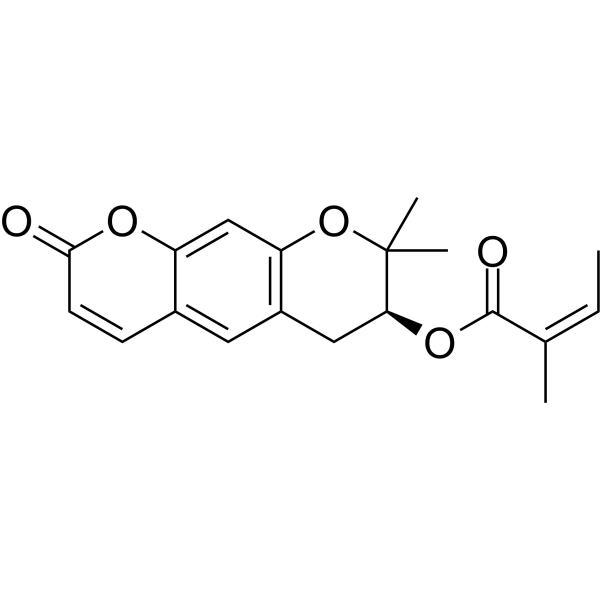
Physicochemical Properties
| Molecular Formula | C19H20O5 |
| Molecular Weight | 328.3591 |
| Exact Mass | 328.131 |
| CAS # | 130848-06-5 |
| PubChem CID | 776123 |
| Appearance | White to off-white solid powder |
| Density | 1.2±0.1 g/cm3 |
| Boiling Point | 469.4±45.0 °C at 760 mmHg |
| Melting Point | 93-94 ºC |
| Flash Point | 206.6±28.8 °C |
| Vapour Pressure | 0.0±1.2 mmHg at 25°C |
| Index of Refraction | 1.580 |
| LogP | 4.57 |
| Hydrogen Bond Donor Count | 0 |
| Hydrogen Bond Acceptor Count | 5 |
| Rotatable Bond Count | 3 |
| Heavy Atom Count | 24 |
| Complexity | 589 |
| Defined Atom Stereocenter Count | 1 |
| SMILES | C/C=C(/C)\C(=O)O[C@H]1CC2=C(C=C3C(=C2)C=CC(=O)O3)OC1(C)C |
| InChi Key | AGABNGOXUSXQDD-XKGFZTIGSA-N |
| InChi Code | InChI=1S/C19H20O5/c1-5-11(2)18(21)23-16-9-13-8-12-6-7-17(20)22-14(12)10-15(13)24-19(16,3)4/h5-8,10,16H,9H2,1-4H3/b11-5-/t16-/m0/s1 |
| Chemical Name | [(3S)-2,2-dimethyl-8-oxo-3,4-dihydropyrano[3,2-g]chromen-3-yl] (Z)-2-methylbut-2-enoate |
| HS Tariff Code | 2934.99.9001 |
| Storage |
Powder-20°C 3 years 4°C 2 years In solvent -80°C 6 months -20°C 1 month Note: This product requires protection from light (avoid light exposure) during transportation and storage. |
| Shipping Condition | Room temperature (This product is stable at ambient temperature for a few days during ordinary shipping and time spent in Customs) |
Biological Activity
| Targets |
Protein kinase C (PKC) (Activator, activity demonstrated at 30 μmol/l) [1] |
| ln Vitro |
Decursinol angelate exhibited in vitro cytotoxicity against a panel of nine human cancer cell lines, with ED~50~ values ranging from 24 to 56 μmol/l. The most sensitive cell line was KG-1 (human bone marrow leukemia, ED~50~ = 24 ± 1.2 μmol/l), and the least sensitive was A-549 (human lung carcinoma, ED~50~ = 56 ± 9.5 μmol/l). [1] Decursinol angelate showed significantly lower cytotoxicity against two normal fibroblast cell lines, MRC-5 (human lung fibroblast, ED~50~ = 116 ± 25.3 μmol/l) and Vero (monkey kidney fibroblast, ED~50~ = 137 ± 31.7 μmol/l), indicating a selective effect against cancer cells. [1] Decursinol angelate (30 μmol/l) activated protein kinase C (PKC) in an in vitro enzyme assay. The PKC activity, measured by the incorporation of 32P into histone, increased to 231% of the control level (no stimulator). This activation level was comparable to that induced by the phorbol ester PDBu (0.2 μmol/l), which increased activity to 187% of control. [1] Alkaline hydrolysis of decursinol angelate to produce decursinol resulted in a loss of cytotoxic activity, suggesting the angelyol moiety is crucial for its cytotoxic effect. [1] |
| ln Vivo |
Decursinol angelate, administered intraperitoneally at doses of 50 and 100 mg/kg daily for 9 consecutive days, significantly increased the life span of ICR mice bearing Sarcoma-180 ascitic tumors. Compared to the control group (median survival time (MST) = 22.4 days), treatment with decursinol angelate at 50 mg/kg increased MST to 32.3 days (44.2% increase in life span), and at 100 mg/kg increased MST to 34.2 days (52.7% increase). [2] In a solid tumor model, subcutaneous inoculation of Sarcoma-180 cells in mice resulted in an average tumor volume of 6229.5 mm³ in the control group. Treatment with decursinol angelate (50 and 100 mg/kg, i.p., daily for 9 days) significantly inhibited tumor growth. At 50 mg/kg, tumor volume was inhibited by 39.5% (3768.8 mm³), and at 100 mg/kg, by 40.6% (3700.3 mm³). [2] Concurrently, decursinol angelate treatment significantly reduced the weight of the excised solid tumors. Compared to the control tumor weight (7.1 g), treatment with 50 mg/kg reduced tumor weight by 35.2% (to 4.6 g), and 100 mg/kg reduced it by 31.0% (to 4.9 g). [2] The study notes that decursin generally exhibited stronger in vivo anti-tumor activity than its structural isomer decursinol angelate, suggesting the senecoylic acid moiety in decursin might be more important for anti-tumor effects than the angeloylic acid moiety in decursinol angelate. [2] |
| Enzyme Assay |
Protein kinase C (PKC) activity was assayed using the mixed micellar method. PKC, purified from rat brain and comprising mainly α, β, and γ isoenzymes, was used. The assay measured the incorporation of 32P from [γ-32P]ATP into histone. The reaction was carried out in the presence of intrinsic activators: 10 mM Ca++ and 10 μg/ml phosphatidylserine. The activity of decursinol angelate (30 μmol/l) was tested and compared to a control (no stimulator) and a positive control (the phorbol ester PDBu at 0.2 μmol/l). The basal histone phosphorylation activity in the absence of Ca++ and phosphatidylserine (with 2 mM EGTA present) was subtracted from the total kinase activities to calculate the specific PKC activation. [1] |
| Cell Assay | Cytotoxic activity was evaluated using the sulforhodamine B (SRB) assay. Various human cancer cell lines and normal fibroblast lines were cultured in their respective media (e.g., DMEM or RPMI-1640) supplemented with fetal bovine serum. Cells were treated with decursinol angelate. The compound was first dissolved in DMSO and then diluted with phosphate-buffered saline (PBS) to achieve the desired final concentrations for treatment. After a designated incubation period, cells were fixed, stained with SRB dye, and the bound dye was solubilized. The optical density was measured to determine cell viability, and the ED~50~ (effective dose for 50% survival) was calculated. All experiments were performed in triplicate. [1] |
| Animal Protocol |
Anti-tumor Activity Evaluation in Sarcoma-180 Models: Four-week-old, specific pathogen-free male ICR mice were used. For the ascitic tumor model, mice were inoculated intraperitoneally with 1 x 10⁶ Sarcoma-180 cells/mouse on day 0. Treatment began 12 hours after tumor inoculation. Decursinol angelate was administered intraperitoneally at doses of 50 and 100 mg/kg, once daily for nine consecutive days. The control group received the vehicle (carboxymethyl cellulose). Survival of the mice was monitored to calculate the median survival time and percentage increase in life span. For the solid tumor model, mice were injected subcutaneously in the right hind limb with 0.1 mL of a Sarcoma-180 cell suspension. Six days after tumor transplantation, mice were randomized into groups and treated intraperitoneally with decursinol angelate (50 and 100 mg/kg) or a positive control drug (5-fluorouracil, 25 mg/kg), once daily for 9 days. Eight days after the start of treatment (day 14 post-inoculation), animals were euthanized by cervical dislocation. Solid tumors were excised, and their wet weight and volume (measured with digital calipers) were recorded. [2] |
| ADME/Pharmacokinetics |
Metabolism / Metabolites Decursinol angelate has known human metabolites that include (2,2-dimethyl-8-oxo-3,4-dihydropyrano[3,2-g]chromen-3-yl) 2,3-dimethyloxirane-2-carboxylate. |
| References |
[1]. Decursinol angelate: a cytotoxic and protein kinase C activating agent from the root of Angelica gigas. Planta Med. 1997 Aug;63(4):360-1. [2]. Anti-tumor activities of decursinol angelate and decursin from Angelica gigas. Arch Pharm Res. 2003 Sep;26(9):727-30. |
| Additional Infomation |
Decursinol angelate has been reported in Angelica gigas and Angelica glauca with data available. See also: Angelica gigas root (part of). Decursinol angelate is a pyranocoumarin compound first isolated from Sesei grandivittatum and also found in Angelica gigas and Angelica acutiloba. It is a structural isomer of decursin, and both are major components in the root of Angelica gigas, which is traditionally used in Korea to treat anemia, as a sedative, and as a tonic. [1] This study is the first report on the in vitro cytotoxic activity and PKC activation by decursinol angelate. The compound displays dual activities: cytotoxicity against cancer cells and activation of PKC. [1] The relationship between its cytotoxic activity and PKC activation mechanism remains to be elucidated. It is unclear whether decursinol angelate functions more like tumor-promoting phorbol esters or anti-tumor agents such as bryostatins, both of which are also PKC activators. [1] The physical properties of the purified decursinol angelate include: white prismatic crystal from methanol; melting point 94–95°C; specific optical rotation [α]D^15^ = +172.9° (c = 1.28 in CHCl3). [1] Decursinol angelate was isolated from the roots of Angelica gigas (Umbelliferae), a plant traditionally used in Korean medicine under the name "Zam Dang Gui" for treating anemia, as a sedative, anodyne, and tonic. [2] This study demonstrates, for the first time, the in vivo anti-tumor activity of decursinol angelate against murine Sarcoma-180 ascitic and solid tumors. [2] Decursinol angelate is a structural isomer of decursin, both being major coumarin components of Angelica gigas. [2] |
Solubility Data
| Solubility (In Vitro) | DMSO : ~100 mg/mL (~304.54 mM) |
| Solubility (In Vivo) |
Solubility in Formulation 1: ≥ 2.5 mg/mL (7.61 mM) (saturation unknown) in 10% DMSO + 90% (20% SBE-β-CD in Saline) (add these co-solvents sequentially from left to right, and one by one), clear solution. For example, if 1 mL of working solution is to be prepared, you can add 100 μL of 25.0 mg/mL clear DMSO stock solution to 900 μL of 20% SBE-β-CD physiological saline solution and mix evenly. Preparation of 20% SBE-β-CD in Saline (4°C,1 week): Dissolve 2 g SBE-β-CD in 10 mL saline to obtain a clear solution. Solubility in Formulation 2: ≥ 2.5 mg/mL (7.61 mM) (saturation unknown) in 10% DMSO + 90% Corn Oil (add these co-solvents sequentially from left to right, and one by one), clear solution. For example, if 1 mL of working solution is to be prepared, you can add 100 μL of 25.0 mg/mL clear DMSO stock solution to 900 μL of corn oil and mix evenly. (Please use freshly prepared in vivo formulations for optimal results.) |
| Preparing Stock Solutions | 1 mg | 5 mg | 10 mg | |
| 1 mM | 3.0454 mL | 15.2272 mL | 30.4544 mL | |
| 5 mM | 0.6091 mL | 3.0454 mL | 6.0909 mL | |
| 10 mM | 0.3045 mL | 1.5227 mL | 3.0454 mL |