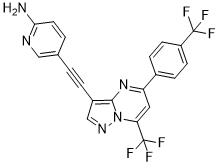
Decoglurant (Ro-4995819, Ro4995819, Ro 4995819) is a novel and potent negative allosteric modulator of the mGlu2 and mGlu3 receptors being developed as an adjunctive treatment modality for major depressive disorder.
Physicochemical Properties
| Molecular Formula | C21H11F6N5 |
| Molecular Weight | 447.335964441299 |
| Exact Mass | 447.092 |
| Elemental Analysis | C, 56.38; H, 2.48; F, 25.48; N, 15.66 |
| CAS # | 911115-16-7 |
| PubChem CID | 71533696 |
| Appearance | Orange to red solid powder |
| LogP | 4.741 |
| Hydrogen Bond Donor Count | 1 |
| Hydrogen Bond Acceptor Count | 10 |
| Rotatable Bond Count | 3 |
| Heavy Atom Count | 32 |
| Complexity | 720 |
| Defined Atom Stereocenter Count | 0 |
| SMILES | FC(C1C=CC(C2C=C(C(F)(F)F)N3C(=C(C=N3)C#CC3C=CC(N)=NC=3)N=2)=CC=1)(F)F |
| InChi Key | DMJHZVARRXJSEG-UHFFFAOYSA-N |
| InChi Code | InChI=1S/C21H11F6N5/c22-20(23,24)15-6-4-13(5-7-15)16-9-17(21(25,26)27)32-19(31-16)14(11-30-32)3-1-12-2-8-18(28)29-10-12/h2,4-11H,(H2,28,29) |
| Chemical Name | 5-[2-[7-(trifluoromethyl)-5-[4-(trifluoromethyl)phenyl]pyrazolo[1,5-a]pyrimidin-3-yl]ethynyl]pyridin-2-amine |
| Synonyms | Ro4995819; Ro4995819; Decoglurant; 911115-16-7; 5-((7-(Trifluoromethyl)-5-(4-(trifluoromethyl)phenyl)pyrazolo[1,5-a]pyrimidin-3-yl)ethynyl)pyridin-2-amine; 5VX4P0JKC5; 5-[2-[7-(trifluoromethyl)-5-[4-(trifluoromethyl)phenyl]pyrazolo[1,5-a]pyrimidin-3-yl]ethynyl]pyridin-2-amine; RO4995,819; RO-4995,819; UNII-5VX4P0JKC5; Ro-4995819 |
| HS Tariff Code | 2934.99.9001 |
| Storage |
Powder-20°C 3 years 4°C 2 years In solvent -80°C 6 months -20°C 1 month |
| Shipping Condition | Room temperature (This product is stable at ambient temperature for a few days during ordinary shipping and time spent in Customs) |
Biological Activity
| Targets | Decoglurant (RG1578/RO4995819) is a negative allosteric modulator (NAM) of metabotropic glutamate receptors 2 and 3 (mGlu2/mGlu3 receptors). [1] |
| ln Vivo |
In preclinical models, Decoglurant demonstrated rapid antidepressant-like effects by modulating glutamate/GABA neurotransmission, consistent with the mechanism of other mGlu2/3 antagonists. [1] Clinical studies indicated that Decoglurant (5–15 mg/day) induced rapid changes in synaptic plasticity markers (e.g., BDNF, mTOR) within 24 hours in depressed patients, supporting its rapid-acting potential. [1] Clinical Trial (Phase II): Decoglurant was evaluated in a randomized, double-blind, placebo-controlled trial (NCT01457677) for major depressive disorder (MDD). Patients received daily oral doses (1.5 mg, 5 mg, 15 mg) or placebo for 6 weeks. [1] The study failed to meet its primary endpoint (change in MADRS score at Day 42), though subgroup analyses suggested efficacy in severely depressed patients (MADRS ≥30). [1] |
| ADME/Pharmacokinetics |
Decoglurant showed dose-proportional exposure following oral administration in humans, with a half-life (t1/2) supporting once-daily dosing. [1] It exhibited good blood-brain barrier penetration in preclinical species, consistent with its CNS target engagement. [1] |
| Toxicity/Toxicokinetics |
Decoglurant showed dose-proportional exposure following oral administration in humans, with a half-life (t1/2) supporting once-daily dosing. [1] It exhibited good blood-brain barrier penetration in preclinical species, consistent with its CNS target engagement. [1] |
| References |
[1]. A new generation of antidepressants: an update on the pharmaceutical pipeline for novel and rapid-acting therapeutics in mood disorders based on glutamate/GABA neurotransmitter systems. Drug Discov Today. 2019 Feb;24(2):606-615. |
| Additional Infomation |
Decoglurant has been used in trials studying the treatment of Major Depressive Disorder. Decoglurant was developed as a rapid-acting antidepressant targeting glutamate dysregulation, distinct from monoamine-based therapies. Its mechanism involves disinhibition of glutamate release via mGlu2/3 blockade. [1] Despite negative Phase II results, it contributed to validating mGlu2/3 modulation as a therapeutic strategy for treatment-resistant depression. [1] |
Solubility Data
| Solubility (In Vitro) | DMSO : ~250 mg/mL (~558.86 mM) |
| Solubility (In Vivo) |
Solubility in Formulation 1: ≥ 2.08 mg/mL (4.65 mM) (saturation unknown) in 10% DMSO + 40% PEG300 +5% Tween-80 + 45% Saline (add these co-solvents sequentially from left to right, and one by one), clear solution. For example, if 1 mL of working solution is to be prepared, you can add 100 μL of 20.8 mg/mL clear DMSO stock solution to 400 μL PEG300 and mix evenly; then add 50 μL Tween-80 + to the above solution and mix evenly; then add 450 μL normal saline to adjust the volume to 1 mL. Preparation of saline: Dissolve 0.9 g of sodium chloride in 100 mL ddH₂ O to obtain a clear solution. (Please use freshly prepared in vivo formulations for optimal results.) |
| Preparing Stock Solutions | 1 mg | 5 mg | 10 mg | |
| 1 mM | 2.2354 mL | 11.1772 mL | 22.3544 mL | |
| 5 mM | 0.4471 mL | 2.2354 mL | 4.4709 mL | |
| 10 mM | 0.2235 mL | 1.1177 mL | 2.2354 mL |