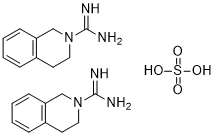
Debrisoquine sulfate (Ro5-3307; Debrisochinum; Tendor), the sulfate salt of Debrisoquin which is a guanidine derivative, is a potent antihypertensive and adrenergic neuron-blocking drug similar to guanethidine. Debrisoquine is commonly used as an indicator for phenotyping the drug metabolizing enzyme CYP2D6 enzyme.
Physicochemical Properties
| Molecular Formula | C20H26N6O4S |
| Molecular Weight | 446.523242473602 |
| Exact Mass | 448.189 |
| CAS # | 581-88-4 |
| Related CAS # | Debrisoquin;1131-64-2 |
| PubChem CID | 2966 |
| Appearance | Light yellow to yellow solid powder |
| Boiling Point | 309.8ºC at 760 mmHg |
| Melting Point | 278-280°, 284-285° or 266-268° (H2O) |
| Flash Point | 141.1ºC |
| LogP | 3.78 |
| Hydrogen Bond Donor Count | 2 |
| Hydrogen Bond Acceptor Count | 1 |
| Rotatable Bond Count | 1 |
| Heavy Atom Count | 13 |
| Complexity | 202 |
| Defined Atom Stereocenter Count | 0 |
| InChi Key | CAYGYVYWRIHZCQ-UHFFFAOYSA-N |
| InChi Code | InChI=1S/2C10H13N3.H2O4S/c2*11-10(12)13-6-5-8-3-1-2-4-9(8)7-13;1-5(2,3)4/h2*1-4H,5-7H2,(H3,11,12);(H2,1,2,3,4) |
| Chemical Name | 3,4-dihydro-1H-isoquinoline-2-carboximidamide; sulfate (2:1) |
| Synonyms | Isocaramidine sulfate; Ro 5-3307; Debrisoquine; Ro-53307; Debrisoquina; Debrisoquin; Ro5-3307; Debrisochinum; Tendor; Debrisoquin sulfate |
| HS Tariff Code | 2934.99.9001 |
| Storage |
Powder-20°C 3 years 4°C 2 years In solvent -80°C 6 months -20°C 1 month |
| Shipping Condition | Room temperature (This product is stable at ambient temperature for a few days during ordinary shipping and time spent in Customs) |
Biological Activity
| ADME/Pharmacokinetics |
Metabolism / Metabolites Hepatic. Debrisoquine has known human metabolites that include 4-Hydroxydebrisoquine. |
| References | Clin Pharmacol Ther. 2001 Oct;70(4):327-35. |
| Additional Infomation |
Debrisoquin is a member of isoquinolines and a carboxamidine. It has a role as an antihypertensive agent, an adrenergic agent, a sympatholytic agent and a human metabolite. An adrenergic neuron-blocking drug similar in effects to guanethidine. It is also noteworthy in being a substrate for a polymorphic cytochrome P-450 enzyme. Persons with certain isoforms of this enzyme are unable to properly metabolize this and many other clinically important drugs. They are commonly referred to as having a debrisoquin 4-hydroxylase polymorphism. Debrisoquine has been reported in Homo sapiens and Euglena gracilis with data available. An adrenergic neuron-blocking drug similar in effects to GUANETHIDINE. It is also noteworthy in being a substrate for a polymorphic cytochrome P-450 enzyme. Persons with certain isoforms of this enzyme are unable to properly metabolize this and many other clinically important drugs. They are commonly referred to as having a debrisoquin 4-hydroxylase polymorphism. Drug Indication For the treatment of moderate and severe hypertension, either alone or as an adjunct, and for the treatment of renal hypertension. Mechanism of Action Debrisoquin acts at the sympathetic neuroeffector junction by inhibiting or interfering with the release and/or distribution of norepinephrine, rather than acting at the effector cell by inhibiting the association of norepinephrine with its receptors. It is taken up by norepinephrine transporters. It becomes concentrated in NE transmitter vesicles, replacing NE in these vesicles. This leads to a gradual depletion of NE stores in the nerve endings. Once inside the terminal it blocks the release of noradrenaline in response to arrival of an action potential. In contrast to ganglionic blocking agents, debrisoquin suppresses equally the responses mediated by alpha-and beta-adrenergic receptors but does not produce parasympathetic blockade. Since sympathetic blockade results in modest decreases in peripheral resistance and cardiac output, debrisoquin lowers blood pressure in the supine position. It further reduces blood pressure by decreasing the degree of vasoconstriction that normally results from reflex sympathetic nervous activity upon assumption of the upright posture, thus reducing venous return and cardiac output more. Pharmacodynamics Debrisoquin is an adrenergic neuron-blocking drug similar in effects to guanethidine. It is a substrate for a polymorphic cytochrome P-450 enzyme. Persons with certain isoforms of this enzyme are unable to properly metabolize this and many other clinically important drugs. They are commonly referred to as having a debrisoquin 4-hydroxylase polymorphism. |
Solubility Data
| Solubility (In Vitro) | H2O : ~10.42 mg/mL (~46.46 mM) |
| Solubility (In Vivo) |
Note: Listed below are some common formulations that may be used to formulate products with low water solubility (e.g. < 1 mg/mL), you may test these formulations using a minute amount of products to avoid loss of samples. Injection Formulations (e.g. IP/IV/IM/SC) Injection Formulation 1: DMSO : Tween 80: Saline = 10 : 5 : 85 (i.e. 100 μL DMSO stock solution → 50 μL Tween 80 → 850 μL Saline) *Preparation of saline: Dissolve 0.9 g of sodium chloride in 100 mL ddH ₂ O to obtain a clear solution. Injection Formulation 2: DMSO : PEG300 :Tween 80 : Saline = 10 : 40 : 5 : 45 (i.e. 100 μL DMSO → 400 μLPEG300 → 50 μL Tween 80 → 450 μL Saline) Injection Formulation 3: DMSO : Corn oil = 10 : 90 (i.e. 100 μL DMSO → 900 μL Corn oil) Example: Take the Injection Formulation 3 (DMSO : Corn oil = 10 : 90) as an example, if 1 mL of 2.5 mg/mL working solution is to be prepared, you can take 100 μL 25 mg/mL DMSO stock solution and add to 900 μL corn oil, mix well to obtain a clear or suspension solution (2.5 mg/mL, ready for use in animals). Injection Formulation 4: DMSO : 20% SBE-β-CD in saline = 10 : 90 [i.e. 100 μL DMSO → 900 μL (20% SBE-β-CD in saline)] *Preparation of 20% SBE-β-CD in Saline (4°C,1 week): Dissolve 2 g SBE-β-CD in 10 mL saline to obtain a clear solution. Injection Formulation 5: 2-Hydroxypropyl-β-cyclodextrin : Saline = 50 : 50 (i.e. 500 μL 2-Hydroxypropyl-β-cyclodextrin → 500 μL Saline) Injection Formulation 6: DMSO : PEG300 : castor oil : Saline = 5 : 10 : 20 : 65 (i.e. 50 μL DMSO → 100 μLPEG300 → 200 μL castor oil → 650 μL Saline) Injection Formulation 7: Ethanol : Cremophor : Saline = 10: 10 : 80 (i.e. 100 μL Ethanol → 100 μL Cremophor → 800 μL Saline) Injection Formulation 8: Dissolve in Cremophor/Ethanol (50 : 50), then diluted by Saline Injection Formulation 9: EtOH : Corn oil = 10 : 90 (i.e. 100 μL EtOH → 900 μL Corn oil) Injection Formulation 10: EtOH : PEG300:Tween 80 : Saline = 10 : 40 : 5 : 45 (i.e. 100 μL EtOH → 400 μLPEG300 → 50 μL Tween 80 → 450 μL Saline) Oral Formulations Oral Formulation 1: Suspend in 0.5% CMC Na (carboxymethylcellulose sodium) Oral Formulation 2: Suspend in 0.5% Carboxymethyl cellulose Example: Take the Oral Formulation 1 (Suspend in 0.5% CMC Na) as an example, if 100 mL of 2.5 mg/mL working solution is to be prepared, you can first prepare 0.5% CMC Na solution by measuring 0.5 g CMC Na and dissolve it in 100 mL ddH2O to obtain a clear solution; then add 250 mg of the product to 100 mL 0.5% CMC Na solution, to make the suspension solution (2.5 mg/mL, ready for use in animals). Oral Formulation 3: Dissolved in PEG400 Oral Formulation 4: Suspend in 0.2% Carboxymethyl cellulose Oral Formulation 5: Dissolve in 0.25% Tween 80 and 0.5% Carboxymethyl cellulose Oral Formulation 6: Mixing with food powders Note: Please be aware that the above formulations are for reference only. InvivoChem strongly recommends customers to read literature methods/protocols carefully before determining which formulation you should use for in vivo studies, as different compounds have different solubility properties and have to be formulated differently. (Please use freshly prepared in vivo formulations for optimal results.) |
| Preparing Stock Solutions | 1 mg | 5 mg | 10 mg | |
| 1 mM | 2.2395 mL | 11.1977 mL | 22.3954 mL | |
| 5 mM | 0.4479 mL | 2.2395 mL | 4.4791 mL | |
| 10 mM | 0.2240 mL | 1.1198 mL | 2.2395 mL |