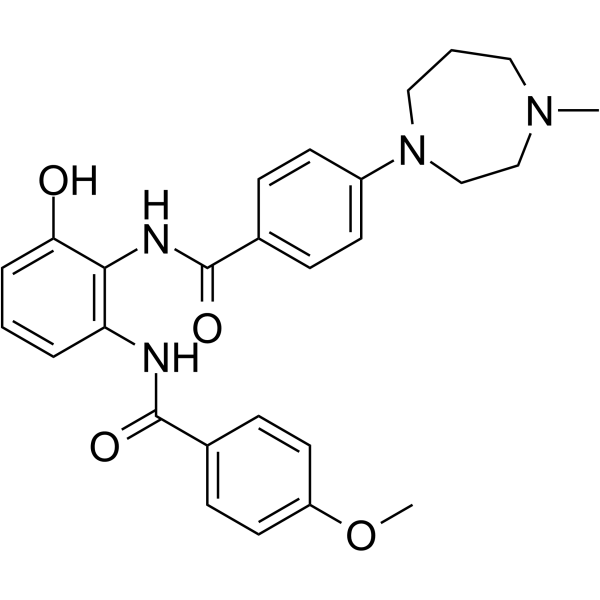
Physicochemical Properties
| Molecular Formula | C27H30N4O4 |
| Molecular Weight | 474.5515 |
| Exact Mass | 474.227 |
| CAS # | 365462-23-3 |
| PubChem CID | 9912771 |
| Appearance | Off-white to light yellow solid powder |
| LogP | 4.196 |
| Hydrogen Bond Donor Count | 3 |
| Hydrogen Bond Acceptor Count | 6 |
| Rotatable Bond Count | 6 |
| Heavy Atom Count | 35 |
| Complexity | 691 |
| Defined Atom Stereocenter Count | 0 |
| InChi Key | IJNIQYINMSGIPS-UHFFFAOYSA-N |
| InChi Code | InChI=1S/C27H30N4O4/c1-30-15-4-16-31(18-17-30)21-11-7-19(8-12-21)27(34)29-25-23(5-3-6-24(25)32)28-26(33)20-9-13-22(35-2)14-10-20/h3,5-14,32H,4,15-18H2,1-2H3,(H,28,33)(H,29,34) |
| Chemical Name | N-[2-hydroxy-6-[(4-methoxybenzoyl)amino]phenyl]-4-(4-methyl-1,4-diazepan-1-yl)benzamide |
| HS Tariff Code | 2934.99.9001 |
| Storage |
Powder-20°C 3 years 4°C 2 years In solvent -80°C 6 months -20°C 1 month |
| Shipping Condition | Room temperature (This product is stable at ambient temperature for a few days during ordinary shipping and time spent in Customs) |
Biological Activity
| ln Vitro | When taken orally, darexaban, an inhibitor of factor Xa (FXa), is quickly and thoroughly metabolized to produce its glucuronide conjugate, YM-222714. In addition to inhibiting prothrombin activation caused by the prothrombinase complex or entire blood clots with potency comparable to that of free FXa, darexaban also specifically and competitively inhibits human FXa [2]. |
| ln Vivo | In mice, Darexaban decreased FXa activity in plasma with an ED50 value of 24.8 mg/kg. Darexaban 3 mg/kg can extend prothrombin time (PT) [2]. In a mouse model of pulmonary thromboembolism (PE), darexaban dosage-dependently reduced mortality, with a substantial impact at a dose of 10 mg/kg [2]. In a mouse model of FeCl3-induced venous thrombosis (VT), Darexaban (0.3-10 mg/kg) dose-dependently reduced thromboprotein content, with significant effects at doses of 3 mg/kg or higher [2]. |
| References |
[1]. Discovery of N-[2-hydroxy-6-(4-methoxybenzamido)phenyl]-4- (4-methyl-1,4-diazepan-1-yl)benzamide (darexaban, YM150) as a potent and orally available factor Xa inhibitor. J Med Chem. 2011 Dec 8;54(23):8051-65. [2]. Darexaban: anticoagulant effects in mice and human plasma in vitro, antithrombotic effects in thrombosis and bleeding models in mice and effects of anti-inhibitor coagulant complex and recombinant factor VIIa. Thromb Res. 2013 May;131(5. [3]. Theoretical Study of Molecular Structure and Physicochemical Properties of Novel Factor Xa Inhibitors and Dual Factor Xa and Factor IIa Inhibitors. Molecules. 2016 Feb 4;21(2):185. |
| Additional Infomation |
Darexaban has been used in trials studying the prevention and basic science of Japanese, Caucasian, Thromboembolism, Pharmacodynamics, and Pharmacokinetics, among others. Tanexaban is an orally active inhibitor of coagulation factor Xa (activated factor X) with anticoagulant activity. Tanexaban is extensively metabolized in the liver to its active metabolite and is excreted by the kidneys and in the feces. |
Solubility Data
| Solubility (In Vitro) | DMSO : ~250 mg/mL (~526.81 mM) |
| Solubility (In Vivo) |
Solubility in Formulation 1: ≥ 2.08 mg/mL (4.38 mM) (saturation unknown) in 10% DMSO + 40% PEG300 + 5% Tween80 + 45% Saline (add these co-solvents sequentially from left to right, and one by one), clear solution. For example, if 1 mL of working solution is to be prepared, you can add 100 μL of 20.8 mg/mL clear DMSO stock solution to 400 μL PEG300 and mix evenly; then add 50 μL Tween-80 to the above solution and mix evenly; then add 450 μL normal saline to adjust the volume to 1 mL. Preparation of saline: Dissolve 0.9 g of sodium chloride in 100 mL ddH₂ O to obtain a clear solution. Solubility in Formulation 2: ≥ 2.08 mg/mL (4.38 mM) (saturation unknown) in 10% DMSO + 90% (20% SBE-β-CD in Saline) (add these co-solvents sequentially from left to right, and one by one), clear solution. For example, if 1 mL of working solution is to be prepared, you can add 100 μL of 20.8 mg/mL clear DMSO stock solution to 900 μL of 20% SBE-β-CD physiological saline solution and mix evenly. Preparation of 20% SBE-β-CD in Saline (4°C,1 week): Dissolve 2 g SBE-β-CD in 10 mL saline to obtain a clear solution. Solubility in Formulation 3: ≥ 2.08 mg/mL (4.38 mM) (saturation unknown) in 10% DMSO + 90% Corn Oil (add these co-solvents sequentially from left to right, and one by one), clear solution. For example, if 1 mL of working solution is to be prepared, you can add 100 μL of 20.8 mg/mL clear DMSO stock solution to 900 μL of corn oil and mix evenly. (Please use freshly prepared in vivo formulations for optimal results.) |
| Preparing Stock Solutions | 1 mg | 5 mg | 10 mg | |
| 1 mM | 2.1073 mL | 10.5363 mL | 21.0726 mL | |
| 5 mM | 0.4215 mL | 2.1073 mL | 4.2145 mL | |
| 10 mM | 0.2107 mL | 1.0536 mL | 2.1073 mL |