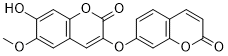
Daphnoretin (formerly also know as NSC291852) is a novel and potent coumarin derivative with anti-cancer activity. It is an active constituent of Wikstroemia indica C. A. Meys with inhibitory effect on mitosis. Daphnoretin also reduces proliferation, invasion, and migration of HCT116 colon cancer cells in a concentration-dependent manner. Daphnoretin is a member of the class of coumarins that is coumarin substituted by a hydroxy group at position 7, a methoxy group at position 6 and a (2-oxo-2H-chromen-7-yl)oxy group at position 3. It has a role as a metabolite, an antiviral agent and an antineoplastic agent. It is a hydroxycoumarin and an aromatic ether. It derives from a coumarin.
Physicochemical Properties
| Molecular Formula | C19H12O7 |
| Molecular Weight | 352.2944 |
| Exact Mass | 352.058 |
| Elemental Analysis | C, 64.78; H, 3.43; O, 31.79 |
| CAS # | 2034-69-7 |
| PubChem CID | 5281406 |
| Appearance | Off-white to light yellow solid powder |
| Density | 1.5±0.1 g/cm3 |
| Boiling Point | 639.6±55.0 °C at 760 mmHg |
| Melting Point | 245-246℃ |
| Flash Point | 237.8±25.0 °C |
| Vapour Pressure | 0.0±2.0 mmHg at 25°C |
| Index of Refraction | 1.675 |
| LogP | 3.33 |
| Hydrogen Bond Donor Count | 1 |
| Hydrogen Bond Acceptor Count | 7 |
| Rotatable Bond Count | 3 |
| Heavy Atom Count | 26 |
| Complexity | 640 |
| Defined Atom Stereocenter Count | 0 |
| SMILES | O(C1C([H])=C([H])C2C([H])=C([H])C(=O)OC=2C=1[H])C1C(=O)OC2=C([H])C(=C(C([H])=C2C=1[H])OC([H])([H])[H])O[H] |
| InChi Key | JRHMMVBOTXEHGJ-UHFFFAOYSA-N |
| InChi Code | InChI=1S/C19H12O7/c1-23-16-6-11-7-17(19(22)26-15(11)9-13(16)20)24-12-4-2-10-3-5-18(21)25-14(10)8-12/h2-9,20H,1H3 |
| Chemical Name | 7-hydroxy-6-methoxy-3-((2-oxo-2H-chromen-7-yl)oxy)-2H-chromen-2-one |
| Synonyms | NSC 291852, NSC291852, NSC-291852, BRN 1299325, BRN1299325, BRN-1299325 |
| HS Tariff Code | 2934.99.9001 |
| Storage |
Powder-20°C 3 years 4°C 2 years In solvent -80°C 6 months -20°C 1 month Note: This product requires protection from light (avoid light exposure) during transportation and storage. |
| Shipping Condition | Room temperature (This product is stable at ambient temperature for a few days during ordinary shipping and time spent in Customs) |
Biological Activity
| ln Vitro | The activity of HCT116 declined with time- and dose- dependence after Daphnoretin intervention, and a rise in G0/G1 ratio and decrease in G2/M ratio was observed. Daphnoretin-treated HCT116 had declined invasion and migration, increased apoptosis rate, and variations in gene expressions related to the Akt signal pathway. Those results indicated that Daphnoretin can inhibit the proliferation, invasion, and migration of HCT116 and promote its apoptosis by regulating the activity of Akt signal pathway. |
| References | :Pharmacother. 111, 1013-1021 (2019). |
| Additional Infomation |
Daphnoretin is a member of the class of coumarins that is coumarin substituted by a hydroxy group at position 7, a methoxy group at position 6 and a (2-oxo-2H-chromen-7-yl)oxy group at position 3. It has a role as a metabolite, an antiviral agent and an antineoplastic agent. It is a hydroxycoumarin and an aromatic ether. It is functionally related to a coumarin. Daphnoretin has been reported in Daphne genkwa, Diarthron vesiculosum, and other organisms with data available. |
Solubility Data
| Solubility (In Vitro) | DMSO : ~25 mg/mL (~70.96 mM) |
| Solubility (In Vivo) |
Solubility in Formulation 1: 2.08 mg/mL (5.90 mM) in 10% DMSO + 40% PEG300 + 5% Tween80 + 45% Saline (add these co-solvents sequentially from left to right, and one by one), suspension solution; with sonication. For example, if 1 mL of working solution is to be prepared, you can add 100 μL of 20.8 mg/mL clear DMSO stock solution to 400 μL PEG300 and mix evenly; then add 50 μL Tween-80 to the above solution and mix evenly; then add 450 μL normal saline to adjust the volume to 1 mL. Preparation of saline: Dissolve 0.9 g of sodium chloride in 100 mL ddH₂ O to obtain a clear solution. Solubility in Formulation 2: 2.08 mg/mL (5.90 mM) in 10% DMSO + 90% (20% SBE-β-CD in Saline) (add these co-solvents sequentially from left to right, and one by one), suspension solution; with ultrasonication. For example, if 1 mL of working solution is to be prepared, you can add 100 μL of 20.8 mg/mL clear DMSO stock solution to 900 μL of 20% SBE-β-CD physiological saline solution and mix evenly. Preparation of 20% SBE-β-CD in Saline (4°C,1 week): Dissolve 2 g SBE-β-CD in 10 mL saline to obtain a clear solution. (Please use freshly prepared in vivo formulations for optimal results.) |
| Preparing Stock Solutions | 1 mg | 5 mg | 10 mg | |
| 1 mM | 2.8386 mL | 14.1929 mL | 28.3857 mL | |
| 5 mM | 0.5677 mL | 2.8386 mL | 5.6771 mL | |
| 10 mM | 0.2839 mL | 1.4193 mL | 2.8386 mL |