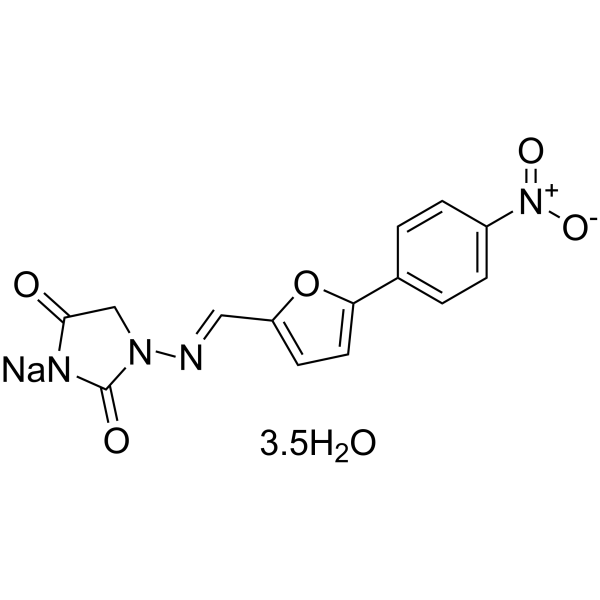
Physicochemical Properties
| Molecular Formula | C14H10N4NAO5 |
| Molecular Weight | 337.2428 |
| Exact Mass | 336.047 |
| CAS # | 24868-20-0 |
| Related CAS # | Dantrolene;7261-97-4;Dantrolene sodium;14663-23-1 |
| PubChem CID | 6604100 |
| Appearance | Yellow to orange solid powder |
| Boiling Point | 544.5ºC at 760mmHg |
| Melting Point | >230ºC |
| Flash Point | 283.1ºC |
| Vapour Pressure | 1.09E-12mmHg at 25°C |
| LogP | 2.978 |
| Hydrogen Bond Donor Count | 0 |
| Hydrogen Bond Acceptor Count | 6 |
| Rotatable Bond Count | 3 |
| Heavy Atom Count | 24 |
| Complexity | 536 |
| Defined Atom Stereocenter Count | 0 |
| SMILES | C1C(=NC(=O)N1/N=C/C2=CC=C(O2)C3=CC=C(C=C3)[N+](=O)[O-])[O-].[Na+] |
| InChi Key | KSRLIXGNPXAZHD-HAZZGOGXSA-M |
| InChi Code | InChI=1S/C14H10N4O5.Na/c19-13-8-17(14(20)16-13)15-7-11-5-6-12(23-11)9-1-3-10(4-2-9)18(21)22;/h1-7H,8H2,(H,16,19,20);/q;+1/p-1/b15-7+; |
| Chemical Name | sodium;3-[(E)-[5-(4-nitrophenyl)furan-2-yl]methylideneamino]-2-oxo-4H-imidazol-5-olate |
| HS Tariff Code | 2934.99.9001 |
| Storage |
Powder-20°C 3 years 4°C 2 years In solvent -80°C 6 months -20°C 1 month Note: Please store this product in a sealed and protected environment, avoid exposure to moisture. |
| Shipping Condition | Room temperature (This product is stable at ambient temperature for a few days during ordinary shipping and time spent in Customs) |
Biological Activity
| Targets |
Glutathione reductase (Ki = 32.7 μM, human erythrocyte-derived) [1] Ryanodine receptor (RyR) (IC50 = 1.2 μM for RyR2 in valve interstitial cells) [2][3][4] |
| ln Vitro |
Dantrolene (60 μM; Days 1 and 3) In paVIC, sodium heptahydrate dramatically reduces the expression of ACTA2 while increasing the expression of RUNX2 [2]. The creation of paVIC calcified nodules triggered by 10 μM lysophosphatidylcholine (LPC) is inhibited by dantrolene (10, 30, 60 μM) sodium hemiheptahydrate [2]. In human erythrocyte lysates, Dantrolene sodium hemiheptahydrate dose-dependently inhibited glutathione reductase activity. At 10 μM, inhibition was 23%; at 50 μM, inhibition reached 58%; and at 100 μM, inhibition was 76%, with a Ki value of 32.7 μM [1] In human aortic valve interstitial cells (VICs) stimulated with lysophosphatidylcholine (LPC, 10 μM), Dantrolene sodium hemiheptahydrate (0.1-5 μM) suppressed calcific nodule formation in a concentration-dependent manner. At 1.2 μM (IC50), calcific nodule area was reduced by 50%; at 5 μM, inhibition was 82%. It also blocked LPC-induced cytosolic calcium overload and downregulated calcification-related genes (Runx2, BMP2) [2] In primary cortical neurons from Huntington's disease (HD) transgenic mice, Dantrolene sodium hemiheptahydrate (1-10 μM) reduced mutant huntingtin (mHTT)-mediated excitotoxicity. At 5 μM, it decreased caspase-3 activation by 45% and reduced reactive oxygen species (ROS) production by 52%, improving neuron viability (MTT assay: 78% viability vs. 42% in control) [3] In primary microglia from Gaucher disease (GD) mice, Dantrolene sodium hemiheptahydrate (2-20 μM) inhibited RyR-mediated calcium release, reduced pro-inflammatory cytokine (TNF-α, IL-6) secretion (maximal 65% reduction at 10 μM), and attenuated microglial activation (Iba1 expression downregulated by 48% at 10 μM) [4] |
| ln Vivo |
Dantrolene three times a week at a dosage of 5 mg/kg In tests of gait and balance beam walking, sodium hexahydrate enhances performance [3]. (10 mg/kg; intraperitoneal; three days a week; for 40–60 days) Significant improvements in gait, decreased LC3-II levels, enhanced mitochondrial ATP synthesis, and decreased brain activation were observed with sodium heptahydrate. In the brain of neuropathic Gaucher illness, dantrolene sodium hemiheptahydrate decreases autophagy and the expression of CALM (calmodulin). [4] In HD transgenic mice (R6/2 strain, 8 weeks old), intraperitoneal administration of Dantrolene sodium hemiheptahydrate (5 mg/kg/day) for 4 weeks improved motor function (rotarod test: latency to fall increased from 12.3 s to 28.7 s) and reduced striatal neuron loss (neuron count increased by 35% vs. vehicle control). It also decreased mHTT aggregation (by 42%) and ROS levels (by 51%) in the striatum [3] In GD mice (Gba1D409V/D409V strain), oral gavage of Dantrolene sodium hemiheptahydrate (10 mg/kg/day) for 8 weeks attenuated neuronopathic phenotypes: spinal cord axonal degeneration was reduced by 47%, microglial activation (Iba1+) was decreased by 53%, and locomotor activity (open field test: total distance traveled increased by 62%) was improved. It also normalized RyR-mediated calcium handling in spinal cord neurons [4] |
| Enzyme Assay |
Glutathione reductase activity assay: Human erythrocyte lysates were mixed with glutathione disulfide (substrate), NADPH, and Dantrolene sodium hemiheptahydrate (0.1-200 μM). The reaction mixture was incubated at 37°C for 10 minutes, and NADPH oxidation was monitored by absorbance at 340 nm. Kinetic parameters (Ki) were calculated via Lineweaver-Burk plots [1] RyR calcium release assay: Purified RyR2 protein was reconstituted in lipid bilayers. Dantrolene sodium hemiheptahydrate (0.01-10 μM) was added, and single-channel currents were recorded using patch-clamp technique. Channel open probability (Po) was analyzed to determine IC50 for RyR2 inhibition [2] |
| Cell Assay |
RT-PCR[2] Cell Types: porcine aortic valve interstitial cells (paVIC) Tested Concentrations: 60 μM Incubation Duration: 1 day and 3 days Experimental Results: Dramatically inhibited ACTA2 expression and upregulated RUNX2 expression. Human erythrocyte lysate preparation: Erythrocytes were isolated from fresh human blood, washed, and lysed by hypotonic shock. Lysates were centrifuged, and the supernatant was used as enzyme source. Dantrolene sodium hemiheptahydrate (0.1-200 μM) was incubated with lysates, substrate, and cofactor, followed by absorbance measurement at 340 nm [1] Human VIC culture and calcification assay: VICs were isolated from human aortic valves, cultured in DMEM with 10% fetal bovine serum. Cells were seeded in 24-well plates (5×10⁴ cells/well), pretreated with Dantrolene sodium hemiheptahydrate (0.1-5 μM) for 1 hour, then stimulated with LPC (10 μM). After 21 days, calcific nodules were stained with alizarin red S, and the stained area was quantified by image analysis. qPCR was used to detect calcification-related gene expression [2] Primary cortical neuron culture from HD mice: Cortices were dissected from E14.5 HD transgenic mouse embryos, dissociated, and cultured in neurobasal medium. Cells were treated with Dantrolene sodium hemiheptahydrate (1-10 μM) for 48 hours, then assessed for viability (MTT), caspase-3 activity (fluorometric assay), and ROS production (DCFH-DA staining) [3] Primary microglia culture from GD mice: Microglia were isolated from postnatal day 3 GD mouse brains, cultured in DMEM with 10% fetal bovine serum. Cells were treated with Dantrolene sodium hemiheptahydrate (2-20 μM) for 24 hours, then analyzed for cytokine secretion (ELISA) and Iba1 expression (immunofluorescence) [4] |
| Animal Protocol |
Animal/Disease Models: YAC128 transgenic mice (FVBN/NJ background strain) and WT mice [3 ] Doses: 5 mg/kg Route of Administration: Oral twice weekly from 2 months of age to 11.5 months of age Experimental Results: Result in significant improvement in performance. Beam walking and gait walking assays. Dramatically diminished the loss of NeuN-positive striatal neurons and diminished the formation of Httexp nuclear aggregates. HD transgenic mouse (R6/2 strain) experiment: 8-week-old male mice (n=12 per group) were randomly assigned to control (saline) and treatment groups. Dantrolene sodium hemiheptahydrate was dissolved in saline (5 mg/mL) and administered via intraperitoneal injection at 5 mg/kg/day for 4 weeks. Motor function was evaluated by rotarod test weekly. Mice were euthanized, and striatal tissues were collected for neuron count (Nissl staining), mHTT aggregation (immunoblot), and ROS measurement [3] GD mouse (Gba1D409V/D409V strain) experiment: 6-week-old male mice (n=10 per group) were divided into control (0.5% methylcellulose) and treatment groups. Dantrolene sodium hemiheptahydrate was suspended in 0.5% methylcellulose (10 mg/mL) and administered via oral gavage at 10 mg/kg/day for 8 weeks. Locomotor activity was assessed by open field test at week 8. Spinal cord tissues were collected for axonal degeneration (toluidine blue staining), microglial activation (Iba1 immunostaining), and RyR calcium handling assay [4] |
| Toxicity/Toxicokinetics |
Effects During Pregnancy and Lactation ◉ Summary of Use during Lactation Because no information is available on the long-term use of dantrolene during breastfeeding, an alternate drug may be preferred, especially while nursing a newborn or preterm infant. After short-term use, the drug would be expected to be eliminated from milk in 1 to 2 days. ◉ Effects in Breastfed Infants Relevant published information was not found as of the revision date. ◉ Effects on Lactation and Breastmilk Relevant published information was not found as of the revision date. In vitro toxicity: Dantrolene sodium hemiheptahydrate (up to 100 μM) had no significant cytotoxicity on human erythrocytes (trypan blue exclusion: >95% viability) [1] In VICs, Dantrolene sodium hemiheptahydrate (up to 5 μM) did not affect cell viability (MTT assay: >90% viability vs. control) [2] In HD transgenic mice, 4-week administration of Dantrolene sodium hemiheptahydrate (5 mg/kg/day, IP) caused no significant changes in body weight, liver function (ALT/AST), or kidney function (creatinine/BUN) [3] In GD mice, 8-week oral administration of Dantrolene sodium hemiheptahydrate (10 mg/kg/day) showed no acute toxicity, with no organ weight abnormalities or histopathological lesions in liver/kidney [4] |
| References |
[1]. Dantrolene inhibits human erythrocyte glutathione reductase. Biol Pharm Bull. 2008 Nov;31(11):2036-9. [2]. Dantrolene inhibits lysophosphatidylcholine-induced valve interstitial cell calcific nodule formation via blockade of the ryanodine receptor. Front Cardiovasc Med. 2023 Mar 30:10:1112965. [3]. Dantrolene is neuroprotective in Huntington's disease transgenic mouse model. Mol Neurodegener. 2011 Nov 25;6:81. [4]. Modulating ryanodine receptors with dantrolene attenuates neuronopathic phenotype in Gaucher disease mice. Hum Mol Genet. 2016 Dec 1;25(23):5126-5141. |
| Additional Infomation |
Crystals (in aqueous DMF). (NTP, 1992) Dantrolene sodium (anhydrous) is the anhydrous sodium salt of dantrolene. It contains a dantrolene(1-). Dantrolene Sodium is the sodium salt form of dantrolene, a hydantoin derivative and direct-acting skeletal muscle relaxant. Dantrolene depresses excitation-contraction coupling in skeletal muscle by binding to the ryanodine receptor 1, and decreasing intracellular calcium concentration. Ryanodine receptors mediate the release of calcium from the sarcoplasmic reticulum, an essential step in muscle contraction. Skeletal muscle relaxant that acts by interfering with excitation-contraction coupling in the muscle fiber. It is used in spasticity and other neuromuscular abnormalities. Although the mechanism of action is probably not central, dantrolene is usually grouped with the central muscle relaxants. See also: Dantrolene (has active moiety). Dantrolene sodium hemiheptahydrate is a RyR antagonist and enzyme inhibitor, with dual mechanisms of action: blocking RyR-mediated calcium release and inhibiting glutathione reductase [1][2][3][4] Its anti-calcific effect in VICs is mediated by suppressing RyR2-dependent calcium overload and downregulating calcification-related signaling pathways [2] In neurodegnerative diseases (HD, GD), it exerts neuroprotective effects by reducing excitotoxicity, ROS production, neuroinflammation, and abnormal protein aggregation [3][4] The compound is clinically used for the treatment of malignant hyperthermia, and preclinical studies support its potential for treating calcium dysregulation-related diseases (e.g., valve calcification, neurodegenerative disorders) [2][3][4] |
Solubility Data
| Solubility (In Vitro) |
DMSO : ≥ 33 mg/mL (~82.64 mM) H2O : < 0.1 mg/mL |
| Solubility (In Vivo) |
Solubility in Formulation 1: ≥ 0.5 mg/mL (1.25 mM) (saturation unknown) in 10% DMSO + 40% PEG300 + 5% Tween80 + 45% Saline (add these co-solvents sequentially from left to right, and one by one), clear solution. For example, if 1 mL of working solution is to be prepared, you can add 100 μL of 5.0 mg/mL clear DMSO stock solution to 400 μL PEG300 and mix evenly; then add 50 μL Tween-80 to the above solution and mix evenly; then add 450 μL normal saline to adjust the volume to 1 mL. Preparation of saline: Dissolve 0.9 g of sodium chloride in 100 mL ddH₂ O to obtain a clear solution. Solubility in Formulation 2: ≥ 0.5 mg/mL (1.25 mM) (saturation unknown) in 10% DMSO + 90% (20% SBE-β-CD in Saline) (add these co-solvents sequentially from left to right, and one by one), clear solution. For example, if 1 mL of working solution is to be prepared, you can add 100 μL of 5.0 mg/mL clear DMSO stock solution to 900 μL of 20% SBE-β-CD physiological saline solution and mix evenly. Preparation of 20% SBE-β-CD in Saline (4°C,1 week): Dissolve 2 g SBE-β-CD in 10 mL saline to obtain a clear solution. (Please use freshly prepared in vivo formulations for optimal results.) |
| Preparing Stock Solutions | 1 mg | 5 mg | 10 mg | |
| 1 mM | 2.9652 mL | 14.8262 mL | 29.6525 mL | |
| 5 mM | 0.5930 mL | 2.9652 mL | 5.9305 mL | |
| 10 mM | 0.2965 mL | 1.4826 mL | 2.9652 mL |