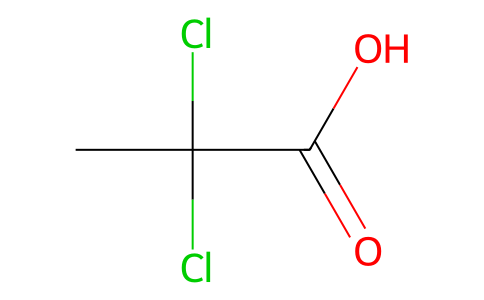
Physicochemical Properties
| Molecular Weight | 142.97 |
| Exact Mass | 141.959 |
| CAS # | 75-99-0 |
| Related CAS # | 75-99-0 (free acid);27-20-8 (sodium);53606-78-3 (calcium); |
| PubChem CID | 6418 |
| Appearance |
Liquid Colorless liquid [Note: A white to tan powder below 46 degrees F. The sodium salt, a white powder, is often used]. |
| Density | 1.4014 |
| Boiling Point | 202°C |
| Melting Point | 166°C (dec.) |
| Flash Point | >110°C |
| Index of Refraction | 1.4544 |
| LogP | 1.264 |
| Hydrogen Bond Donor Count | 1 |
| Hydrogen Bond Acceptor Count | 2 |
| Rotatable Bond Count | 1 |
| Heavy Atom Count | 7 |
| Complexity | 88.9 |
| Defined Atom Stereocenter Count | 0 |
| SMILES | CC(C(=O)O)(Cl)Cl |
| InChi Key | NDUPDOJHUQKPAG-UHFFFAOYSA-N |
| InChi Code | InChI=1S/C3H4Cl2O2/c1-3(4,5)2(6)7/h1H3,(H,6,7) |
| Chemical Name | 2,2-dichloropropanoic acid |
| HS Tariff Code | 2934.99.9001 |
| Storage |
Powder-20°C 3 years 4°C 2 years In solvent -80°C 6 months -20°C 1 month |
| Shipping Condition | Room temperature (This product is stable at ambient temperature for a few days during ordinary shipping and time spent in Customs) |
Biological Activity
| ADME/Pharmacokinetics |
Absorption, Distribution and Excretion In varying degrees, organochlorines are absorbed from the gut and also by the lung and across the skin. /Soild Organochlorines/ ...Fed to animals... quickly excreted (nonmetabolized) in herbicidal concentrations in urine. ...Dalapon residues reported in milk were much <1% of amount ingested in feed... . ... /It was/ found... in milk from cow whose feed contained (36)chlorine labeled Dalapon. When dairy cows were fed dalapon, <1% of ingested dose appeared as residues in milk, mainly as unchanged dalapon but with traces of dalapon glycerides. For more Absorption, Distribution and Excretion (Complete) data for DALAPON (12 total), please visit the HSDB record page. Metabolism / Metabolites Pure (36)chlorine dalapon in aq stock solution was metabolized over a period of several mo in refrigerator by ... possibly Alternaria sp, which produced 5 new (36)chlorine labeled substances. Two of the substances were tentatively identified as inorganic (36)chlorine & (36)chlorine monochloropropionate. Early labeled metabolic degradation products of 2-(14)carbon dalapon in presence of pure cultures of arthrobacter sp grown under aerobic conditions were pyruvate & alanine. ... Enzyme from Arthrobacter sp that removed organic bound chlorine from dalapon. ... Product resulting from enzymic dehalogenation ... was pyruvate. ... immediate precursor of pyruvate in this system is probably 2-chloro-2-hydroxypropionate. Comparison of 1-(14)carbon dalapon and 2-(14)carbon dalapon metabolism /in mixed bacterial populations/ ... showed rapid evolution of (14)CO2 from carboxyl-labeled dalapon, whereas labeled carbon from 2 position ... was found primarily in lipid, nucleic acid, protein ... fractions of organisms. Study of soluble labeled products extracted from microorganisms incubated with (14)carbon dalapon showed activity in ... Alanine and glutamic acid. ...Dalapon is degraded in the environment or metabolized by organisms through dechlorination, dehydrochlorination, and oxidation to chloride ion, pyruvic acid (pyruvate), alanine, carbon dioxide, and other minor or intermediate transitory compounds. |
| Toxicity/Toxicokinetics |
Interactions Investigation of several derivatives ... has failed to reveal any with greater biological activity than sodium salt. ... Activity ... enhanced by changing pH or by adding any of several suitable surfactants. Latter alters physiologically important ionic & polar properties of dalapon solution. Non-Human Toxicity Values LD50 Rat (male) oral 7126 mg/kg LD50 Rat (female) oral 6936 mg/kg LD50 Rat (male) oral 9330 mg/kg /Sodium 2,2-dichloropropionic acid/ LD50 Rat (female) oral 7570 mg/kg /Sodium 2,2-dichloropropionic acid/ For more Non-Human Toxicity Values (Complete) data for DALAPON (11 total), please visit the HSDB record page. |
| Additional Infomation |
2,2-dichloropropionic acid appears as a colorless liquid. Soluble in water. Corrosive to metals and tissue. Used as a herbicide. Dalapon is a carboxylic acid and an organohalogen compound. Mechanism of Action Two types of action: acute toxicity ... and slower growth inhibition. Acute toxicity ... due to its action as acid and protein precipitant which causes drastic permeability changes in plasma membranes and nonselective, localized destruction of cellular constituents. ... Toxic effects of dalapon at high rates are typical of those of strong acids, disrupting lipoidal membranes. ... the strongest inhibitors of NADH oxidase of the SMP are chloro-derivatives of aromatic hydrocarbons (DDT and its analogs DDD and DDE). Derivatives of propionic and acetic acids (propinate, dalapon, MCAA, DCAA, and TCAA) did not exhibit any appreciable inhibiting effect under the experimental conditions. |
Solubility Data
| Solubility (In Vitro) | May dissolve in DMSO (in most cases), if not, try other solvents such as H2O, Ethanol, or DMF with a minute amount of products to avoid loss of samples |
| Solubility (In Vivo) |
Note: Listed below are some common formulations that may be used to formulate products with low water solubility (e.g. < 1 mg/mL), you may test these formulations using a minute amount of products to avoid loss of samples. Injection Formulations (e.g. IP/IV/IM/SC) Injection Formulation 1: DMSO : Tween 80: Saline = 10 : 5 : 85 (i.e. 100 μL DMSO stock solution → 50 μL Tween 80 → 850 μL Saline) *Preparation of saline: Dissolve 0.9 g of sodium chloride in 100 mL ddH ₂ O to obtain a clear solution. Injection Formulation 2: DMSO : PEG300 :Tween 80 : Saline = 10 : 40 : 5 : 45 (i.e. 100 μL DMSO → 400 μLPEG300 → 50 μL Tween 80 → 450 μL Saline) Injection Formulation 3: DMSO : Corn oil = 10 : 90 (i.e. 100 μL DMSO → 900 μL Corn oil) Example: Take the Injection Formulation 3 (DMSO : Corn oil = 10 : 90) as an example, if 1 mL of 2.5 mg/mL working solution is to be prepared, you can take 100 μL 25 mg/mL DMSO stock solution and add to 900 μL corn oil, mix well to obtain a clear or suspension solution (2.5 mg/mL, ready for use in animals). Injection Formulation 4: DMSO : 20% SBE-β-CD in saline = 10 : 90 [i.e. 100 μL DMSO → 900 μL (20% SBE-β-CD in saline)] *Preparation of 20% SBE-β-CD in Saline (4°C,1 week): Dissolve 2 g SBE-β-CD in 10 mL saline to obtain a clear solution. Injection Formulation 5: 2-Hydroxypropyl-β-cyclodextrin : Saline = 50 : 50 (i.e. 500 μL 2-Hydroxypropyl-β-cyclodextrin → 500 μL Saline) Injection Formulation 6: DMSO : PEG300 : castor oil : Saline = 5 : 10 : 20 : 65 (i.e. 50 μL DMSO → 100 μLPEG300 → 200 μL castor oil → 650 μL Saline) Injection Formulation 7: Ethanol : Cremophor : Saline = 10: 10 : 80 (i.e. 100 μL Ethanol → 100 μL Cremophor → 800 μL Saline) Injection Formulation 8: Dissolve in Cremophor/Ethanol (50 : 50), then diluted by Saline Injection Formulation 9: EtOH : Corn oil = 10 : 90 (i.e. 100 μL EtOH → 900 μL Corn oil) Injection Formulation 10: EtOH : PEG300:Tween 80 : Saline = 10 : 40 : 5 : 45 (i.e. 100 μL EtOH → 400 μLPEG300 → 50 μL Tween 80 → 450 μL Saline) Oral Formulations Oral Formulation 1: Suspend in 0.5% CMC Na (carboxymethylcellulose sodium) Oral Formulation 2: Suspend in 0.5% Carboxymethyl cellulose Example: Take the Oral Formulation 1 (Suspend in 0.5% CMC Na) as an example, if 100 mL of 2.5 mg/mL working solution is to be prepared, you can first prepare 0.5% CMC Na solution by measuring 0.5 g CMC Na and dissolve it in 100 mL ddH2O to obtain a clear solution; then add 250 mg of the product to 100 mL 0.5% CMC Na solution, to make the suspension solution (2.5 mg/mL, ready for use in animals). Oral Formulation 3: Dissolved in PEG400 Oral Formulation 4: Suspend in 0.2% Carboxymethyl cellulose Oral Formulation 5: Dissolve in 0.25% Tween 80 and 0.5% Carboxymethyl cellulose Oral Formulation 6: Mixing with food powders Note: Please be aware that the above formulations are for reference only. InvivoChem strongly recommends customers to read literature methods/protocols carefully before determining which formulation you should use for in vivo studies, as different compounds have different solubility properties and have to be formulated differently. (Please use freshly prepared in vivo formulations for optimal results.) |
| Preparing Stock Solutions | 1 mg | 5 mg | 10 mg | |
| 1 mM | 6.9945 mL | 34.9724 mL | 69.9447 mL | |
| 5 mM | 1.3989 mL | 6.9945 mL | 13.9889 mL | |
| 10 mM | 0.6994 mL | 3.4972 mL | 6.9945 mL |