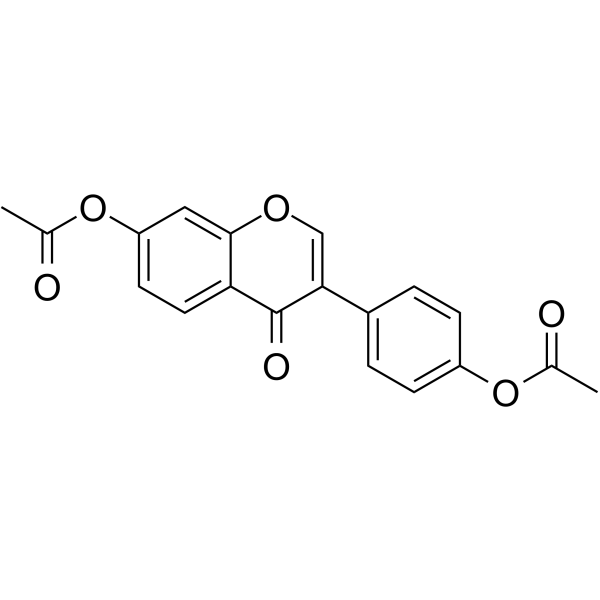
Physicochemical Properties
| Molecular Formula | C19H14O6 |
| Molecular Weight | 338.3109 |
| Exact Mass | 338.079 |
| CAS # | 3682-01-7 |
| PubChem CID | 10359753 |
| Appearance | Typically exists as solid at room temperature |
| LogP | 3.31 |
| Hydrogen Bond Donor Count | 0 |
| Hydrogen Bond Acceptor Count | 6 |
| Rotatable Bond Count | 5 |
| Heavy Atom Count | 25 |
| Complexity | 573 |
| Defined Atom Stereocenter Count | 0 |
| SMILES | O1C([H])=C(C2C([H])=C([H])C(=C([H])C=2[H])OC(C([H])([H])[H])=O)C(C2C([H])=C([H])C(=C([H])C1=2)OC(C([H])([H])[H])=O)=O |
| InChi Key | OHNNFNBOPWLDFH-UHFFFAOYSA-N |
| InChi Code | InChI=1S/C19H14O6/c1-11(20)24-14-5-3-13(4-6-14)17-10-23-18-9-15(25-12(2)21)7-8-16(18)19(17)22/h3-10H,1-2H3 |
| Chemical Name | [4-(7-acetyloxy-4-oxochromen-3-yl)phenyl] acetate |
| Synonyms | Daidzein diacetate; 3682-01-7; [4-(7-acetyloxy-4-oxochromen-3-yl)phenyl] acetate; 4-(7-Acetoxy-4-oxo-4H-chromen-3-yl)phenyl acetate; 7-(Acetyloxy)-3-[4-(acetyloxy)phenyl]-4H-1-benzopyran-4-one; 4',7-Dihydroxy-isoflavone Diacetate; 4',7-Diacetyl-O-isoflavone; 7,4'-Diacetoxyisoflavone; MFCD11044311; SCHEMBL1724568; DTXSID80438726; |
| HS Tariff Code | 2934.99.9001 |
| Storage |
Powder-20°C 3 years 4°C 2 years In solvent -80°C 6 months -20°C 1 month |
| Shipping Condition | Room temperature (This product is stable at ambient temperature for a few days during ordinary shipping and time spent in Customs) |
Biological Activity
| Targets | Daidzein derivative |
| ln Vitro | Obesity-induced inflammation caused by adipocyte-macrophage interactions plays a critical role in developing insulin resistance, and peroxisome proliferator-activated receptors (PPARs) regulate inflammatory gene expression in these cells. Recently, the soy isoflavone daidzein was reported to act as a PPAR activator. We examined whether daidzein affected adipocyte-macrophage crosstalk via the regulation of PPARs. Co-cultures of 3T3-L1 adipocytes and RAW264 macrophages, or palmitate-stimulated RAW264 macrophages were treated with daidzein in the presence or absence of specific inhibitors for PPARs: GW6471 (a PPARα antagonist), and GW9662 (a PPARγ antagonist). Inflammatory gene expression was then determined. Daidzein significantly decreased chemokine (C-C motif) ligand 2 (Ccl2, known in humans as monocyte chemo-attractant protein 1 (MCP1)) and interleukin 6 (Il6) mRNA levels induced by co-culture. In 3T3-L1 adipocytes, daidzein inversed the attenuation of adiponectin gene expression by co-culture, and these effects were inhibited by the PPAR-γ specific inhibitor. Daidzein also decreased Ccl2 and Il6 mRNA levels in RAW264 macrophages stimulated with palmitate or conditioned medium (CM) from hypertrophied 3T3-L1 adipocytes. This inhibitory effect on Il6 expression was abrogated by a PPAR-α inhibitor. Additionally, we examined the activation of nuclear factor-kappa B (NF-κB) and c-Jun N-terminal kinase (JNK) pathways and found that daidzein significantly inhibited palmitate-induced phosphorylation of JNK. Our data suggest that daidzein regulates pro-inflammatory gene expression by activating PPAR-α and -γ and inhibiting the JNK pathway in adipocyte and macrophage co-cultures. These effects might be favorable in improving adipose inflammation, thus, treatment of daidzein may be a therapeutic strategy for chronic inflammation in obese adipose tissue.[2] |
| References |
[1]. SomepalliVenkateswarlu, et al. Isoaurostatin: Total Synthesis and Structural Revision. ChemInform 2005, 61(12):3013-3017.
[2]. Sakamoto Y1, et al. The Dietary Isoflavone Daidzein Reduces Expression of Pro-Inflammatory Genes through PPARα/γ and JNK Pathways in Adipocyte and Macrophage Co-Cultures. PLoS One. 2016 Feb 22;11(2):e0149676. |
Solubility Data
| Solubility (In Vitro) | May dissolve in DMSO (in most cases), if not, try other solvents such as H2O, Ethanol, or DMF with a minute amount of products to avoid loss of samples |
| Solubility (In Vivo) |
Note: Listed below are some common formulations that may be used to formulate products with low water solubility (e.g. < 1 mg/mL), you may test these formulations using a minute amount of products to avoid loss of samples. Injection Formulations (e.g. IP/IV/IM/SC) Injection Formulation 1: DMSO : Tween 80: Saline = 10 : 5 : 85 (i.e. 100 μL DMSO stock solution → 50 μL Tween 80 → 850 μL Saline) *Preparation of saline: Dissolve 0.9 g of sodium chloride in 100 mL ddH ₂ O to obtain a clear solution. Injection Formulation 2: DMSO : PEG300 :Tween 80 : Saline = 10 : 40 : 5 : 45 (i.e. 100 μL DMSO → 400 μLPEG300 → 50 μL Tween 80 → 450 μL Saline) Injection Formulation 3: DMSO : Corn oil = 10 : 90 (i.e. 100 μL DMSO → 900 μL Corn oil) Example: Take the Injection Formulation 3 (DMSO : Corn oil = 10 : 90) as an example, if 1 mL of 2.5 mg/mL working solution is to be prepared, you can take 100 μL 25 mg/mL DMSO stock solution and add to 900 μL corn oil, mix well to obtain a clear or suspension solution (2.5 mg/mL, ready for use in animals). Injection Formulation 4: DMSO : 20% SBE-β-CD in saline = 10 : 90 [i.e. 100 μL DMSO → 900 μL (20% SBE-β-CD in saline)] *Preparation of 20% SBE-β-CD in Saline (4°C,1 week): Dissolve 2 g SBE-β-CD in 10 mL saline to obtain a clear solution. Injection Formulation 5: 2-Hydroxypropyl-β-cyclodextrin : Saline = 50 : 50 (i.e. 500 μL 2-Hydroxypropyl-β-cyclodextrin → 500 μL Saline) Injection Formulation 6: DMSO : PEG300 : castor oil : Saline = 5 : 10 : 20 : 65 (i.e. 50 μL DMSO → 100 μLPEG300 → 200 μL castor oil → 650 μL Saline) Injection Formulation 7: Ethanol : Cremophor : Saline = 10: 10 : 80 (i.e. 100 μL Ethanol → 100 μL Cremophor → 800 μL Saline) Injection Formulation 8: Dissolve in Cremophor/Ethanol (50 : 50), then diluted by Saline Injection Formulation 9: EtOH : Corn oil = 10 : 90 (i.e. 100 μL EtOH → 900 μL Corn oil) Injection Formulation 10: EtOH : PEG300:Tween 80 : Saline = 10 : 40 : 5 : 45 (i.e. 100 μL EtOH → 400 μLPEG300 → 50 μL Tween 80 → 450 μL Saline) Oral Formulations Oral Formulation 1: Suspend in 0.5% CMC Na (carboxymethylcellulose sodium) Oral Formulation 2: Suspend in 0.5% Carboxymethyl cellulose Example: Take the Oral Formulation 1 (Suspend in 0.5% CMC Na) as an example, if 100 mL of 2.5 mg/mL working solution is to be prepared, you can first prepare 0.5% CMC Na solution by measuring 0.5 g CMC Na and dissolve it in 100 mL ddH2O to obtain a clear solution; then add 250 mg of the product to 100 mL 0.5% CMC Na solution, to make the suspension solution (2.5 mg/mL, ready for use in animals). Oral Formulation 3: Dissolved in PEG400 Oral Formulation 4: Suspend in 0.2% Carboxymethyl cellulose Oral Formulation 5: Dissolve in 0.25% Tween 80 and 0.5% Carboxymethyl cellulose Oral Formulation 6: Mixing with food powders Note: Please be aware that the above formulations are for reference only. InvivoChem strongly recommends customers to read literature methods/protocols carefully before determining which formulation you should use for in vivo studies, as different compounds have different solubility properties and have to be formulated differently. (Please use freshly prepared in vivo formulations for optimal results.) |
| Preparing Stock Solutions | 1 mg | 5 mg | 10 mg | |
| 1 mM | 2.9559 mL | 14.7793 mL | 29.5587 mL | |
| 5 mM | 0.5912 mL | 2.9559 mL | 5.9117 mL | |
| 10 mM | 0.2956 mL | 1.4779 mL | 2.9559 mL |