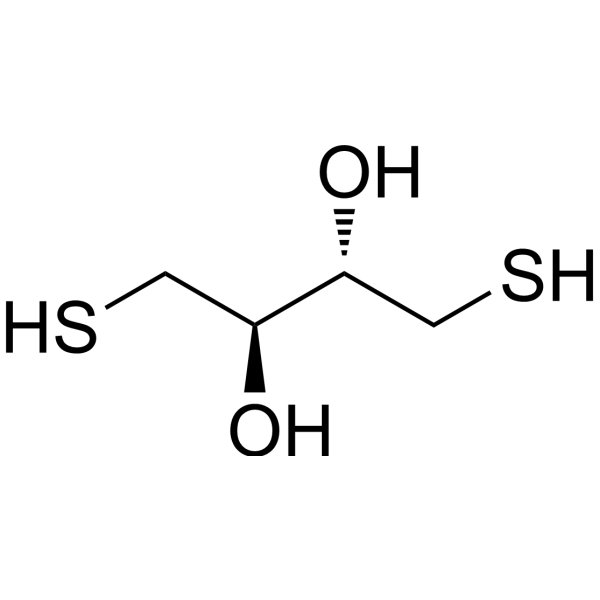
Physicochemical Properties
| Molecular Formula | C4H10O2S2 |
| Molecular Weight | 154.2510 |
| Exact Mass | 154.012 |
| CAS # | 6892-68-8 |
| PubChem CID | 439352 |
| Appearance | White to off-white solid powder |
| Density | 1.3±0.1 g/cm3 |
| Boiling Point | 364.5±42.0 °C at 760 mmHg |
| Melting Point | 82-86ºC |
| Flash Point | 174.2±27.9 °C |
| Vapour Pressure | 0.0±1.8 mmHg at 25°C |
| Index of Refraction | 1.579 |
| LogP | 0.07 |
| Hydrogen Bond Donor Count | 4 |
| Hydrogen Bond Acceptor Count | 4 |
| Rotatable Bond Count | 3 |
| Heavy Atom Count | 8 |
| Complexity | 52 |
| Defined Atom Stereocenter Count | 2 |
| SMILES | S([H])C([H])([H])[C@@]([H])([C@@]([H])(C([H])([H])S[H])O[H])O[H] |
| InChi Key | VHJLVAABSRFDPM-ZXZARUISSA-N |
| InChi Code | InChI=1S/C4H10O2S2/c5-3(1-7)4(6)2-8/h3-8H,1-2H2/t3-,4+ |
| Chemical Name | (2R,3S)-1,4-bis(sulfanyl)butane-2,3-diol |
| HS Tariff Code | 2934.99.9001 |
| Storage |
Powder-20°C 3 years 4°C 2 years In solvent -80°C 6 months -20°C 1 month |
| Shipping Condition | Room temperature (This product is stable at ambient temperature for a few days during ordinary shipping and time spent in Customs) |
Biological Activity
| References |
[1]. Dithioerythritol, From Wikipedia. |
| Additional Infomation |
Dithioerythritol is the meso-diastereomer of 1,4-dimercaptobutane-2,3-diol; a sulfur-containing sugar derived from the monosaccharide erythrose; and an epimer of dithiothreitol. It has a role as a reducing agent. A compound that, along with its isomer, Cleland's reagent (DITHIOTHREITOL), is used for the protection of sulfhydryl groups against oxidation to disulfides and for the reduction of disulfides to sulfhydryl groups. |
Solubility Data
| Solubility (In Vitro) |
DMSO : ~100 mg/mL (~648.30 mM) H2O : ~50 mg/mL (~324.15 mM) |
| Solubility (In Vivo) |
Solubility in Formulation 1: ≥ 2.5 mg/mL (16.21 mM) (saturation unknown) in 10% DMSO + 40% PEG300 + 5% Tween80 + 45% Saline (add these co-solvents sequentially from left to right, and one by one), clear solution. For example, if 1 mL of working solution is to be prepared, you can add 100 μL of 25.0 mg/mL clear DMSO stock solution to 400 μL PEG300 and mix evenly; then add 50 μL Tween-80 to the above solution and mix evenly; then add 450 μL normal saline to adjust the volume to 1 mL. Preparation of saline: Dissolve 0.9 g of sodium chloride in 100 mL ddH₂ O to obtain a clear solution. Solubility in Formulation 2: ≥ 2.5 mg/mL (16.21 mM) (saturation unknown) in 10% DMSO + 90% (20% SBE-β-CD in Saline) (add these co-solvents sequentially from left to right, and one by one), clear solution. For example, if 1 mL of working solution is to be prepared, you can add 100 μL of 25.0 mg/mL clear DMSO stock solution to 900 μL of 20% SBE-β-CD physiological saline solution and mix evenly. Preparation of 20% SBE-β-CD in Saline (4°C,1 week): Dissolve 2 g SBE-β-CD in 10 mL saline to obtain a clear solution. Solubility in Formulation 3: ≥ 2.5 mg/mL (16.21 mM) (saturation unknown) in 10% DMSO + 90% Corn Oil (add these co-solvents sequentially from left to right, and one by one), clear solution. For example, if 1 mL of working solution is to be prepared, you can add 100 μL of 25.0 mg/mL clear DMSO stock solution to 900 μL of corn oil and mix evenly. Solubility in Formulation 4: 50 mg/mL (324.15 mM) in PBS (add these co-solvents sequentially from left to right, and one by one), clear solution; with ultrasonication. (Please use freshly prepared in vivo formulations for optimal results.) |
| Preparing Stock Solutions | 1 mg | 5 mg | 10 mg | |
| 1 mM | 6.4830 mL | 32.4149 mL | 64.8298 mL | |
| 5 mM | 1.2966 mL | 6.4830 mL | 12.9660 mL | |
| 10 mM | 0.6483 mL | 3.2415 mL | 6.4830 mL |