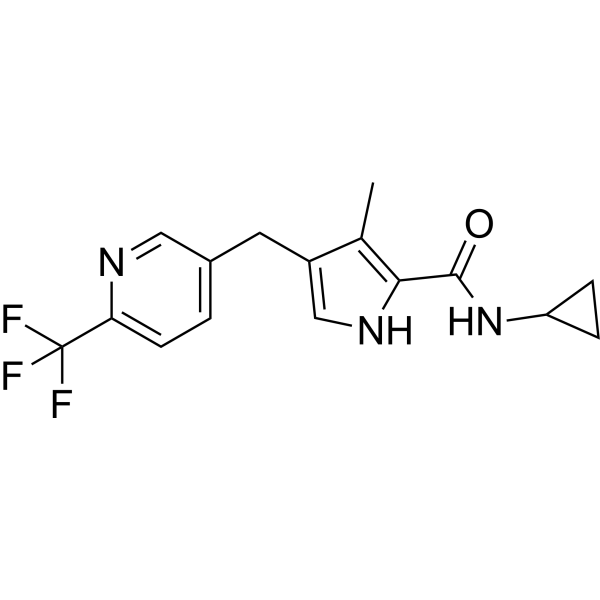
Physicochemical Properties
| Molecular Formula | C16H16F3N3O |
| Molecular Weight | 323.31 |
| Exact Mass | 323.124 |
| CAS # | 2426616-55-7 |
| PubChem CID | 154699462 |
| Appearance | White to off-white solid powder |
| LogP | 3 |
| Hydrogen Bond Donor Count | 2 |
| Hydrogen Bond Acceptor Count | 5 |
| Rotatable Bond Count | 4 |
| Heavy Atom Count | 23 |
| Complexity | 439 |
| Defined Atom Stereocenter Count | 0 |
| SMILES | N1C=C(CC2=CC=C(C(F)(F)F)N=C2)C(C)=C1C(NC1CC1)=O |
| InChi Key | AFOVOYRODSYDMK-UHFFFAOYSA-N |
| InChi Code | InChI=1S/C16H16F3N3O/c1-9-11(8-21-14(9)15(23)22-12-3-4-12)6-10-2-5-13(20-7-10)16(17,18)19/h2,5,7-8,12,21H,3-4,6H2,1H3,(H,22,23) |
| Chemical Name | N-cyclopropyl-3-methyl-4-[[6-(trifluoromethyl)pyridin-3-yl]methyl]-1H-pyrrole-2-carboxamide |
| HS Tariff Code | 2934.99.9001 |
| Storage |
Powder-20°C 3 years 4°C 2 years In solvent -80°C 6 months -20°C 1 month |
| Shipping Condition | Room temperature (This product is stable at ambient temperature for a few days during ordinary shipping and time spent in Customs) |
Biological Activity
| Targets | Plasmodium |
| ln Vitro | DSM502 has inhibitory activity with no inhibition of the human enzyme against P. falciparum DHODH (PfDHODH, IC50=20 nM), P. vivax DHODH (PvDHODH, IC50=14 nM), and Pf3D7 cells (EC50=14 nM)[1]. |
| ln Vivo | In contrast to the 85% clearance in the GSK research, DSM502 (10 and 50 mg/kg; po once daily for 4 days) results in 97% parasite clearance in a confirmatory SCID study[1]. Mouse studies with DSM502 (18.3 and 50 mg/kg; a single po) show high oral bioavailability (>100%, >100%), apparent t1/2 (2.6, 3.6 h), and Cmax (8.4, 42.3 μM)[1]. In mice, Vss (1.2 L/kg), plasma clearance (26.1 mL/min/kg), and apparent t1/2 (2.8 h) are all demonstrated by DSM502 (2.8 mg/kg; a single IV)[1]. |
| Animal Protocol |
Animal/Disease Models: SCID (severe combined immunodeficient) mouse (23-36 g) were inoculated with parasites[1] Doses: 10 and 50 mg/kg Route of Administration: Po one time/day for 4 days starting on day 3 after mice had been inoculated with parasites Experimental Results: Resulted in 97% parasite clearance compared to 85% clearance in the GSK study. The 10 mg/kg mouse died on day 5. |
| References |
[1]. Lead Optimization of a Pyrrole-Based Dihydroorotate Dehydrogenase Inhibitor Series for the Treatment of Malaria. J Med Chem. 2020 May 14;63(9):4929-4956. [2]. Potent Antimalarials with Development Potential Identified by Structure-Guided Computational Optimization of a Pyrrole-Based Dihydroorotate Dehydrogenase Inhibitor Series. J Med Chem. 2021 May 13;64(9):6085-6136. |
Solubility Data
| Solubility (In Vitro) | DMSO : 250 mg/mL (773.25 mM) |
| Solubility (In Vivo) |
Solubility in Formulation 1: ≥ 2.08 mg/mL (6.43 mM) (saturation unknown) in 10% DMSO + 90% (20% SBE-β-CD in Saline) (add these co-solvents sequentially from left to right, and one by one), clear solution. For example, if 1 mL of working solution is to be prepared, you can add 100 μL of 20.8 mg/mL clear DMSO stock solution to 900 μL of 20% SBE-β-CD physiological saline solution and mix evenly. Preparation of 20% SBE-β-CD in Saline (4°C,1 week): Dissolve 2 g SBE-β-CD in 10 mL saline to obtain a clear solution. Solubility in Formulation 2: ≥ 2.08 mg/mL (6.43 mM) (saturation unknown) in 10% DMSO + 90% Corn Oil (add these co-solvents sequentially from left to right, and one by one), clear solution. For example, if 1 mL of working solution is to be prepared, you can add 100 μL of 20.8 mg/mL clear DMSO stock solution to 900 μL of corn oil and mix evenly. (Please use freshly prepared in vivo formulations for optimal results.) |
| Preparing Stock Solutions | 1 mg | 5 mg | 10 mg | |
| 1 mM | 3.0930 mL | 15.4650 mL | 30.9301 mL | |
| 5 mM | 0.6186 mL | 3.0930 mL | 6.1860 mL | |
| 10 mM | 0.3093 mL | 1.5465 mL | 3.0930 mL |