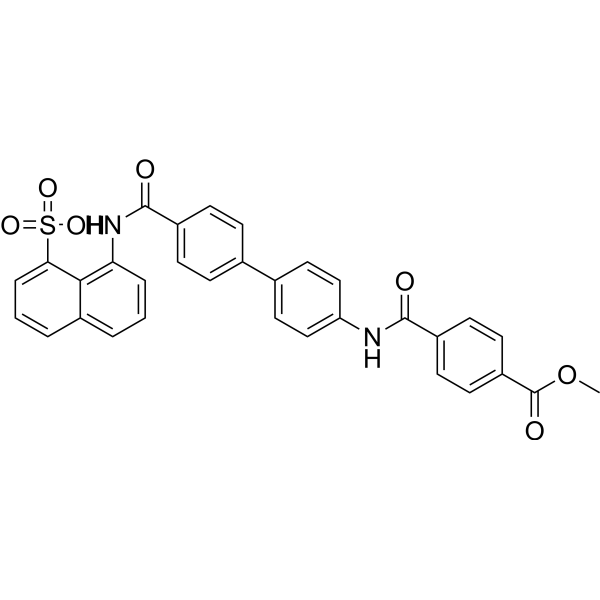
Physicochemical Properties
| Molecular Formula | C32H24N2O7S |
| Molecular Weight | 580.607167243958 |
| Exact Mass | 580.13 |
| CAS # | 2101765-81-3 |
| PubChem CID | 129275747 |
| Appearance | Off-white to gray solid powder |
| LogP | 5.1 |
| Hydrogen Bond Donor Count | 3 |
| Hydrogen Bond Acceptor Count | 7 |
| Rotatable Bond Count | 8 |
| Heavy Atom Count | 42 |
| Complexity | 1050 |
| Defined Atom Stereocenter Count | 0 |
| SMILES | S(C1C=CC=C2C=CC=C(C2=1)NC(C1C=CC(=CC=1)C1C=CC(=CC=1)NC(C1C=CC(C(=O)OC)=CC=1)=O)=O)(=O)(=O)O |
| InChi Key | BZAWLSZPOBGURT-UHFFFAOYSA-N |
| InChi Code | InChI=1S/C32H24N2O7S/c1-41-32(37)25-14-12-23(13-15-25)30(35)33-26-18-16-21(17-19-26)20-8-10-24(11-9-20)31(36)34-27-6-2-4-22-5-3-7-28(29(22)27)42(38,39)40/h2-19H,1H3,(H,33,35)(H,34,36)(H,38,39,40) |
| Chemical Name | 8-[[4-[4-[(4-methoxycarbonylbenzoyl)amino]phenyl]benzoyl]amino]naphthalene-1-sulfonic acid |
| HS Tariff Code | 2934.99.9001 |
| Storage |
Powder-20°C 3 years 4°C 2 years In solvent -80°C 6 months -20°C 1 month |
| Shipping Condition | Room temperature (This product is stable at ambient temperature for a few days during ordinary shipping and time spent in Customs) |
Biological Activity
| Targets |
DRI-C21045 targets CD40-CD40L costimulatory protein-protein interaction (PPI) (IC₅₀ = 0.17 μM) [1, 2, 4, 6] DRI-C21045 inhibits CD40L-induced NF-κB activation (IC₅₀ = 17.1 μM) and CD40L-induced B cell proliferation (IC₅₀ = 4.5 μM) [2, 4, 6] |
| ln Vitro |
CD40L-induced NF-κB activation in CD40 sensor cells is concentration-dependently inhibited by DRI-C21045 (3.2-100 μM; 18 h) [1]. Primary B cells' CD40L-induced functional activation is blocked by DRI-C21045 (0.6–50 μM; 48 hours) [1]. In THP-1 cells, CD40L-induced MHC-II upregulation is inhibited by DRI-C21045 (0.4-50 μM; 48 hours) [1]. The 48-hour DRI-C21045 (2-100 μM) inhibits the proliferation of B cells induced by CD40L [1]. At concentrations of up to 500 µM, DRI-C21045 exhibits no potential genotoxicity and no indications of cytotoxicity [1]. - In cell-free ELISA-type assay, DRI-C21045 concentration-dependently inhibited human CD40-CD40L interaction, with no significant inhibition of human TNF-R1-TNF-α interaction at effective concentrations [1] - In CD40 sensor cells, DRI-C21045 (3.2–100 μM, 18 h) concentration-dependently inhibited CD40L (20 ng/mL)-induced NF-κB activation, with an anti-CD40L antibody as positive control [1, 2] - In primary human B cells stimulated with IL-4 (0.2 μg/mL) and CD40L (0.2 μg/mL), DRI-C21045 (0.6–50 μM, 48 h) blocked CD40L-induced functional activation (AID activation quantified via fluorescent marker by flow cytometry) and (2–100 μM, 48 h) inhibited CD40L-induced B cell proliferation [1, 2] - In THP-1 myeloid cells, DRI-C21045 (0.4–50 μM, 48 h) inhibited CD40L-induced MHC-II upregulation [2] - At concentrations up to 500 μM, DRI-C21045 showed no potential genotoxicity or cytotoxicity [2] |
| ln Vivo |
In a mouse skin allograft model, DRI-C21045 (30 mg/kg; daily, subcutaneous; in 20% HPβCD) prolongs graft life [1]. In draining lymph nodes (DLN), DRI-C21045 (20–60 mg/kg; subcutaneous injection twice daily; dissolved in 20% HPβCD) suppresses T cell growth induced by alloantigen [1]. - In a mouse skin allograft model (full-thickness ear skin transplantation from Balb/c to dorsal thorax of C57BL/6 mice), DRI-C21045 (30 mg/kg, daily subcutaneous injection in 20% HPβCD) combined with CTLA4-Ig (250 μg on days 0, 2, 4, 6) significantly prolonged skin allograft survival compared to CTLA4-Ig alone [1, 2] - In Balb/c mice receiving footpad injection of DBA-2 mouse splenocytes, DRI-C21045 (20–60 mg/kg, twice daily subcutaneous injection in 20% HPβCD from day -1 to 3) dose-dependently suppressed alloantigen-induced T cell expansion in draining popliteal lymph nodes [1, 2] |
| Enzyme Assay |
- Cell-free CD40-CD40L interaction assay: The interaction between human CD40 and CD40L was quantified using an ELISA-type assay. DRI-C21045 at different concentrations was added, and the inhibitory effect was evaluated by measuring normalized percent binding. Data were presented as average ± SD from 3 independent experiments with triplicates per condition, and standard binding curves were fitted [1] - CD40L-induced NF-κB activation assay in CD40 sensor cells: CD40 sensor cells were treated with DRI-C21045 at various concentrations (3.2–100 μM) for 18 h, then stimulated with CD40L (20 ng/mL). NF-κB activation level was detected, and data were collected from 4 independent experiments with duplicates per condition, normalized to CD40L-activated cells alone [1, 2] |
| Cell Assay |
- Primary human B cell functional activation assay: Human B cells were transfected with a lentiviral construct containing the aicda promoter/enhancer fused to Ds-Red reporter. Transfected cells were treated with DRI-C21045 (0.6–50 μM) and stimulated with IL-4 (0.2 μg/mL) + CD40L (0.2 μg/mL) for 48 h. AID activation was evaluated by Ds-Red level via flow cytometry, with an anti-CD40L antibody (33.3 nM) as positive control [1, 2] - Primary human B cell proliferation assay: Primary human B cells were treated with DRI-C21045 (2–100 μM) and stimulated with CD40L for 48 h. Cell proliferation was measured to assess inhibitory effect [2] - THP-1 cell MHC-II upregulation assay: THP-1 cells were treated with DRI-C21045 (0.4–50 μM) and stimulated with CD40L for 48 h. MHC-II expression level was detected to evaluate inhibitory activity [2] |
| Animal Protocol |
Animal/Disease Models: Full-thickness ear skin transplantation from BALB/c to dorsal thorax of C57BL/6 [1] Doses: 30 mg/kg Route of Administration: daily subcutaneous injection; in 20% w/v hydroxypropyl-β-cyclo Administration of dextrin (HPβCD) in solution resulted in prolonged skin allograft survival. - Mouse skin allograft experiment: C57BL/6 mice were transplanted with full-thickness ear skin from Balb/c mice. Mice were treated with DRI-C21045 (30 mg/kg, daily subcutaneous injection) dissolved in 20% w/v hydroxypropyl-β-cyclodextrin (HPβCD), combined with CTLA4-Ig (250 μg administered on days 0, 2, 4, 6). Graft survival time was monitored, with 5–8 mice per group [1, 2] - Mouse draining lymph node (DLN) T cell expansion experiment: Balb/c mice received footpad injection of DBA-2 mouse splenocytes. Mice were treated with DRI-C21045 (20–60 mg/kg, twice daily subcutaneous injection) dissolved in 20% HPβCD from day -1 to 3. On day 3 post-alloantigen challenge, popliteal DLNs were collected and DLN cell count was performed to assess T cell expansion, with 3–4 mice per group [1, 2] - Mouse pharmacokinetic experiment: Mice received a single subcutaneous dose of DRI-C21045 (1.6 mg/mouse). Plasma concentrations of DRI-C21045 were measured at different time points, and data were fitted with a one-compartment pharmacokinetic model with first-order absorption and elimination (n = 4, average ± SD) [1] |
| ADME/Pharmacokinetics |
- In mice, following a single subcutaneous dose of DRI-C21045 (1.6 mg/mouse), plasma concentration-time profile was fitted to a one-compartment model with first-order absorption and first-order elimination [1] |
| Toxicity/Toxicokinetics |
- In vitro, DRI-C21045 exhibited no cytotoxicity or genotoxicity at concentrations up to 500 μM [2] - In vivo, no overt toxicity (e.g., weight loss, clinical signs) was observed in mice treated with DRI-C21045 at doses up to 60 mg/kg (twice daily subcutaneous injection) [1, 2] |
| References |
[1]. Small-Molecule Inhibitors of the CD40-CD40L Costimulatory Protein-Protein Interaction. J Med Chem. 2017 Nov 9;60(21):8906-8922. [2]. Toward Small-Molecule Inhibition of Protein-Protein Interactions: General Aspects and Recent Progress in Targeting Costimulatory and Coinhibitory (Immune Checkpoint) Interactions. Curr Top Med Chem. 2018;18(8):674-699. |
| Additional Infomation |
- Chemical properties of DRI-C21045: CAS No. 2101765-81-3; molecular weight 580.61; molecular formula C₃₂H₂₄N₂O₇S [4, 6] - Solubility of DRI-C21045: 2 mg/mL (3.44 mM) in DMSO (requires ultrasonic treatment) [6] - Storage conditions of DRI-C21045: Powder stored at -20°C for 3 years; solution stored at -80°C for 2 years [6] - DRI-C21045 is a potent and selective small-molecule inhibitor of CD40-CD40L PPI, developed for immunomodulation in transplantation and autoimmune diseases [1, 2] |
Solubility Data
| Solubility (In Vitro) | DMSO : ~2 mg/mL (~3.44 mM) |
| Solubility (In Vivo) |
Solubility in Formulation 1: 0.5 mg/mL (0.86 mM) in 10% DMSO + 90% (20% SBE-β-CD in Saline) (add these co-solvents sequentially from left to right, and one by one), suspension solution; with sonication. For example, if 1 mL of working solution is to be prepared, you can add 100 μL of 5.0 mg/mL clear DMSO stock solution to 900 μL of 20% SBE-β-CD physiological saline solution and mix evenly. Preparation of 20% SBE-β-CD in Saline (4°C,1 week): Dissolve 2 g SBE-β-CD in 10 mL saline to obtain a clear solution. (Please use freshly prepared in vivo formulations for optimal results.) |
| Preparing Stock Solutions | 1 mg | 5 mg | 10 mg | |
| 1 mM | 1.7223 mL | 8.6116 mL | 17.2233 mL | |
| 5 mM | 0.3445 mL | 1.7223 mL | 3.4447 mL | |
| 10 mM | 0.1722 mL | 0.8612 mL | 1.7223 mL |