Physicochemical Properties
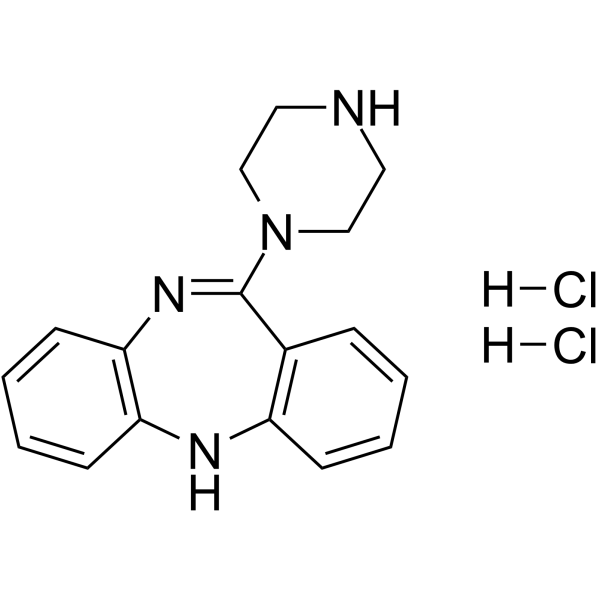
| Molecular Formula | C17H20CL2N4 |
| Molecular Weight | 351.27 |
| Exact Mass | 350.106 |
| CAS # | 2250025-92-2 |
| Related CAS # | DREADD agonist 21;56296-18-5 |
| PubChem CID | 134812837 |
| Appearance | Light yellow to yellow solid powder |
| Hydrogen Bond Donor Count | 4 |
| Hydrogen Bond Acceptor Count | 3 |
| Rotatable Bond Count | 1 |
| Heavy Atom Count | 23 |
| Complexity | 388 |
| Defined Atom Stereocenter Count | 0 |
| SMILES | N1(C2C3=CC=CC=C3NC3=CC=CC=C3N=2)CCNCC1.Cl.Cl |
| InChi Key | SETCOPAXYQJWKI-UHFFFAOYSA-N |
| InChi Code | InChI=1S/C17H18N4.2ClH/c1-2-6-14-13(5-1)17(21-11-9-18-10-12-21)20-16-8-4-3-7-15(16)19-14;;/h1-8,18-19H,9-12H2;2*1H |
| Chemical Name | 6-piperazin-1-yl-11H-benzo[b][1,4]benzodiazepine;dihydrochloride |
| HS Tariff Code | 2934.99.9001 |
| Storage |
Powder-20°C 3 years 4°C 2 years In solvent -80°C 6 months -20°C 1 month Note: Please store this product in a sealed and protected environment (e.g. under nitrogen), avoid exposure to moisture. |
| Shipping Condition | Room temperature (This product is stable at ambient temperature for a few days during ordinary shipping and time spent in Customs) |
Biological Activity
| Targets | EC50: 1.7 nM (hM3Dq)[1] pKi: 5.97 (hM1), 5.44 (hM4), 7.20 (hM1Dq), and 6.75 (hM4Di)[2] Ki: 6 nM (H1 histamine receptor), 66 nM (5HT2A serotonin receptor 5HT2A), 170 nM (5HT2C serotonin receptor), 280 nM (α1A adrenergic receptor)[1] |
| ln Vitro | Human muscarinic cholinergic M3 receptors (hM3Dq) are strongly agonistic to DREADD agonist 21 (EC50=1.7 nM), which does not activate human M3 receptors (hM3). Apart from its inactivity at hM3, DREADD agonist 21, a powerful full agonist of hM3Dq (EC50=1.7 nM), exhibits selectiveities of only 3.5 fold for hM3Dq over H1, 40 fold over 5HT2A, 100 fold over 5HT2C, and 165 fold over α1A. With Ki values of 66, 170, 280, and 6 nM, respectively, DREADD agonist 21 has strong binding affinities to the α1A adrenergic receptor, the H1 histamine receptor, and the 5HT2A and 5HT2C serotonin receptor[1]. hM1Dq, hM3Dq, and hM4Di are all strongly activated by DREADD agonist 21. The DREADD agonist 21 has pKis of 5.97, 5.44, 7.20, and 6.75 for binding to the hM1, hM4, hM1Dq, and hM4Di receptors, respectively. With a pEC50 of 8.48±0.05, DREADD agonist 21 potently activates hM3Dq in transfected Chinese hamster ovary (CHO) cells in vitro. A highly potent and selective agonist for muscarinic DREADDs, DREADD agonist 21 (pEC50 for hM1Dq=6.54 and that for hM4Di=7.77 in pERK assays)[2]. |
| ln Vivo | In mice, intraperitoneal DREADD agonist 21 (0.3, 1.0, and 3.0 mg/kg) activates neuronal hM3Dq[2]. Excellent brain penetrability, pharmacokinetics, and bioavailability characterize DREADD agonist 21. In mice, DREADD agonist 21 (0.1, 1, and 10 mg/kg; ip) exhibits 95.1% binding to plasma proteins and 95% binding to brain proteins[2]. |
| References |
[1]. The first structure-activity relationship studies for designer receptors exclusively activated by designer drugs. ACS Chem Neurosci. 2015 Mar 18;6(3):476-84. [2]. DREADD Agonist 21 Is an Effective Agonist for Muscarinic-Based DREADDs in Vitro and in Vivo. ACS Pharmacol Transl Sci. 2018 Sep 14;1(1):61-72. |
Solubility Data
| Solubility (In Vitro) | DMSO: 200 mg/mL (569.36 mM) |
| Solubility (In Vivo) |
Note: Listed below are some common formulations that may be used to formulate products with low water solubility (e.g. < 1 mg/mL), you may test these formulations using a minute amount of products to avoid loss of samples. Injection Formulations (e.g. IP/IV/IM/SC) Injection Formulation 1: DMSO : Tween 80: Saline = 10 : 5 : 85 (i.e. 100 μL DMSO stock solution → 50 μL Tween 80 → 850 μL Saline) *Preparation of saline: Dissolve 0.9 g of sodium chloride in 100 mL ddH ₂ O to obtain a clear solution. Injection Formulation 2: DMSO : PEG300 :Tween 80 : Saline = 10 : 40 : 5 : 45 (i.e. 100 μL DMSO → 400 μLPEG300 → 50 μL Tween 80 → 450 μL Saline) Injection Formulation 3: DMSO : Corn oil = 10 : 90 (i.e. 100 μL DMSO → 900 μL Corn oil) Example: Take the Injection Formulation 3 (DMSO : Corn oil = 10 : 90) as an example, if 1 mL of 2.5 mg/mL working solution is to be prepared, you can take 100 μL 25 mg/mL DMSO stock solution and add to 900 μL corn oil, mix well to obtain a clear or suspension solution (2.5 mg/mL, ready for use in animals). Injection Formulation 4: DMSO : 20% SBE-β-CD in saline = 10 : 90 [i.e. 100 μL DMSO → 900 μL (20% SBE-β-CD in saline)] *Preparation of 20% SBE-β-CD in Saline (4°C,1 week): Dissolve 2 g SBE-β-CD in 10 mL saline to obtain a clear solution. Injection Formulation 5: 2-Hydroxypropyl-β-cyclodextrin : Saline = 50 : 50 (i.e. 500 μL 2-Hydroxypropyl-β-cyclodextrin → 500 μL Saline) Injection Formulation 6: DMSO : PEG300 : castor oil : Saline = 5 : 10 : 20 : 65 (i.e. 50 μL DMSO → 100 μLPEG300 → 200 μL castor oil → 650 μL Saline) Injection Formulation 7: Ethanol : Cremophor : Saline = 10: 10 : 80 (i.e. 100 μL Ethanol → 100 μL Cremophor → 800 μL Saline) Injection Formulation 8: Dissolve in Cremophor/Ethanol (50 : 50), then diluted by Saline Injection Formulation 9: EtOH : Corn oil = 10 : 90 (i.e. 100 μL EtOH → 900 μL Corn oil) Injection Formulation 10: EtOH : PEG300:Tween 80 : Saline = 10 : 40 : 5 : 45 (i.e. 100 μL EtOH → 400 μLPEG300 → 50 μL Tween 80 → 450 μL Saline) Oral Formulations Oral Formulation 1: Suspend in 0.5% CMC Na (carboxymethylcellulose sodium) Oral Formulation 2: Suspend in 0.5% Carboxymethyl cellulose Example: Take the Oral Formulation 1 (Suspend in 0.5% CMC Na) as an example, if 100 mL of 2.5 mg/mL working solution is to be prepared, you can first prepare 0.5% CMC Na solution by measuring 0.5 g CMC Na and dissolve it in 100 mL ddH2O to obtain a clear solution; then add 250 mg of the product to 100 mL 0.5% CMC Na solution, to make the suspension solution (2.5 mg/mL, ready for use in animals). Oral Formulation 3: Dissolved in PEG400 Oral Formulation 4: Suspend in 0.2% Carboxymethyl cellulose Oral Formulation 5: Dissolve in 0.25% Tween 80 and 0.5% Carboxymethyl cellulose Oral Formulation 6: Mixing with food powders Note: Please be aware that the above formulations are for reference only. InvivoChem strongly recommends customers to read literature methods/protocols carefully before determining which formulation you should use for in vivo studies, as different compounds have different solubility properties and have to be formulated differently. (Please use freshly prepared in vivo formulations for optimal results.) |
| Preparing Stock Solutions | 1 mg | 5 mg | 10 mg | |
| 1 mM | 2.8468 mL | 14.2341 mL | 28.4681 mL | |
| 5 mM | 0.5694 mL | 2.8468 mL | 5.6936 mL | |
| 10 mM | 0.2847 mL | 1.4234 mL | 2.8468 mL |