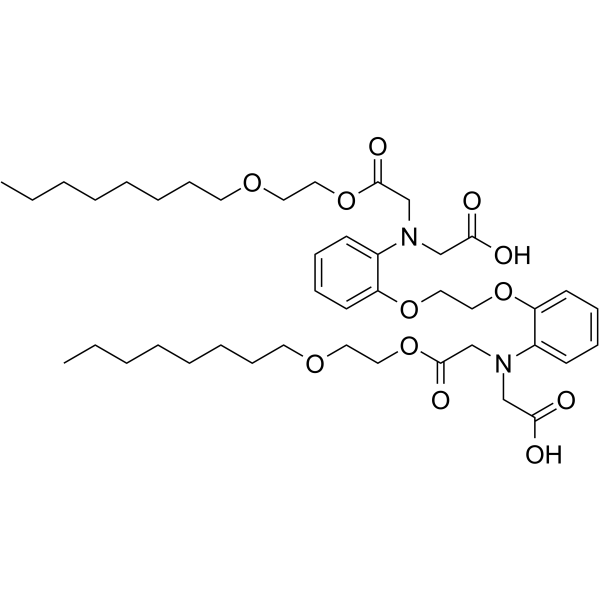
Physicochemical Properties
| Molecular Formula | C42H64N2O12 |
| Molecular Weight | 788.96376 |
| Exact Mass | 788.445 |
| CAS # | 222315-88-0 |
| PubChem CID | 9810955 |
| Appearance | White to light yellow solid powder |
| Density | 1.2±0.1 g/cm3 |
| Boiling Point | 864.8±65.0 °C at 760 mmHg |
| Flash Point | 476.8±34.3 °C |
| Vapour Pressure | 0.0±0.3 mmHg at 25°C |
| Index of Refraction | 1.542 |
| LogP | 9.4 |
| Hydrogen Bond Donor Count | 2 |
| Hydrogen Bond Acceptor Count | 14 |
| Rotatable Bond Count | 37 |
| Heavy Atom Count | 56 |
| Complexity | 969 |
| Defined Atom Stereocenter Count | 0 |
| InChi Key | FTGBVHPWUIHWRH-UHFFFAOYSA-N |
| InChi Code | InChI=1S/C42H64N2O12/c1-3-5-7-9-11-17-23-51-25-27-55-41(49)33-43(31-39(45)46)35-19-13-15-21-37(35)53-29-30-54-38-22-16-14-20-36(38)44(32-40(47)48)34-42(50)56-28-26-52-24-18-12-10-8-6-4-2/h13-16,19-22H,3-12,17-18,23-34H2,1-2H3,(H,45,46)(H,47,48) |
| Chemical Name | 2-[2-[2-[2-[carboxymethyl-[2-(2-octoxyethoxy)-2-oxoethyl]amino]phenoxy]ethoxy]-N-[2-(2-octoxyethoxy)-2-oxoethyl]anilino]acetic acid |
| Synonyms | DP-BAPTA-99; DP-b-99; DP-b 99 |
| HS Tariff Code | 2934.99.9001 |
| Storage |
Powder-20°C 3 years 4°C 2 years In solvent -80°C 6 months -20°C 1 month Note: This product requires protection from light (avoid light exposure) during transportation and storage. |
| Shipping Condition | Room temperature (This product is stable at ambient temperature for a few days during ordinary shipping and time spent in Customs) |
Biological Activity
| Additional Infomation |
DP-b99 is a newly developed lipophilic, cell permeable derivative of BAPTA (1,2-bis(2-aminophenoxy)ethane-N,N,N',N'-tetraacetic acid), that is under development as a neuroprotectant for the potential treatment of stroke, head trauma and neurological damage associated with coronary artery bypass graft. Drug Indication Investigated for use/treatment in strokes and traumatic brain injuries. Mechanism of Action DP-b99 is a discovery product, rationally designed using D-Pharm’s proprietary technology, Membrane Active Chelators (MAC). Considerable evidence suggests that redistribution of metal ions and disturbances in metal ion homeostasis are key components in the cascade of events underlying cell damage in stroke. In the first hours post-stroke ion disturbances cause excitatory cell damage and in the days and weeks following they contribute to edema, inflammation and cell death. DP-b99 is a novel approach to neuroprotection based on selective modulation of calcium, zinc, copper and iron homeostasis in the vicinity of cell membranes. |
Solubility Data
| Solubility (In Vitro) | DMSO : ~100 mg/mL (~126.75 mM) |
| Solubility (In Vivo) |
Solubility in Formulation 1: ≥ 2.5 mg/mL (3.17 mM) (saturation unknown) in 10% DMSO + 40% PEG300 + 5% Tween80 + 45% Saline (add these co-solvents sequentially from left to right, and one by one), clear solution. For example, if 1 mL of working solution is to be prepared, you can add 100 μL of 25.0 mg/mL clear DMSO stock solution to 400 μL PEG300 and mix evenly; then add 50 μL Tween-80 to the above solution and mix evenly; then add 450 μL normal saline to adjust the volume to 1 mL. Preparation of saline: Dissolve 0.9 g of sodium chloride in 100 mL ddH₂ O to obtain a clear solution. Solubility in Formulation 2: ≥ 2.5 mg/mL (3.17 mM) (saturation unknown) in 10% DMSO + 90% (20% SBE-β-CD in Saline) (add these co-solvents sequentially from left to right, and one by one), suspension solution. For example, if 1 mL of working solution is to be prepared, you can add 100 μL of 25.0 mg/mL clear DMSO stock solution to 900 μL of 20% SBE-β-CD physiological saline solution and mix evenly. Preparation of 20% SBE-β-CD in Saline (4°C,1 week): Dissolve 2 g SBE-β-CD in 10 mL saline to obtain a clear solution. Solubility in Formulation 3: ≥ 2.5 mg/mL (3.17 mM) (saturation unknown) in 10% DMSO + 90% Corn Oil (add these co-solvents sequentially from left to right, and one by one), clear solution. For example, if 1 mL of working solution is to be prepared, you can add 100 μL of 25.0 mg/mL clear DMSO stock solution to 900 μL of corn oil and mix evenly. (Please use freshly prepared in vivo formulations for optimal results.) |
| Preparing Stock Solutions | 1 mg | 5 mg | 10 mg | |
| 1 mM | 1.2675 mL | 6.3375 mL | 12.6749 mL | |
| 5 mM | 0.2535 mL | 1.2675 mL | 2.5350 mL | |
| 10 mM | 0.1267 mL | 0.6337 mL | 1.2675 mL |