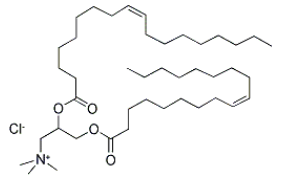
DOTAP chloride is a novel cationic lipid that has been used in gene delivery, e.g. transfecting DNA, RNA, or other negatively charged molecules into eukaryotic cells.
Physicochemical Properties
| Molecular Formula | C42H80NO4+ |
| Molecular Weight | 663.0889 |
| Exact Mass | 662.609 |
| CAS # | 132172-61-3 |
| Related CAS # | 132172-61-3 (chloride);113669-21-9 (cation); |
| PubChem CID | 11636182 |
| Appearance | White to off-white <35°C powder,>38°C liquid |
| Melting Point | 35-38ºC |
| LogP | 12.222 |
| Hydrogen Bond Donor Count | 0 |
| Hydrogen Bond Acceptor Count | 5 |
| Rotatable Bond Count | 37 |
| Heavy Atom Count | 48 |
| Complexity | 754 |
| Defined Atom Stereocenter Count | 0 |
| SMILES | CCCCCCCC/C=C\CCCCCCCC(=O)OCC(C[N+](C)(C)C)OC(=O)CCCCCCC/C=C\CCCCCCCC.[Cl-] |
| InChi Key | KSXTUUUQYQYKCR-LQDDAWAPSA-M |
| InChi Code | InChI=1S/C42H80NO4.ClH/c1-6-8-10-12-14-16-18-20-22-24-26-28-30-32-34-36-41(44)46-39-40(38-43(3,4)5)47-42(45)37-35-33-31-29-27-25-23-21-19-17-15-13-11-9-7-2;/h20-23,40H,6-19,24-39H2,1-5H3;1H/q+1;/p-1/b22-20-,23-21-; |
| Chemical Name | 2,3-bis[[(Z)-octadec-9-enoyl]oxy]propyl-trimethylazanium;chloride |
| HS Tariff Code | 2934.99.9001 |
| Storage |
Powder-20°C 3 years 4°C 2 years In solvent -80°C 6 months -20°C 1 month Note: (1). This product requires protection from light (avoid light exposure) during transportation and storage.(2). Please store this product in a sealed and protected environment (e.g. under nitrogen), avoid exposure to moisture. |
| Shipping Condition | Room temperature (This product is stable at ambient temperature for a few days during ordinary shipping and time spent in Customs) |
Biological Activity
| ln Vitro | Gate bodies attach to DNA and recombine. Size and zeta potential have little effect on the transfection efficacy of DOTAP gates, but gate composition and cell type do [1]. |
| References |
[1]. DOTAP/DOPE ratio and cell type determine transfection efficiency with DOTAP-liposomes.Biochim Biophys Acta. 2015 Oct;1848(10 Pt A):1996-2001. |
Solubility Data
| Solubility (In Vitro) |
Ethanol : ~130 mg/mL (~186.10 mM) DMSO : ~25 mg/mL (~35.79 mM) |
| Solubility (In Vivo) |
Solubility in Formulation 1: ≥ 2.5 mg/mL (3.58 mM) (saturation unknown) in 10% DMSO + 40% PEG300 + 5% Tween80 + 45% Saline (add these co-solvents sequentially from left to right, and one by one), clear solution. For example, if 1 mL of working solution is to be prepared, you can add 100 μL of 25.0 mg/mL clear DMSO stock solution to 400 μL PEG300 and mix evenly; then add 50 μL Tween-80 to the above solution and mix evenly; then add 450 μL normal saline to adjust the volume to 1 mL. Preparation of saline: Dissolve 0.9 g of sodium chloride in 100 mL ddH₂ O to obtain a clear solution. Solubility in Formulation 2: 2.5 mg/mL (3.58 mM) in 10% DMSO + 90% (20% SBE-β-CD in Saline) (add these co-solvents sequentially from left to right, and one by one), suspension solution; with ultrasonication. For example, if 1 mL of working solution is to be prepared, you can add 100 μL of 25.0 mg/mL clear DMSO stock solution to 900 μL of 20% SBE-β-CD physiological saline solution and mix evenly. Preparation of 20% SBE-β-CD in Saline (4°C,1 week): Dissolve 2 g SBE-β-CD in 10 mL saline to obtain a clear solution. Solubility in Formulation 3: ≥ 2.5 mg/mL (3.58 mM) (saturation unknown) in 10% DMSO + 90% Corn Oil (add these co-solvents sequentially from left to right, and one by one), clear solution. For example, if 1 mL of working solution is to be prepared, you can add 100 μL of 25.0 mg/mL clear DMSO stock solution to 900 μL of corn oil and mix evenly. (Please use freshly prepared in vivo formulations for optimal results.) |
| Preparing Stock Solutions | 1 mg | 5 mg | 10 mg | |
| 1 mM | 1.5081 mL | 7.5405 mL | 15.0809 mL | |
| 5 mM | 0.3016 mL | 1.5081 mL | 3.0162 mL | |
| 10 mM | 0.1508 mL | 0.7540 mL | 1.5081 mL |