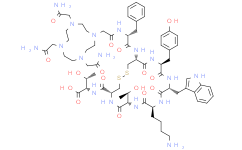
Physicochemical Properties
| Molecular Formula | C65H93N17O16S2 |
| Molecular Weight | 1432.67 |
| Exact Mass | 1431.642762 |
| Elemental Analysis | C, 54.49; H, 6.54; N, 16.62; O, 17.87; S, 4.48 |
| CAS # | 2415661-92-4 |
| PubChem CID | 135228365 |
| Sequence | DOTAM-{d-Phe}-Cys-Tyr-{d-Trp}-Lys-Thr-Cys-Thr (Disulfide bridge: Cys2-Cys7) |
| SequenceShortening | DOTAM-{d-Phe}-CY-{d-Trp}-KTCT (Disulfide bridge: Cys2-Cys7) |
| Appearance | Typically exists as solids at room temperature |
| LogP | -4.4 |
| Hydrogen Bond Donor Count | 17 |
| Hydrogen Bond Acceptor Count | 23 |
| Rotatable Bond Count | 26 |
| Heavy Atom Count | 100 |
| Complexity | 2700 |
| Defined Atom Stereocenter Count | 10 |
| SMILES | S1C[C@@H](C(N[C@@H](CC2C=CC(=CC=2)O)C(N[C@@H](C(N[C@H](C(N[C@H](C(N[C@H](C(N[C@H](C(=O)O)[C@@H](C)O)=O)CS1)=O)[C@@H](C)O)=O)CCCCN)=O)CC1=CNC2C=CC=CC1=2)=O)=O)NC([C@@H](CC1C=CC=CC=1)NC(CN1CCN(CC(N)=O)CCN(CC(N)=O)CCN(CC(N)=O)CC1)=O)=O |
| InChi Key | YXHMVRPWRYCPJP-CSBVGUNJSA-N |
| InChi Code | InChI=1S/C65H93N17O16S2/c1-38(83)56-64(96)76-51(63(95)78-57(39(2)84)65(97)98)37-100-99-36-50(75-59(91)47(28-40-10-4-3-5-11-40)71-55(89)35-82-26-24-80(33-53(68)87)22-20-79(32-52(67)86)21-23-81(25-27-82)34-54(69)88)62(94)73-48(29-41-15-17-43(85)18-16-41)60(92)74-49(30-42-31-70-45-13-7-6-12-44(42)45)61(93)72-46(58(90)77-56)14-8-9-19-66/h3-7,10-13,15-18,31,38-39,46-51,56-57,70,83-85H,8-9,14,19-30,32-37,66H2,1-2H3,(H2,67,86)(H2,68,87)(H2,69,88)(H,71,89)(H,72,93)(H,73,94)(H,74,92)(H,75,91)(H,76,96)(H,77,90)(H,78,95)(H,97,98)/t38-,39-,46+,47-,48+,49-,50+,51+,56+,57+/m1/s1 |
| Chemical Name | (2S,3R)-2-[[(4R,7S,10S,13R,16S,19R)-10-(4-aminobutyl)-7-[(1R)-1-hydroxyethyl]-16-[(4-hydroxyphenyl)methyl]-13-(1H-indol-3-ylmethyl)-6,9,12,15,18-pentaoxo-19-[[(2R)-3-phenyl-2-[[2-[4,7,10-tris(2-amino-2-oxoethyl)-1,4,7,10-tetrazacyclododec-1-yl]acetyl]amino]propanoyl]amino]-1,2-dithia-5,8,11,14,17-pentazacycloicosane-4-carbonyl]amino]-3-hydroxybutanoic acid |
| Synonyms | DOTAMTATE; J2KEK56NRS; UNII-J2KEK56NRS; 2415661-92-4; orb2815769; SCHEMBL20385901; EX-A13015; ((4R,7S,10S,13R,16S,19R)-13-((1H-INDOL-3-YL)METHYL)-10-(4-AMINOBUTYL)-16-(4-HYDROXYBENZYL)-7-((R)-1-HYDROXYETHYL)-6,9,12,15,18-PENTAOXO-19-((R)-3-PHENYL-2-(2-(4,7,10-TRIS(2-AMINO-2-OXOETHYL)-1,4,7,10-TETRAAZACYCLODODECAN-1-YL)ACETAMIDO)PROPANAMIDO)-1,2-DITHIA-5,8,11,14,17-PENTAAZACYCLOICOSANE-4-CARBONYL)-L-THREONINE |
| HS Tariff Code | 2934.99.9001 |
| Storage |
Powder-20°C 3 years 4°C 2 years In solvent -80°C 6 months -20°C 1 month |
| Shipping Condition | Room temperature (This product is stable at ambient temperature for a few days during ordinary shipping and time spent in Customs) |
Biological Activity
| Targets | 212Pb-DOTAMTATE targets the somatostatin receptor subtype 2 (SSTR2) with high affinity, as demonstrated by in vitro receptor binding assays. The IC₅₀ value for SSTR2 binding was determined to be 1.2 ± 0.3 nM in competitive radioligand displacement experiments . |
| ln Vitro | 1. Receptor Binding Affinity: Competitive radioligand binding assays using 125I-Tyr³-octreotide revealed that 212Pb-DOTAMTATE exhibits nanomolar affinity for SSTR2 (IC₅₀ = 1.2 ± 0.3 nM). This binding specificity was confirmed in SSTR2-expressing cell lines (e.g., BON-1 and QGP-1) . 2. Cell Proliferation Inhibition: In vitro MTT assays demonstrated dose-dependent inhibition of cell viability in SSTR2-positive neuroendocrine tumor cells (BON-1 and QGP-1). The IC₅₀ values were 2.1 ± 0.5 nM for BON-1 and 3.4 ± 0.8 nM for QGP-1 cells after 72-hour exposure. 3. Apoptosis Induction: Flow cytometry analysis showed increased Annexin V-positive cells in 212Pb-DOTAMTATE-treated BON-1 cells, indicating induction of apoptosis. This was accompanied by activation of caspase-3 and cleavage of poly(ADP-ribose) polymerase (PARP) . |
| ln Vivo | 1. Tumor Growth Inhibition: In athymic nude mice bearing subcutaneous BON-1 tumors, intravenous administration of 212Pb-DOTAMTATE (2.5 MBq/mouse) resulted in significant tumor growth delay compared to control groups. Tumor volumes were reduced by 65 ± 12% at day 21 post-treatment . 2. Biodistribution: Ex vivo biodistribution studies in tumor-bearing mice showed high tumor uptake of 212Pb-DOTAMTATE (18.5 ± 3.2% ID/g at 24 hours post-injection), with minimal accumulation in non-target organs (e.g., kidneys: 8.1 ± 1.5% ID/g; liver: 3.4 ± 0.7% ID/g) . 3. Tumor Regression: Histological analysis revealed extensive necrosis and reduced Ki-67 staining in tumors treated with 212Pb-DOTAMTATE, confirming anti-proliferative effects in vivo . |
| Enzyme Assay | 1. Radioligand Binding Assay: - Membrane fractions from SSTR2-expressing CHO-K1 cells were incubated with 125I-Tyr³-octreotide (0.1 nM) and increasing concentrations of 212Pb-DOTAMTATE (0.01–100 nM) in binding buffer (50 mM Tris-HCl, pH 7.4). - After 90-minute incubation at 4°C, bound and free radioligand were separated by centrifugation, and radioactivity was measured. - The IC₅₀ value was calculated using non-linear regression analysis to determine competitive binding affinity . |
| Cell Assay | 1. MTT Cell Viability Assay: - BON-1 cells (5,000 cells/well) were seeded in 96-well plates and treated with 212Pb-DOTAMTATE (0.1–100 nM) for 72 hours. - MTT solution (0.5 mg/mL) was added, and formazan crystals were solubilized with DMSO. - Absorbance at 570 nm was measured to determine cell viability, with IC₅₀ values calculated using dose-response curves . 2. Annexin V/PI Staining: - BON-1 cells treated with 212Pb-DOTAMTATE (10 nM) for 48 hours were stained with Annexin V-FITC and propidium iodide (PI). - Apoptotic cells were quantified by flow cytometry, with early apoptosis (Annexin V+/PI−) and late apoptosis/necrosis (Annexin V+/PI+) analyzed . |
| Animal Protocol | 1. Tumor Xenograft Model: - Athymic nude mice (6–8 weeks old) were subcutaneously implanted with BON-1 cells (5 × 10⁶ cells/mouse). - When tumors reached ~100 mm³, mice received a single intravenous injection of 212Pb-DOTAMTATE (2.5 MBq/mouse) in sterile saline. - Tumor volumes were measured twice weekly using calipers, and survival was monitored for 28 days . 2. Biodistribution Study: - Tumor-bearing mice were euthanized at 1, 4, 24, and 48 hours post-injection of 212Pb-DOTAMTATE (1 MBq/mouse). - Organs and tumors were harvested, weighed, and counted in a gamma counter to determine tissue uptake (% ID/g) . |
| ADME/Pharmacokinetics | 1. Blood Clearance: In mice, 212Pb-DOTAMTATE exhibited rapid blood clearance with a plasma half-life (t₁/₂) of 2.1 ± 0.4 hours. 2. Excretion: The majority of radioactivity was excreted renally, with 72 ± 8% of the dose eliminated in urine within 24 hours. 3. Tumor Retention: Tumor uptake remained stable at 18.5 ± 3.2% ID/g at 24 hours post-injection, indicating prolonged tumor retention . |
| Toxicity/Toxicokinetics | 1. Acute Toxicity: No significant weight loss or signs of distress were observed in mice receiving single doses of 212Pb-DOTAMTATE up to 10 MBq/mouse. 2. Hematological Effects: Mild transient thrombocytopenia was noted at 7 days post-treatment in high-dose groups (>5 MBq/mouse), but platelet counts recovered by day 14 . 3. Organ Toxicity: Histopathological analysis revealed minimal kidney and liver damage, with no evidence of necrosis or inflammation in non-target organs . |
| References |
[1]. Preclinical Investigation of 212Pb-DOTAMTATE for Peptide Receptor Radionuclide Therapy in a Neuroendocrine Tumor Model. Mol Cancer Ther. 2019 May;18(5):1012-1021. |
| Additional Infomation | - Mechanism of Action: 212Pb-DOTAMTATE delivers α-particle radiation (212Bi decay) to SSTR2-expressing tumors, causing double-strand DNA breaks and cell death. - Preclinical Efficacy: The compound demonstrated superior anti-tumor activity compared to β-particle emitters (e.g., 177Lu-DOTATATE) in the same neuroendocrine tumor model . - Translational Potential: These findings support further development of 212Pb-DOTAMTATE for peptide receptor radionuclide therapy (PRRT) of SSTR2-positive neuroendocrine tumors . |
Solubility Data
| Solubility (In Vitro) | May dissolve in DMSO (in most cases), if not, try other solvents such as H2O, Ethanol, or DMF with a minute amount of products to avoid loss of samples |
| Solubility (In Vivo) |
Note: Listed below are some common formulations that may be used to formulate products with low water solubility (e.g. < 1 mg/mL), you may test these formulations using a minute amount of products to avoid loss of samples. Injection Formulations (e.g. IP/IV/IM/SC) Injection Formulation 1: DMSO : Tween 80: Saline = 10 : 5 : 85 (i.e. 100 μL DMSO stock solution → 50 μL Tween 80 → 850 μL Saline) *Preparation of saline: Dissolve 0.9 g of sodium chloride in 100 mL ddH ₂ O to obtain a clear solution. Injection Formulation 2: DMSO : PEG300 :Tween 80 : Saline = 10 : 40 : 5 : 45 (i.e. 100 μL DMSO → 400 μLPEG300 → 50 μL Tween 80 → 450 μL Saline) Injection Formulation 3: DMSO : Corn oil = 10 : 90 (i.e. 100 μL DMSO → 900 μL Corn oil) Example: Take the Injection Formulation 3 (DMSO : Corn oil = 10 : 90) as an example, if 1 mL of 2.5 mg/mL working solution is to be prepared, you can take 100 μL 25 mg/mL DMSO stock solution and add to 900 μL corn oil, mix well to obtain a clear or suspension solution (2.5 mg/mL, ready for use in animals). Injection Formulation 4: DMSO : 20% SBE-β-CD in saline = 10 : 90 [i.e. 100 μL DMSO → 900 μL (20% SBE-β-CD in saline)] *Preparation of 20% SBE-β-CD in Saline (4°C,1 week): Dissolve 2 g SBE-β-CD in 10 mL saline to obtain a clear solution. Injection Formulation 5: 2-Hydroxypropyl-β-cyclodextrin : Saline = 50 : 50 (i.e. 500 μL 2-Hydroxypropyl-β-cyclodextrin → 500 μL Saline) Injection Formulation 6: DMSO : PEG300 : castor oil : Saline = 5 : 10 : 20 : 65 (i.e. 50 μL DMSO → 100 μLPEG300 → 200 μL castor oil → 650 μL Saline) Injection Formulation 7: Ethanol : Cremophor : Saline = 10: 10 : 80 (i.e. 100 μL Ethanol → 100 μL Cremophor → 800 μL Saline) Injection Formulation 8: Dissolve in Cremophor/Ethanol (50 : 50), then diluted by Saline Injection Formulation 9: EtOH : Corn oil = 10 : 90 (i.e. 100 μL EtOH → 900 μL Corn oil) Injection Formulation 10: EtOH : PEG300:Tween 80 : Saline = 10 : 40 : 5 : 45 (i.e. 100 μL EtOH → 400 μLPEG300 → 50 μL Tween 80 → 450 μL Saline) Oral Formulations Oral Formulation 1: Suspend in 0.5% CMC Na (carboxymethylcellulose sodium) Oral Formulation 2: Suspend in 0.5% Carboxymethyl cellulose Example: Take the Oral Formulation 1 (Suspend in 0.5% CMC Na) as an example, if 100 mL of 2.5 mg/mL working solution is to be prepared, you can first prepare 0.5% CMC Na solution by measuring 0.5 g CMC Na and dissolve it in 100 mL ddH2O to obtain a clear solution; then add 250 mg of the product to 100 mL 0.5% CMC Na solution, to make the suspension solution (2.5 mg/mL, ready for use in animals). Oral Formulation 3: Dissolved in PEG400 Oral Formulation 4: Suspend in 0.2% Carboxymethyl cellulose Oral Formulation 5: Dissolve in 0.25% Tween 80 and 0.5% Carboxymethyl cellulose Oral Formulation 6: Mixing with food powders Note: Please be aware that the above formulations are for reference only. InvivoChem strongly recommends customers to read literature methods/protocols carefully before determining which formulation you should use for in vivo studies, as different compounds have different solubility properties and have to be formulated differently. (Please use freshly prepared in vivo formulations for optimal results.) |
| Preparing Stock Solutions | 1 mg | 5 mg | 10 mg | |
| 1 mM | 0.6980 mL | 3.4900 mL | 6.9800 mL | |
| 5 mM | 0.1396 mL | 0.6980 mL | 1.3960 mL | |
| 10 mM | 0.0698 mL | 0.3490 mL | 0.6980 mL |