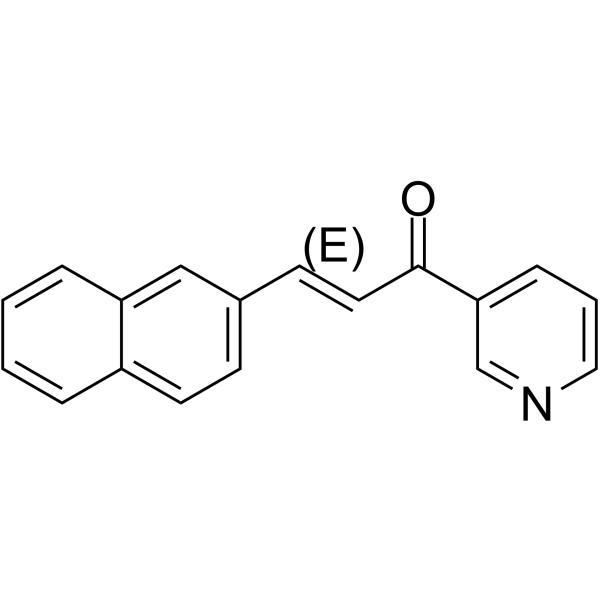
Physicochemical Properties
| Molecular Formula | C18H13NO |
| Molecular Weight | 259.301924467087 |
| Exact Mass | 259.099 |
| CAS # | 1821143-79-6 |
| Related CAS # | (E/Z)-DMU2105;1031063-36-1 |
| PubChem CID | 8854335 |
| Appearance | Light yellow to yellow solid powder |
| LogP | 3.9 |
| Hydrogen Bond Donor Count | 0 |
| Hydrogen Bond Acceptor Count | 2 |
| Rotatable Bond Count | 3 |
| Heavy Atom Count | 20 |
| Complexity | 362 |
| Defined Atom Stereocenter Count | 0 |
| SMILES | O=C(C1C=NC=CC=1)/C=C/C1=CC=C2C=CC=CC2=C1 |
| InChi Key | VWBDGXJRQZDLRV-CSKARUKUSA-N |
| InChi Code | InChI=1S/C18H13NO/c20-18(17-6-3-11-19-13-17)10-8-14-7-9-15-4-1-2-5-16(15)12-14/h1-13H/b10-8+ |
| Chemical Name | (E)-3-naphthalen-2-yl-1-pyridin-3-ylprop-2-en-1-one |
| HS Tariff Code | 2934.99.9001 |
| Storage |
Powder-20°C 3 years 4°C 2 years In solvent -80°C 6 months -20°C 1 month |
| Shipping Condition | Room temperature (This product is stable at ambient temperature for a few days during ordinary shipping and time spent in Customs) |
Biological Activity
| ln Vitro | DMU2105 (compound 7k) exhibits 74-fold and 120-fold selectivity for CYP1B1 relative to CYP1A1 and CYP1A2. Nevertheless, when DMU2105 was present, the EC50 decreased to 1 μM, suggesting that the cells had experienced toxicity, potentially due to CYP1B1 suppression. When treated with cisplatin and DMU2105 (10×IC50), untransfected cells (HEK293: pcDNA3.1) did not exhibit any significant decrease in cisplatin EC50 (8.5 μM ± 0.9) [1]. |
| References |
[1]. Discovery and characterization of novel CYP1B1 inhibitors based on heterocyclic chalcones: Overcoming cisplatin resistance in CYP1B1-overexpressing lines. Eur J Med Chem. 2017 Mar 31;129:159-174. |
Solubility Data
| Solubility (In Vitro) | DMSO : ~33.33 mg/mL (~128.54 mM) |
| Solubility (In Vivo) |
Solubility in Formulation 1: ≥ 3.33 mg/mL (12.84 mM) (saturation unknown) in 10% DMSO + 90% Corn Oil (add these co-solvents sequentially from left to right, and one by one), clear solution. For example, if 1 mL of working solution is to be prepared, you can add 100 μL of 33.3 mg/mL clear DMSO stock solution to 900 μL of corn oil and mix evenly. Solubility in Formulation 2: 2.67 mg/mL (10.30 mM) in 10% DMSO + 40% PEG300 + 5% Tween80 + 45% Saline (add these co-solvents sequentially from left to right, and one by one), suspension solution; with ultrasonication. For example, if 1 mL of working solution is to be prepared, you can add 100 μL of 26.7 mg/mL clear DMSO stock solution to 400 μL PEG300 and mix evenly; then add 50 μL Tween-80 to the above solution and mix evenly; then add 450 μL normal saline to adjust the volume to 1 mL. Preparation of saline: Dissolve 0.9 g of sodium chloride in 100 mL ddH₂ O to obtain a clear solution. (Please use freshly prepared in vivo formulations for optimal results.) |
| Preparing Stock Solutions | 1 mg | 5 mg | 10 mg | |
| 1 mM | 3.8565 mL | 19.2827 mL | 38.5654 mL | |
| 5 mM | 0.7713 mL | 3.8565 mL | 7.7131 mL | |
| 10 mM | 0.3857 mL | 1.9283 mL | 3.8565 mL |