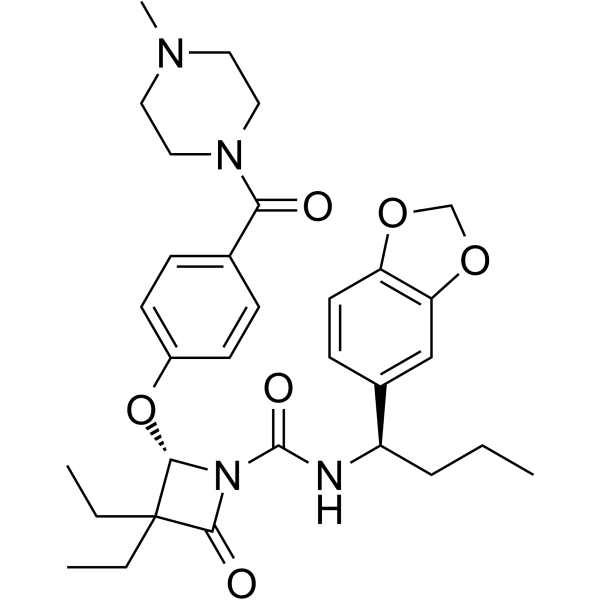
Physicochemical Properties
| Molecular Formula | C31H40N4O6 |
| Molecular Weight | 564.683 |
| Exact Mass | 564.295 |
| CAS # | 157341-41-8 |
| PubChem CID | 177992 |
| Appearance | Solid powder |
| Density | 1.227g/cm3 |
| Index of Refraction | 1.581 |
| LogP | 4.612 |
| Hydrogen Bond Donor Count | 1 |
| Hydrogen Bond Acceptor Count | 7 |
| Rotatable Bond Count | 9 |
| Heavy Atom Count | 41 |
| Complexity | 928 |
| Defined Atom Stereocenter Count | 2 |
| SMILES | CCC[C@H](C1=CC2=C(C=C1)OCO2)NC(=O)N3[C@H](C(C3=O)(CC)CC)OC4=CC=C(C=C4)C(=O)N5CCN(CC5)C |
| InChi Key | ZSDCIRYNTCVTMF-GIGWZHCTSA-N |
| InChi Code | InChI=1S/C31H40N4O6/c1-5-8-24(22-11-14-25-26(19-22)40-20-39-25)32-30(38)35-28(37)31(6-2,7-3)29(35)41-23-12-9-21(10-13-23)27(36)34-17-15-33(4)16-18-34/h9-14,19,24,29H,5-8,15-18,20H2,1-4H3,(H,32,38)/t24-,29+/m1/s1 |
| Chemical Name | (2S)-N-[(1R)-1-(1,3-benzodioxol-5-yl)butyl]-3,3-diethyl-2-[4-(4-methylpiperazine-1-carbonyl)phenoxy]-4-oxoazetidine-1-carboxamide |
| Synonyms | DMP777; DMP 777; DMP-777 |
| HS Tariff Code | 2934.99.9001 |
| Storage |
Powder-20°C 3 years 4°C 2 years In solvent -80°C 6 months -20°C 1 month Note: Please store this product in a sealed and protected environment (e.g. under nitrogen), avoid exposure to moisture. |
| Shipping Condition | Room temperature (This product is stable at ambient temperature for a few days during ordinary shipping and time spent in Customs) |
Biological Activity
| ln Vivo | Rats given DMP-777 had much less parietal cell H/K-ATPase labeling. The loss of parietal cells induced by DMP-777 was greatly ameliorated by coadministration of omeprazole. When rats were treated with DMP-777, they showed a noticeable increase in amylase-resistant, PAS-positive surface mucous cells together with a pronounced foveal hyperplasia of the fundus. Compared to rats given DMP-777 alone, there was a notable decrease in BrdU-positive S-phase cells when DMP-777 and opaprazole were given together [1]. Following oral administration of 40 mg/kg of DMP-777 to monkeys, no configuration at positions "a" and "b" of DMP Inversion-777 has happened in vivo, and the starting material DMP-777 was the only stereoisomer found in the post-dose plasma sample [2]. DMP-777-treated Mist1-/-mice displayed reduced chief cell transition to SPEM. Compared to control mice, L635-treated Mist1-/-mice showed noticeably less proliferating SPEM cells [3]. |
| References |
[1]. Omeprazole treatment ameliorates oxyntic atrophy induced by DMP-777. Dig Dis Sci. 2006 Mar;51(3):431-9. [2]. Separation of the four stereoisomers of a potent inhibitor (L-694,458) of human leukocyte elastase and its determination in human plasma using achiral/chiral chromatography with column switching. J Pharm Biomed Anal. 1998 Sep 1;17(6-7. [3]. Maturity and age influence chief cell ability to transdifferentiate into metaplasia. Am J Physiol Gastrointest Liver Physiol. 2016 Nov 23:ajpgi.00326.2016. |
| Additional Infomation | DMP-777 is a selective inhibitor of polymorphonuclear leukocyte (PMN) elastase. |
Solubility Data
| Solubility (In Vitro) | DMSO : ~38.33 mg/mL (~67.88 mM) |
| Solubility (In Vivo) |
Solubility in Formulation 1: 35 mg/mL (61.98 mM) in 15% Cremophor EL + 85% Saline (add these co-solvents sequentially from left to right, and one by one), suspension solution; with sonication. Preparation of saline: Dissolve 0.9 g of sodium chloride in 100 mL ddH₂ O to obtain a clear solution. Solubility in Formulation 2: ≥ 2.5 mg/mL (4.43 mM) (saturation unknown) in 10% DMSO + 40% PEG300 + 5% Tween80 + 45% Saline (add these co-solvents sequentially from left to right, and one by one), clear solution. For example, if 1 mL of working solution is to be prepared, you can add 100 μL of 25.0 mg/mL clear DMSO stock solution to 400 μL PEG300 and mix evenly; then add 50 μL Tween-80 to the above solution and mix evenly; then add 450 μL normal saline to adjust the volume to 1 mL. Preparation of saline: Dissolve 0.9 g of sodium chloride in 100 mL ddH₂ O to obtain a clear solution. Solubility in Formulation 3: 2.5 mg/mL (4.43 mM) in 10% DMSO + 90% (20% SBE-β-CD in Saline) (add these co-solvents sequentially from left to right, and one by one), suspension solution; with ultrasonication. For example, if 1 mL of working solution is to be prepared, you can add 100 μL of 25.0 mg/mL clear DMSO stock solution to 900 μL of 20% SBE-β-CD physiological saline solution and mix evenly. Preparation of 20% SBE-β-CD in Saline (4°C,1 week): Dissolve 2 g SBE-β-CD in 10 mL saline to obtain a clear solution. Solubility in Formulation 4: ≥ 2.5 mg/mL (4.43 mM) (saturation unknown) in 10% DMSO + 90% Corn Oil (add these co-solvents sequentially from left to right, and one by one), clear solution. For example, if 1 mL of working solution is to be prepared, you can add 100 μL of 25.0 mg/mL clear DMSO stock solution to 900 μL corn oil and mix evenly. Solubility in Formulation 5: ≥ 2.5 mg/mL (4.43 mM) (saturation unknown) in 5% DMSO + 40% PEG300 + 5% Tween80 + 50% Saline (add these co-solvents sequentially from left to right, and one by one), clear solution. Preparation of saline: Dissolve 0.9 g of sodium chloride in 100 mL ddH₂ O to obtain a clear solution. Solubility in Formulation 6: ≥ 2.5 mg/mL (4.43 mM) (saturation unknown) in 5% DMSO + 95% (20% SBE-β-CD in Saline) (add these co-solvents sequentially from left to right, and one by one), clear solution. Preparation of 20% SBE-β-CD in Saline (4°C,1 week): Dissolve 2 g SBE-β-CD in 10 mL saline to obtain a clear solution. (Please use freshly prepared in vivo formulations for optimal results.) |
| Preparing Stock Solutions | 1 mg | 5 mg | 10 mg | |
| 1 mM | 1.7709 mL | 8.8546 mL | 17.7091 mL | |
| 5 mM | 0.3542 mL | 1.7709 mL | 3.5418 mL | |
| 10 mM | 0.1771 mL | 0.8855 mL | 1.7709 mL |