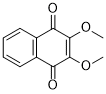
Physicochemical Properties
| Molecular Formula | C12H10O4 |
| Molecular Weight | 218.21 |
| Exact Mass | 218.058 |
| CAS # | 6956-96-3 |
| Related CAS # | 6956-96-3; |
| PubChem CID | 3136 |
| Appearance | Light yellow to yellow solid powder |
| Density | 1.28g/cm3 |
| Boiling Point | 392.5ºC at 760 mmHg |
| Flash Point | 177.6ºC |
| Index of Refraction | 1.571 |
| LogP | 1.57 |
| Hydrogen Bond Donor Count | 0 |
| Hydrogen Bond Acceptor Count | 4 |
| Rotatable Bond Count | 2 |
| Heavy Atom Count | 16 |
| Complexity | 322 |
| Defined Atom Stereocenter Count | 0 |
| InChi Key | ZEGDFCCYTFPECB-UHFFFAOYSA-N |
| InChi Code | InChI=1S/C12H10O4/c1-15-11-9(13)7-5-3-4-6-8(7)10(14)12(11)16-2/h3-6H,1-2H3 |
| Chemical Name | 2,3-Dimethoxynaphthalene-1,4-dione |
| Synonyms | DMNQ NSC 69355 NSC-69355 NSC69355 |
| HS Tariff Code | 2934.99.9001 |
| Storage |
Powder-20°C 3 years 4°C 2 years In solvent -80°C 6 months -20°C 1 month |
| Shipping Condition | Room temperature (This product is stable at ambient temperature for a few days during ordinary shipping and time spent in Customs) |
Biological Activity
| ln Vitro | H2O2 production in A549-S cells can be induced in a concentration-dependent manner by DMNQ (20-100 μM; 30 minutes) [1]. In a concentration- and time-dependent manner, DMNQ (5-10 μM; 0-24 h) can raise the activity of γ-glutamine cysteine amino acid synthetase (γGCS) in L2 cells to 70%. Contents of GSH (antioxidant function of the body) [2]. |
| Cell Assay |
Western Blot Analysis[2] Cell Types: L2 Tested Concentrations: 5 μM, 10 μM Incubation Duration: 24 hrs (hours) Experimental Results: Increased γGCS-HS protein levels. |
| References |
[1]. Autoxidation of extracellular hydroquinones is a causative event for the cytotoxicity of menadione and DMNQ in A549-S cells. Arch Biochem Biophys. 2003 Mar 1;411(1):145-57. [2]. Quinone-induced oxidative stress elevates glutathione and induces gamma-glutamylcysteine synthetase activity in rat lung epithelial L2 cells. J Biol Chem. 1994 Oct 21;269(42):26512-7. |
| Additional Infomation |
2,3-dimethoxynaphthalene-1,4-dione is a naphthoquinone that is 1,4-naphthoquinone bearing two methoxy substituents at positions 2 and 3. Redox-cycling agent that induces intracellular superoxide anion formation and, depending on the concentration, induces cell proliferation, apoptosis or necrosis. Used to study the role of ROS in cell toxicity, apoptosis, and necrosis. It is functionally related to a 1,4-naphthoquinone. 2,3-Dimethoxy-1,4-naphthoquinone has been reported in Newbouldia laevis with data available. |
Solubility Data
| Solubility (In Vitro) | DMSO : ~50 mg/mL (~229.14 mM) |
| Solubility (In Vivo) |
Solubility in Formulation 1: 2.5 mg/mL (11.46 mM) in 10% DMSO + 40% PEG300 + 5% Tween80 + 45% Saline (add these co-solvents sequentially from left to right, and one by one), suspension solution; with sonication. For example, if 1 mL of working solution is to be prepared, you can add 100 μL of 25.0 mg/mL clear DMSO stock solution to 400 μL PEG300 and mix evenly; then add 50 μL Tween-80 to the above solution and mix evenly; then add 450 μL normal saline to adjust the volume to 1 mL. Preparation of saline: Dissolve 0.9 g of sodium chloride in 100 mL ddH₂ O to obtain a clear solution. Solubility in Formulation 2: 2.5 mg/mL (11.46 mM) in 10% DMSO + 90% (20% SBE-β-CD in Saline) (add these co-solvents sequentially from left to right, and one by one), suspension solution; with ultrasonication. For example, if 1 mL of working solution is to be prepared, you can add 100 μL of 25.0 mg/mL clear DMSO stock solution to 900 μL of 20% SBE-β-CD physiological saline solution and mix evenly. Preparation of 20% SBE-β-CD in Saline (4°C,1 week): Dissolve 2 g SBE-β-CD in 10 mL saline to obtain a clear solution. Solubility in Formulation 3: ≥ 2.5 mg/mL (11.46 mM) (saturation unknown) in 10% DMSO + 90% Corn Oil (add these co-solvents sequentially from left to right, and one by one), clear solution. For example, if 1 mL of working solution is to be prepared, you can add 100 μL of 25.0 mg/mL clear DMSO stock solution to 900 μL of corn oil and mix evenly. (Please use freshly prepared in vivo formulations for optimal results.) |
| Preparing Stock Solutions | 1 mg | 5 mg | 10 mg | |
| 1 mM | 4.5827 mL | 22.9137 mL | 45.8274 mL | |
| 5 mM | 0.9165 mL | 4.5827 mL | 9.1655 mL | |
| 10 mM | 0.4583 mL | 2.2914 mL | 4.5827 mL |