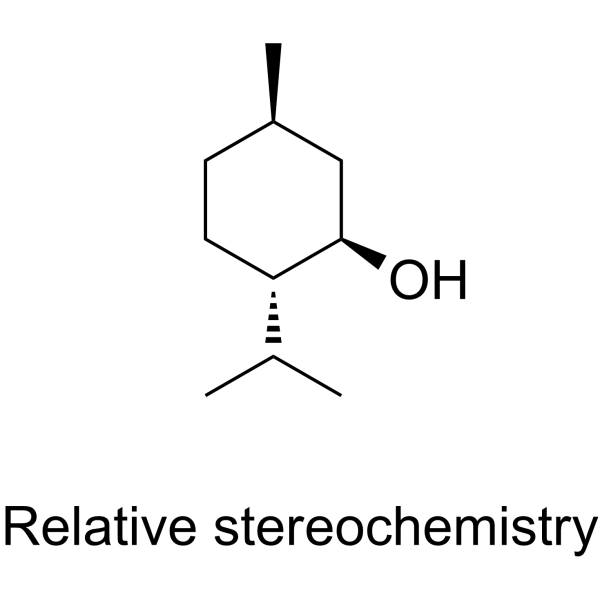
Physicochemical Properties
| Molecular Formula | C10H20O |
| Molecular Weight | 156.2652 |
| Exact Mass | 156.151 |
| CAS # | 89-78-1 |
| PubChem CID | 16666 |
| Appearance | White to off-white solid powder |
| Density | 0.9±0.1 g/cm3 |
| Boiling Point | 215.4±8.0 °C at 760 mmHg |
| Melting Point | 34-36 °C(lit.) |
| Flash Point | 93.3±0.0 °C |
| Vapour Pressure | 0.0±0.9 mmHg at 25°C |
| Index of Refraction | 1.457 |
| LogP | 3.2 |
| Hydrogen Bond Donor Count | 1 |
| Hydrogen Bond Acceptor Count | 1 |
| Rotatable Bond Count | 1 |
| Heavy Atom Count | 11 |
| Complexity | 120 |
| Defined Atom Stereocenter Count | 3 |
| SMILES | C[C@@H]1CC[C@H]([C@@H](C1)O)C(C)C |
| InChi Key | NOOLISFMXDJSKH-KXUCPTDWSA-N |
| InChi Code | InChI=1S/C10H20O/c1-7(2)9-5-4-8(3)6-10(9)11/h7-11H,4-6H2,1-3H3/t8-,9+,10-/m1/s1 |
| Chemical Name | (1R,2S,5R)-5-methyl-2-propan-2-ylcyclohexan-1-ol |
| HS Tariff Code | 2934.99.9001 |
| Storage |
Powder-20°C 3 years 4°C 2 years In solvent -80°C 6 months -20°C 1 month |
| Shipping Condition | Room temperature (This product is stable at ambient temperature for a few days during ordinary shipping and time spent in Customs) |
Biological Activity
| ADME/Pharmacokinetics |
Absorption, Distribution and Excretion ...THE PERCENTAGE OF A DOSE OF L-MENTHOL THAT IS EXCRETED COMBINED WITH GLUCURONIC ACID IN THE RABBIT DEPENDS ON THE MAGNITUDE OF THE DOSE; THE LARGER THE DOSE, THE LESS IS THE CONJUGATION. Metabolism / Metabolites L-MENTHOL CONJUGATES READILY IN RABBIT FORMING L-MENTHYL-BETA-D-GLUCURONIDE. ABOUT HALF OF THE L-MENTHOL FED TO RABBITS IS EXCRETED COMBINED WITH GLUCURONIC ACID; THE FATE OF OTHER HALF IS NOT KNOWN, BUT IT IS POSSIBLE THAT RING FISSION OCCURS WITH CONSIDERABLE DEGRADATION OF THE MENTHOL MOLECULE. IN DOGS, MUCH OXIDATION OF MENTHOL TAKES PLACE AND ONLY ABOUT 5% OF THE DOSE CAN BE RECOVERED IN URINE AS THE GLUCURONIDE. /MENTHOL/ L-MENTHOL WAS RAPIDLY BUT INCOMPLETELY GLUCURONIDATED. THE OUTPUT OF L-MENTHOL GLUCURONIDE WAS INCR IN ALL BUT 1 SUBJECT PRETREATED WITH CIMETIDINE (1 G/DAY FOR 1 WK), AN INHIBITOR OF OXIDATIVE DRUG METABOLISM, & IN ALL SUBJECTS PRETREATED WITH A DRUG-METABOLIZING ENZYME INDUCER, PHENOBARBITONE (60 MG NIGHTLY FOR 10 DAYS). Corynebacterium sp. strain RWM1 grew with (-)-menthol, (-)-menthone and other acyclic monoterpenes as sole carbon sources. Growth on menthol was very slow, with a doubling time of more than 24 h, and was not rapid with (-)-menthone (doubling time 12 h). Concentrations of either carbon source greater than 0.025% inhibited growth. (-)-Menthone-grown cultures transiently accumulated 3,7-dimethyl-6-hydroxyoctanoate during growth, and (-)-menthol-grown cells oxidized (-)-menthol, (-)-menthone, 3,7-dimethyl-6-octanolide and 3,7-dimethyl-6-hydroxyoctanoate. Although neither a menthol oxidase nor a menthol dehydrogenase could be detected in extracts of (-)-menthol- or (-)-menthone-grown cells, an induced NADPH-linked monooxygenase with activity towards (-)-menthone was readily detected. With crude cell extracts, only 3,7-dimethyl-6-hydroxyoctanoate was detected as the reaction product. When the (-)-menthone monooxygenase was separated from an induced 3,7-dimethyl-6-octanolide hydrolase by chromatography on hydroxyapatite, the lactone 3,7-dimethyl-6-octanolide was shown to be the product of oxygenation. (-)-Menthol has known human metabolites that include (2S,3S,4S,5R)-3,4,5-trihydroxy-6-[(1R,2S,5R)-5-methyl-2-propan-2-ylcyclohexyl]oxyoxane-2-carboxylic acid and p-Menthane-3,-8-diol. L-Menthol conjugates rapidly, forming L-Methyl-beta-Glucuronide. About half of the menthol absorbed is excreted combined with glucuronic acid (A661). |
| References |
[1]. Menthol Induces Surgical Anesthesia and Rapid Movement in Fishes. The Open Neuroscience. 2014 Feb; 8(1):1-8. |
| Additional Infomation |
D,l-menthol is a white crystalline solid with a peppermint odor and taste. (NTP, 1992) (-)-menthol is a p-menthan-3-ol which has (1R,2S,5R)-stereochemistry. It is the most common naturally occurring enantiomer. It has a role as an antipruritic drug, an antitussive and an antispasmodic drug. It is an enantiomer of a (+)-menthol. Menthol is a covalent organic compound made synthetically or obtained from peppermint or other mint oils. Forming clear or white waxy, crystalline substance, menthol is typically solid at room temperature. (-)-Menthol is the naturally-occurring and main form of menthol, and is assigned the (1R,2S,5R) configuration. Menthol mediates anesthetic properties and anti-irritating properties locally, thus it is widely used to relieve minor throat irritations. l-Menthol has been reported in Citrus reticulata, Punica granatum, and other organisms with data available. Levomenthol is a levo isomer of menthol, an organic compound made synthetically or obtained from peppermint or mint oils with flavoring and local anesthetic properties. When added to pharmaceuticals and foods, menthol functions as a fortifier for peppermint flavors. It also has a counterirritant effect on skin and mucous membranes, thereby producing a local analgesic or anesthetic effect. Menthol is an alcohol produced from mint oils or prepared synthetically. Menthol is a covalent organic compound made synthetically or obtained from peppermint or other mint oils. It is a waxy, crystalline substance, clear or white in color, which is solid at room temperature and melts slightly above. The main form of menthol occurring in nature is (-)-menthol, which is assigned the (1R,2S,5R) configuration. Menthol has local anesthetic and counterirritant qualities, and it is widely used to relieve minor throat irritation. See also: Menthol (annotation moved to). Drug Indication Used to treat occasional minor irritation, pain, sore mouth, and sore throat as well as cough associated with a cold or inhaled irritants. Mechanism of Action Menthol primarily activates the cold-sensitive TRPM8 receptors in the skin. Menthol, after topical application, causes a feeling of coolness due to stimulation of 'cold' receptors by inhibiting Ca++ currents of neuronal membranes. It may also yield analgesic properties via kappa-opioid receptor agonism. |
Solubility Data
| Solubility (In Vitro) |
DMSO : ~100 mg/mL (~639.92 mM) H2O : ~1 mg/mL (~6.40 mM) |
| Solubility (In Vivo) |
Solubility in Formulation 1: ≥ 2.5 mg/mL (16.00 mM) (saturation unknown) in 10% DMSO + 90% (20% SBE-β-CD in Saline) (add these co-solvents sequentially from left to right, and one by one), clear solution. For example, if 1 mL of working solution is to be prepared, you can add 100 μL of 25.0 mg/mL clear DMSO stock solution to 900 μL of 20% SBE-β-CD physiological saline solution and mix evenly. Preparation of 20% SBE-β-CD in Saline (4°C,1 week): Dissolve 2 g SBE-β-CD in 10 mL saline to obtain a clear solution. Solubility in Formulation 2: ≥ 2.5 mg/mL (16.00 mM) (saturation unknown) in 10% DMSO + 90% Corn Oil (add these co-solvents sequentially from left to right, and one by one), clear solution. For example, if 1 mL of working solution is to be prepared, you can add 100 μL of 25.0 mg/mL clear DMSO stock solution to 900 μL of corn oil and mix evenly. (Please use freshly prepared in vivo formulations for optimal results.) |
| Preparing Stock Solutions | 1 mg | 5 mg | 10 mg | |
| 1 mM | 6.3992 mL | 31.9959 mL | 63.9918 mL | |
| 5 mM | 1.2798 mL | 6.3992 mL | 12.7984 mL | |
| 10 mM | 0.6399 mL | 3.1996 mL | 6.3992 mL |