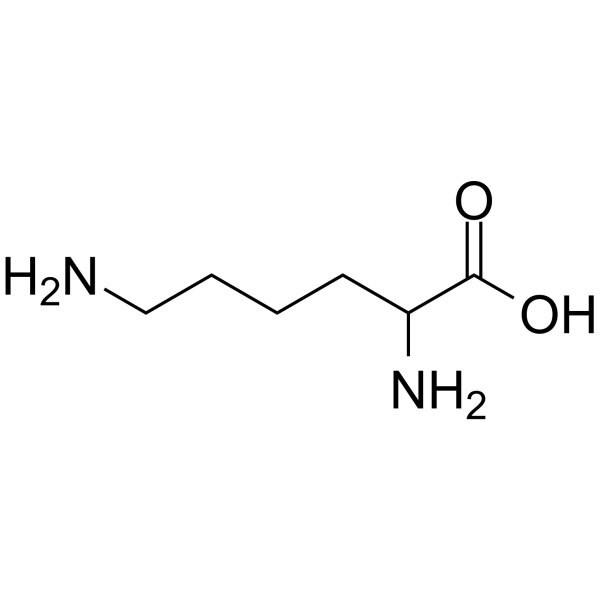
Physicochemical Properties
| Molecular Formula | C6H14N2O2 |
| Molecular Weight | 146.1876 |
| Exact Mass | 146.105 |
| CAS # | 70-54-2 |
| Related CAS # | DL-Lysine-d4 dihydrochloride;284664-88-6;DL-Lysine monohydrate;885701-25-7 |
| PubChem CID | 866 |
| Appearance | White to light yellow solid powder |
| Density | 1.1±0.1 g/cm3 |
| Boiling Point | 311.5±32.0 °C at 760 mmHg |
| Melting Point | 170ºC (dec.) |
| Flash Point | 142.2±25.1 °C |
| Vapour Pressure | 0.0±1.4 mmHg at 25°C |
| Index of Refraction | 1.503 |
| LogP | -1.04 |
| Hydrogen Bond Donor Count | 3 |
| Hydrogen Bond Acceptor Count | 4 |
| Rotatable Bond Count | 5 |
| Heavy Atom Count | 10 |
| Complexity | 106 |
| Defined Atom Stereocenter Count | 0 |
| InChi Key | KDXKERNSBIXSRK-UHFFFAOYSA-N |
| InChi Code | InChI=1S/C6H14N2O2/c7-4-2-1-3-5(8)6(9)10/h5H,1-4,7-8H2,(H,9,10) |
| Chemical Name | 2,6-diaminohexanoic acid |
| HS Tariff Code | 2934.99.9001 |
| Storage |
Powder-20°C 3 years 4°C 2 years In solvent -80°C 6 months -20°C 1 month |
| Shipping Condition | Room temperature (This product is stable at ambient temperature for a few days during ordinary shipping and time spent in Customs) |
Biological Activity
| ln Vitro | D-lysine is created from L-lysine through continuous chemical racemization and microbial asymmetric breakdown. L-lysine is the enantiomer of D-lysine. D-Lysine is found in all species from bacteria to humans. D-Lysine is a potentially hazardous chemical [1]. |
| References |
[1]. Influence of the lysine on the calcium oxalate renal calculi. Int Urol Nephrol. 2014 Mar;46(3):593-7. |
| Additional Infomation |
Lysine is a diamino acid that is caproic (hexanoic) acid bearing two amino substituents at positions 2 and 6. It has a role as a Daphnia magna metabolite. It is an alpha-amino acid, a diamino acid and a polar amino acid. It contains a 4-aminobutyl group. It is functionally related to a hexanoic acid. It is a conjugate base of a lysinium(1+). It is a conjugate acid of a lysinate. DL-Lysine has been reported in Drosophila melanogaster, Enterococcus faecalis, and other organisms with data available. See also: Fenugreek seed (part of); Lysine (annotation moved to). |
Solubility Data
| Solubility (In Vitro) |
H2O : ~100 mg/mL (~684.04 mM) DMSO : ~1 mg/mL (~6.84 mM) |
| Solubility (In Vivo) |
Solubility in Formulation 1: 100 mg/mL (684.04 mM) in PBS (add these co-solvents sequentially from left to right, and one by one), clear solution; with sonication. (Please use freshly prepared in vivo formulations for optimal results.) |
| Preparing Stock Solutions | 1 mg | 5 mg | 10 mg | |
| 1 mM | 6.8404 mL | 34.2021 mL | 68.4041 mL | |
| 5 mM | 1.3681 mL | 6.8404 mL | 13.6808 mL | |
| 10 mM | 0.6840 mL | 3.4202 mL | 6.8404 mL |