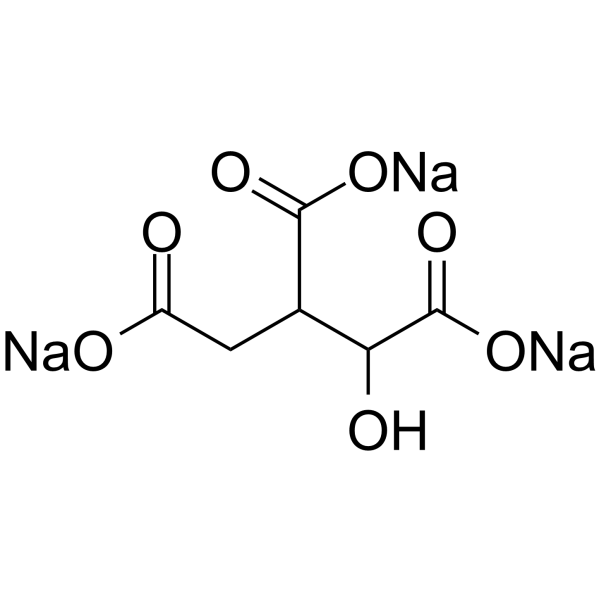
Physicochemical Properties
| Molecular Formula | C6H5NA3O7 |
| Molecular Weight | 258.07 |
| Exact Mass | 257.972 |
| CAS # | 1637-73-6 |
| Related CAS # | Isocitric acid;320-77-4;DL-Isocitric acid-13C4 (mixture of isomers) (trisodium hydrate);DL-Isocitric acid-13C4 trisodium salt |
| PubChem CID | 168942 |
| Appearance | White to light yellow solid powder |
| Density | 1.751g/cm3 |
| Boiling Point | 329.6ºC at 760mmHg |
| Melting Point | 86-88 °C(lit.) |
| Flash Point | 167.4ºC |
| Vapour Pressure | 1.3E-05mmHg at 25°C |
| Hydrogen Bond Donor Count | 1 |
| Hydrogen Bond Acceptor Count | 7 |
| Rotatable Bond Count | 2 |
| Heavy Atom Count | 16 |
| Complexity | 217 |
| Defined Atom Stereocenter Count | 0 |
| SMILES | C(C(C(C(=O)[O-])O)C(=O)[O-])C(=O)[O-].[Na+].[Na+].[Na+] |
| InChi Key | HWMVXEKEEAIYGB-UHFFFAOYSA-K |
| InChi Code | InChI=1S/C6H8O7.3Na/c7-3(8)1-2(5(10)11)4(9)6(12)13;;;/h2,4,9H,1H2,(H,7,8)(H,10,11)(H,12,13);;;/q;3*+1/p-3 |
| Chemical Name | trisodium;1-hydroxypropane-1,2,3-tricarboxylate |
| Synonyms | 1637-73-6; Isocitric acid trisodium salt; DL-Isocitric acid trisodium salt hydrate; Isocitric acid, dl-; DL-Isocitric acid trisodium salt; trisodium;1-hydroxypropane-1,2,3-tricarboxylate; sodium 1-hydroxypropane-1,2,3-tricarboxylate; MFCD00149284; |
| HS Tariff Code | 2934.99.9001 |
| Storage |
Powder-20°C 3 years 4°C 2 years In solvent -80°C 6 months -20°C 1 month Note: Please store this product in a sealed and protected environment, avoid exposure to moisture. |
| Shipping Condition | Room temperature (This product is stable at ambient temperature for a few days during ordinary shipping and time spent in Customs) |
Biological Activity
| Targets | Endogenous metabolite. |
| ln Vitro | NaHS (an H2S donor) treatment increased the activity of cultured cardiomyocytes and reduced hypertrophy in cultured cardiomyocytes at concentrations ranging from 25 to 200 µmol/L. NaHS treatment increased glucose uptake and the efficiency of glycolysis and the citric acid cycle. The key enzymes in these reactions, including lactate dehydrogenase and pyruvate kinase and succinate dehydrogenase, were activated by NaHS treatment (100 µmol/L). Some intermediates of glycolysis and the citric acid cycle, including lactic acid, cyclohexylammonium, oxaloacetic acid, succinate, L-dimalate, sodium citrate, cis-aconitic acid, ketoglutarate and DL-isocitric acid trisodium also showed anti-hypertrophic effects in cardiomyocytes [1]. |
| Cell Assay | Introduction: Hydrogen sulfide (H2S) has been reported to inhibit myocardial hypertrophy in a cell model of cardiomyocyte hypertrophy. Our previous study also shows an H2S-induced increase in glucose metabolism in insulin-targeting cells. The present study aims to examine the hypothesis that H2S attenuates myocardial hypertrophy and promotes glucose utilization in cardiomyocytes. Methods: The cell model of cardiomyocyte hypertrophy was induced by application of phenylephrine and cardiomyocyte hypertrophy was examined using leucine incorporation assay. Protein levels were measured using Western blot analysis. The activity of related enzymes was measured with enzyme-linked immunosorbent assay (ELISA) [1]. |
| References | [1]. Hydrogen sulfide improves glucose metabolism and prevents hypertrophy in cardiomyocytes. Nitric Oxide. 2015 Apr 30;46:114-22. |
| Additional Infomation | Isocitric acid, DL- is a carbonyl compound. |
Solubility Data
| Solubility (In Vitro) |
H2O :~100 mg/mL (~387.49 mM) DMSO :< 1 mg/mL |
| Solubility (In Vivo) |
Solubility in Formulation 1: 100 mg/mL (387.49 mM) in PBS (add these co-solvents sequentially from left to right, and one by one), clear solution; with sonication. (Please use freshly prepared in vivo formulations for optimal results.) |
| Preparing Stock Solutions | 1 mg | 5 mg | 10 mg | |
| 1 mM | 3.8749 mL | 19.3746 mL | 38.7492 mL | |
| 5 mM | 0.7750 mL | 3.8749 mL | 7.7498 mL | |
| 10 mM | 0.3875 mL | 1.9375 mL | 3.8749 mL |