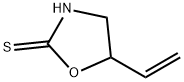
Physicochemical Properties
| Molecular Formula | C5H7NOS |
| Molecular Weight | 129.1802 |
| Exact Mass | 129.025 |
| CAS # | 13190-34-6 |
| Related CAS # | 500-12-9 (L) |
| PubChem CID | 3034683 |
| Appearance | White to off-white solid powder |
| Density | 1.19g/cm3 |
| Boiling Point | 150.6ºC at 760mmHg |
| Melting Point | 64-65ºC |
| Flash Point | 44.9ºC |
| LogP | 0.774 |
| Hydrogen Bond Donor Count | 1 |
| Hydrogen Bond Acceptor Count | 2 |
| Rotatable Bond Count | 1 |
| Heavy Atom Count | 8 |
| Complexity | 124 |
| Defined Atom Stereocenter Count | 0 |
| InChi Key | UZQVYLOFLQICCT-UHFFFAOYSA-N |
| InChi Code | InChI=1S/C5H7NOS/c1-2-4-3-6-5(8)7-4/h2,4H,1,3H2,(H,6,8) |
| Chemical Name | 5-ethenyl-1,3-oxazolidine-2-thione |
| HS Tariff Code | 2934.99.9001 |
| Storage |
Powder-20°C 3 years 4°C 2 years In solvent -80°C 6 months -20°C 1 month Note: This product requires protection from light (avoid light exposure) during transportation and storage. |
| Shipping Condition | Room temperature (This product is stable at ambient temperature for a few days during ordinary shipping and time spent in Customs) |
Biological Activity
| ln Vitro | Anti-influenza virus is said to be the active component in spring in the table. Not only is spring supposedly dormant, but it's also said to be somewhat poisonous [1]. |
| ADME/Pharmacokinetics |
Absorption, Distribution and Excretion A total of six cows, divided into 3 groups, were fed various amounts of rape cake containing 6 g of goitrin/kg over a period of 7 days. The cows were milked twice a day ... . When rape cake was fed at 0.39, 1.9 and 3.9% resp. of the total feed this resulted in medium goitrin values of 37, 163 and 707 ug/l milk. These values correspond to a transfer of about 0.1% of the original progoitrin content in the feed. 12 h after the last rape feeding the amount of goitrin in the milk was below the detection limit of 7 ppb. |
| Toxicity/Toxicokinetics |
Interactions Goitrin is a potent goitrogen that has been shown to induce glutathione S-transferase (GST) activity and to increase aflatoxin detoxification. goitrin --a naturally occurring compound in cruciferous vegetables and rape--could be easily nitrosated by treatment with nitrite under stomach conditions, yielding with loss of sulfur the N-nitroso- oxazolidone 4. This product has a mutagenicity pattern and potency similar to that of N-nitroso-N-methyl-N'- nitroguanidine (MNNG) in the Ames Salmonella/mammalian microsome test. |
| References |
[1]. Method for separating epigoitrin and goitrin contained in DL-goitrin. CN104030999A. |
| Additional Infomation |
5-ethenyl-1,3-oxazolidine-2-thione is a member of the class of oxazolidines that is 1,3-oxazolidine substituted by sulfanylidene and ethenyl groups at positions 2 and 5, respectively. It is a member of oxazolidines and an olefinic compound. DL-Goitrin has been reported in Isatis tinctoria with data available. Mechanism of Action A wide variety of chemicals, drugs, and other xenobiotics affect the second step in thyroid hormone biosynthesis. The stepwise binding of iodide to the tyrosyl residues in thyroglobulin requires oxidation of inorganic iodide (I2) to molecular (reactive) iodine (I2) by the thyroid peroxidase present in the luminal aspect (microvillar membranes) of follicular cells and adjacent colloid. Classes of chemicals that inhibit the organification of thyroglobulin include ... the thionamides (such as ... goitrin)... . |
Solubility Data
| Solubility (In Vitro) | DMSO : ~100 mg/mL (~774.11 mM) |
| Solubility (In Vivo) |
Solubility in Formulation 1: ≥ 2.5 mg/mL (19.35 mM) (saturation unknown) in 10% DMSO + 40% PEG300 + 5% Tween80 + 45% Saline (add these co-solvents sequentially from left to right, and one by one), clear solution. For example, if 1 mL of working solution is to be prepared, you can add 100 μL of 25.0 mg/mL clear DMSO stock solution to 400 μL PEG300 and mix evenly; then add 50 μL Tween-80 to the above solution and mix evenly; then add 450 μL normal saline to adjust the volume to 1 mL. Preparation of saline: Dissolve 0.9 g of sodium chloride in 100 mL ddH₂ O to obtain a clear solution. Solubility in Formulation 2: ≥ 2.5 mg/mL (19.35 mM) (saturation unknown) in 10% DMSO + 90% (20% SBE-β-CD in Saline) (add these co-solvents sequentially from left to right, and one by one), clear solution. For example, if 1 mL of working solution is to be prepared, you can add 100 μL of 25.0 mg/mL clear DMSO stock solution to 900 μL of 20% SBE-β-CD physiological saline solution and mix evenly. Preparation of 20% SBE-β-CD in Saline (4°C,1 week): Dissolve 2 g SBE-β-CD in 10 mL saline to obtain a clear solution. Solubility in Formulation 3: ≥ 2.5 mg/mL (19.35 mM) (saturation unknown) in 10% DMSO + 90% Corn Oil (add these co-solvents sequentially from left to right, and one by one), clear solution. For example, if 1 mL of working solution is to be prepared, you can add 100 μL of 25.0 mg/mL clear DMSO stock solution to 900 μL of corn oil and mix evenly. (Please use freshly prepared in vivo formulations for optimal results.) |
| Preparing Stock Solutions | 1 mg | 5 mg | 10 mg | |
| 1 mM | 7.7411 mL | 38.7057 mL | 77.4114 mL | |
| 5 mM | 1.5482 mL | 7.7411 mL | 15.4823 mL | |
| 10 mM | 0.7741 mL | 3.8706 mL | 7.7411 mL |