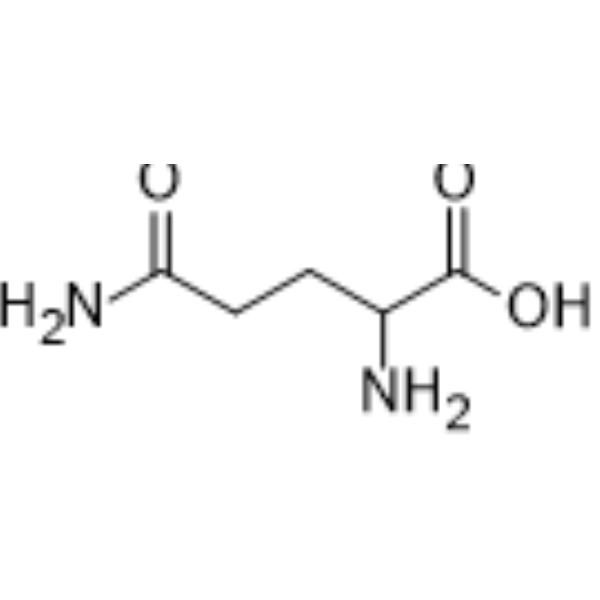
Physicochemical Properties
| Molecular Formula | C5H10N2O3 |
| Molecular Weight | 146.1445 |
| Exact Mass | 146.069 |
| Elemental Analysis | C, 41.09; H, 6.90; N, 19.17; O, 32.84 |
| CAS # | 6899-04-3 |
| Related CAS # | D-Glutamine;5959-95-5;L-Glutamine;56-85-9 |
| PubChem CID | 738 |
| Appearance | White to off-white solid powder |
| Density | 1.3±0.1 g/cm3 |
| Boiling Point | 445.6±40.0 °C at 760 mmHg |
| Melting Point | 177℃ |
| Flash Point | 223.3±27.3 °C |
| Vapour Pressure | 0.0±2.3 mmHg at 25°C |
| Index of Refraction | 1.524 |
| LogP | -1.67 |
| Hydrogen Bond Donor Count | 3 |
| Hydrogen Bond Acceptor Count | 4 |
| Rotatable Bond Count | 4 |
| Heavy Atom Count | 10 |
| Complexity | 146 |
| Defined Atom Stereocenter Count | 0 |
| InChi Key | ZDXPYRJPNDTMRX-UHFFFAOYSA-N |
| InChi Code | InChI=1S/C5H10N2O3/c6-3(5(9)10)1-2-4(7)8/h3H,1-2,6H2,(H2,7,8)(H,9,10) |
| Chemical Name | 2,5-diamino-5-oxopentanoic acid |
| Synonyms | DL-Glutamine; 6899-04-3; 585-21-7; 2,5-diamino-5-oxopentanoic acid; glutamin; H-DL-Gln-OH; Glutamine, DL-; 2-amino-4-carbamoylbutanoic acid; |
| HS Tariff Code | 2934.99.9001 |
| Storage |
Powder-20°C 3 years 4°C 2 years In solvent -80°C 6 months -20°C 1 month |
| Shipping Condition | Room temperature (This product is stable at ambient temperature for a few days during ordinary shipping and time spent in Customs) |
Biological Activity
| Targets | Endogenous Metabolite; Microbial Metabolite |
| ln Vitro | Glutamine is an alpha-amino acid that consists of butyric acid bearing an amino substituent at position 2 and a carbamoyl substituent at position 4. It has a role as a fundamental metabolite. It is an alpha-amino acid and a polar amino acid. It contains a 3-amino-3-oxopropyl group. It is a conjugate base of a glutaminium. It is a conjugate acid of a glutaminate. |
| Additional Infomation |
Glutamine is an alpha-amino acid that consists of butyric acid bearing an amino substituent at position 2 and a carbamoyl substituent at position 4. It has a role as a fundamental metabolite. It is an alpha-amino acid and a polar amino acid. It contains a 3-amino-3-oxopropyl group. It is a conjugate base of a glutaminium. It is a conjugate acid of a glutaminate. DL-Glutamine has been reported in Drosophila melanogaster, Medicago sativa, and other organisms with data available. See also: Glutamine (annotation moved to). |
Solubility Data
| Solubility (In Vitro) |
H2O : ~33.33 mg/mL (~228.07 mM) DMSO : ~1 mg/mL (~6.84 mM) |
| Solubility (In Vivo) |
Solubility in Formulation 1: 50 mg/mL (342.14 mM) in PBS (add these co-solvents sequentially from left to right, and one by one), clear solution; with sonication. (Please use freshly prepared in vivo formulations for optimal results.) |
| Preparing Stock Solutions | 1 mg | 5 mg | 10 mg | |
| 1 mM | 6.8428 mL | 34.2138 mL | 68.4275 mL | |
| 5 mM | 1.3686 mL | 6.8428 mL | 13.6855 mL | |
| 10 mM | 0.6843 mL | 3.4214 mL | 6.8428 mL |