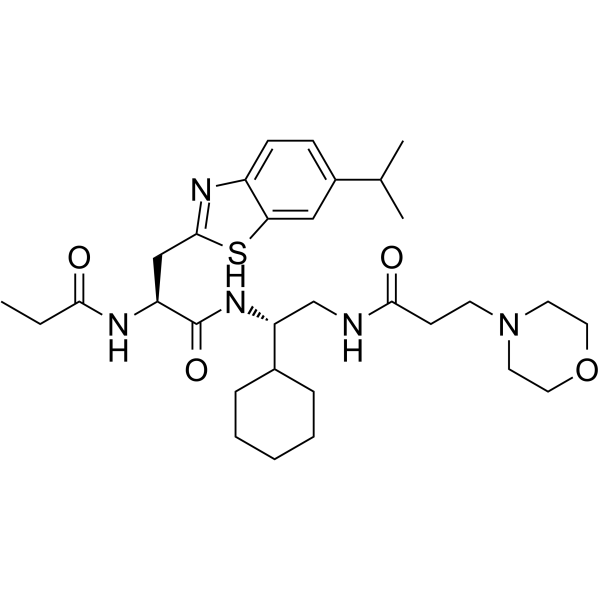
Physicochemical Properties
| Molecular Formula | C31H47N5O4S |
| Molecular Weight | 585.800986528397 |
| Exact Mass | 585.334 |
| CAS # | 2245887-38-9 |
| PubChem CID | 131750123 |
| Appearance | White to off-white solid powder |
| LogP | 4.3 |
| Hydrogen Bond Donor Count | 3 |
| Hydrogen Bond Acceptor Count | 7 |
| Rotatable Bond Count | 13 |
| Heavy Atom Count | 41 |
| Complexity | 848 |
| Defined Atom Stereocenter Count | 2 |
| SMILES | S1C2C=C(C=CC=2N=C1C[C@H](C(N[C@@H](CNC(CCN1CCOCC1)=O)C1CCCCC1)=O)NC(CC)=O)C(C)C |
| InChi Key | CNJKDQGPBAWNRY-IZZNHLLZSA-N |
| InChi Code | InChI=1S/C31H47N5O4S/c1-4-28(37)33-25(19-30-34-24-11-10-23(21(2)3)18-27(24)41-30)31(39)35-26(22-8-6-5-7-9-22)20-32-29(38)12-13-36-14-16-40-17-15-36/h10-11,18,21-22,25-26H,4-9,12-17,19-20H2,1-3H3,(H,32,38)(H,33,37)(H,35,39)/t25-,26+/m0/s1 |
| Chemical Name | (2S)-N-[(1S)-1-cyclohexyl-2-(3-morpholin-4-ylpropanoylamino)ethyl]-2-(propanoylamino)-3-(6-propan-2-yl-1,3-benzothiazol-2-yl)propanamide |
| HS Tariff Code | 2934.99.9001 |
| Storage |
Powder-20°C 3 years 4°C 2 years In solvent -80°C 6 months -20°C 1 month |
| Shipping Condition | Room temperature (This product is stable at ambient temperature for a few days during ordinary shipping and time spent in Customs) |
Biological Activity
| Targets | DCN1-UBC12[1] |
| ln Vitro | DI-591 (compound 44) has no discernible protein binding to DCN3, DCN4, or DCN5. Instead, it binds to DCN1 and DCN2 with Ki values of 12 nM and 10.4 nM, respectively. As a result, DI-591 is more than 1000 times more selective than recombinant human DCN3-5 proteins and shows very high binding affinity to recombinant human DCN1 and DCN2 proteins [1]. DI-591 (Compound 44; 0–10 μM; 1 hour; KYSE70 cells) binds to DCN1 and DCN2 proteins in cells and prevents DCN1 and UBC12 proteins from binding to each other [1]. The treatment of THLE2 cells with DI-591 (Compound 44; 10 μM) for 24 hours resulted in a significant increase in NQO1 and HO1 mRNA levels, which in turn caused the cells to upregulate HO1 protein. Interestingly, NRF2 mRNA levels are unaffected by DI-591 [1]. By specifically blocking cuLlin 3's neddylation, DI-591 causes an accumulation of NRF2 protein and the transcriptional activation of that protein. According to knockdown studies, cuLlin 3's neddylation is primarily regulated by DCN1, not DCN2, but not by other cuLlins. For the purpose of researching the function of cuLlin 3 CRL (CuLlin-RING E3 ubiquitin ligase) in biological processes and human diseases, DI-591 is a fantastic probe compound [1]. |
| Cell Assay |
Western Blot Analysis[1] Cell Types: KYSE70 cells Tested Concentrations: 0 μM, 1 μM, 3 Μm or 10 μM Incubation Duration: 1 hour Experimental Results: Potently bound to cellular DCN1 and DCN2 proteins. Enhanced the stability of DCN1 and DCN2 protein in a dose-dependent manner. RT-PCR[1] Cell Types: THLE2 cells Tested Concentrations: 10 μM Incubation Duration: 24 hrs (hours) Experimental Results: Robustly increases the mRNA levels of NQO1 and HO1. |
| References |
[1]. A potent small-molecule inhibitor of the DCN1-UBC12 interaction that selectively blocks cullin 3 neddylation. Nat Commun. 2017 Oct 27;8(1):1150. |
Solubility Data
| Solubility (In Vitro) | DMSO: 12.5 mg/mL (21.34 mM) |
| Solubility (In Vivo) |
Solubility in Formulation 1: ≥ 1.25 mg/mL (2.13 mM) (saturation unknown) in 10% DMSO + 40% PEG300 + 5% Tween80 + 45% Saline (add these co-solvents sequentially from left to right, and one by one), clear solution. For example, if 1 mL of working solution is to be prepared, you can add 100 μL of 12.5 mg/mL clear DMSO stock solution to 400 μL PEG300 and mix evenly; then add 50 μL Tween-80 to the above solution and mix evenly; then add 450 μL normal saline to adjust the volume to 1 mL. Preparation of saline: Dissolve 0.9 g of sodium chloride in 100 mL ddH₂ O to obtain a clear solution. Solubility in Formulation 2: ≥ 1.25 mg/mL (2.13 mM) (saturation unknown) in 10% DMSO + 90% (20% SBE-β-CD in Saline) (add these co-solvents sequentially from left to right, and one by one), clear solution. For example, if 1 mL of working solution is to be prepared, you can add 100 μL of 12.5 mg/mL clear DMSO stock solution to 900 μL of 20% SBE-β-CD physiological saline solution and mix evenly. Preparation of 20% SBE-β-CD in Saline (4°C,1 week): Dissolve 2 g SBE-β-CD in 10 mL saline to obtain a clear solution. Solubility in Formulation 3: ≥ 1.25 mg/mL (2.13 mM) (saturation unknown) in 10% DMSO + 90% Corn Oil (add these co-solvents sequentially from left to right, and one by one), clear solution. For example, if 1 mL of working solution is to be prepared, you can add 100 μL of 12.5 mg/mL clear DMSO stock solution to 900 μL of corn oil and mix evenly. (Please use freshly prepared in vivo formulations for optimal results.) |
| Preparing Stock Solutions | 1 mg | 5 mg | 10 mg | |
| 1 mM | 1.7071 mL | 8.5353 mL | 17.0707 mL | |
| 5 mM | 0.3414 mL | 1.7071 mL | 3.4141 mL | |
| 10 mM | 0.1707 mL | 0.8535 mL | 1.7071 mL |