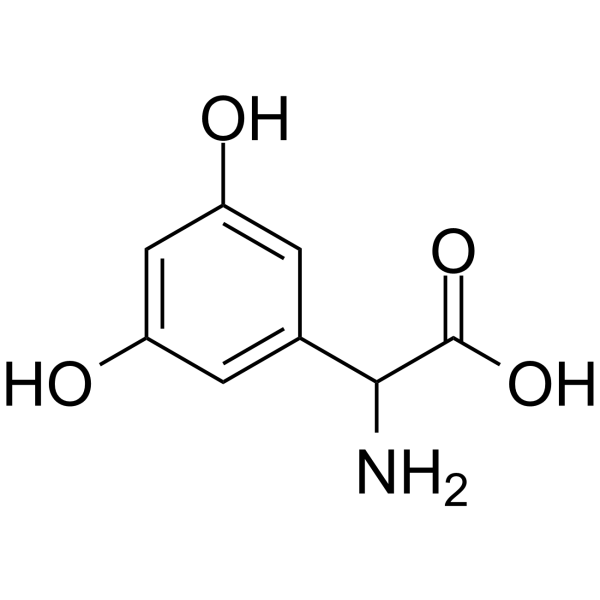
Physicochemical Properties
| Molecular Formula | C8H9NO4 |
| Molecular Weight | 183.161362409592 |
| Exact Mass | 183.053 |
| CAS # | 146255-66-5 |
| Related CAS # | (S)-3,5-DHPG;162870-29-3 |
| PubChem CID | 108001 |
| Appearance | Off-white to gray solid powder |
| Density | 1.55g/cm3 |
| Boiling Point | 448.8ºC at 760mmHg |
| Flash Point | 225.2ºC |
| LogP | 0.882 |
| Hydrogen Bond Donor Count | 4 |
| Hydrogen Bond Acceptor Count | 5 |
| Rotatable Bond Count | 2 |
| Heavy Atom Count | 13 |
| Complexity | 187 |
| Defined Atom Stereocenter Count | 0 |
| InChi Key | HOOWCUZPEFNHDT-UHFFFAOYSA-N |
| InChi Code | InChI=1S/C8H9NO4/c9-7(8(12)13)4-1-5(10)3-6(11)2-4/h1-3,7,10-11H,9H2,(H,12,13) |
| Chemical Name | 2-amino-2-(3,5-dihydroxyphenyl)acetic acid |
| HS Tariff Code | 2934.99.9001 |
| Storage |
Powder-20°C 3 years 4°C 2 years In solvent -80°C 6 months -20°C 1 month Note: Please store this product in a sealed and protected environment (e.g. under nitrogen), avoid exposure to moisture. |
| Shipping Condition | Room temperature (This product is stable at ambient temperature for a few days during ordinary shipping and time spent in Customs) |
Biological Activity
| ln Vitro |
In adult rat hippocampal slices, DHPG (100 μM) had no detectable effect on isoproterenol (Iso, 10 μM)-stimulated cAMP accumulation, in contrast to the robust potentiation observed with the mGluR agonist 1S,3R-ACPD. [1] This lack of effect on cAMP potentiation, combined with its known activity on phosphoinositide hydrolysis, was used as key pharmacological evidence to argue that mGluR-mediated potentiation of cAMP responses is not secondary to phosphoinositide hydrolysis and is likely mediated by a group II-like mGluR. [1] In adult rat hippocampal slices, DHPG (100 μM) promotes the formation of [³H]-inositol phosphates ([³H]-IPs), although it produces only about half the maximal response of 100 μM (1S,3R)-ACPD.[2] When tested on phospholipase D (PLD) activity in hippocampal slices, DHPG (up to 1 mM) is virtually inactive as an agonist.[2] However, DHPG (100 and 300 μM) inhibits the formation of [³H]-phosphatidylethanol ([³H]-PEt) induced by 100 μM (1S,3R)-ACPD in a concentration-dependent manner.[2] |
| References |
[1]. Metabotropic glutamate receptor (mGluR)-mediated potentiation of cyclic AMP responses does not require phosphoinositide hydrolysis: mediation by a group II-like mGluR. J Neurochem. 1995 Feb;64(2):592-9. [2]. Pharmacological characterization of metabotropic glutamate receptors coupled to phospholipase D in the rat hippocampus. Br J Pharmacol. 1996 Jun;118(4):1035-43. |
| Additional Infomation |
2-amino-2-(3,5-dihydroxyphenyl)acetic acid is an alpha-amino acid. (RS)-3,5-Dihydroxyphenylglycine (DHPG) is used as a selective pharmacological tool to activate group I mGluRs. Based on data from transfected cells cited in the literature, the EC50 of DHPG for mGluR1 is approximately 60 μM. [1] Its pharmacological profile (active on PI hydrolysis but inactive on cAMP potentiation in the assay system used) helped dissect the signaling pathways coupled to different mGluR subtypes. [1] DHPG is referred to as a recently characterized selective agonist of mGluRs of the first group, which are coupled to phosphoinositide hydrolysis.[2] The study demonstrates that while DHPG stimulates the phospholipase C (PLC) pathway, it does not stimulate the phospholipase D (PLD) pathway and can even inhibit PLD activity induced by (1S,3R)-ACPD, suggesting independent coupling of mGluRs to PLC and PLD pathways.[2] |
Solubility Data
| Solubility (In Vitro) |
DMSO : ~5 mg/mL (~27.30 mM) H2O : ~1 mg/mL (~5.46 mM) |
| Solubility (In Vivo) |
Solubility in Formulation 1: ≥ 0.5 mg/mL (2.73 mM) (saturation unknown) in 10% DMSO + 90% (20% SBE-β-CD in Saline) (add these co-solvents sequentially from left to right, and one by one), clear solution. For example, if 1 mL of working solution is to be prepared, you can add 100 μL of 5.0 mg/mL clear DMSO stock solution to 900 μL of 20% SBE-β-CD physiological saline solution and mix evenly. Preparation of 20% SBE-β-CD in Saline (4°C,1 week): Dissolve 2 g SBE-β-CD in 10 mL saline to obtain a clear solution. Solubility in Formulation 2: 4.55 mg/mL (24.84 mM) in PBS (add these co-solvents sequentially from left to right, and one by one), clear solution; with ultrasonication (<60°C). (Please use freshly prepared in vivo formulations for optimal results.) |
| Preparing Stock Solutions | 1 mg | 5 mg | 10 mg | |
| 1 mM | 5.4597 mL | 27.2985 mL | 54.5971 mL | |
| 5 mM | 1.0919 mL | 5.4597 mL | 10.9194 mL | |
| 10 mM | 0.5460 mL | 2.7299 mL | 5.4597 mL |